
Generate Zero Trust Architecture Diagrams from Text with AI
Describe your identity verification, device trust, and micro-segmentation in plain English. Get a valid Draw.io diagram with NIST 800-207 components and policy flows.
This AI zero trust architecture diagram generator converts plain-text zero trust descriptions into Draw.io diagrams with NIST SP 800-207 policy components, identity verification flows, device trust evaluation, and micro-segmented network zones. Describe a BeyondCorp-style architecture where Okta serves as the identity provider, a policy decision point evaluates user identity plus device posture plus resource sensitivity before granting access, Zscaler Private Access replaces the traditional VPN, and mutual TLS enforces service-to-service authentication within Kubernetes via Istio. The AI maps each component to its role in the NIST 800-207 framework, draws policy evaluation flows, and groups resources into micro-segments. Every element snaps to a 10px grid. Architecture warnings flag missing security boundaries (WARN-04) and public endpoints without WAF (WARN-02). Native .drawio XML output.
What Is an AI Zero Trust Architecture Diagram Generator?
A zero trust architecture diagram maps the components and decision flows that enforce 'never trust, always verify' across every access request. The NIST SP 800-207 framework defines three core components: the policy engine that decides access, the policy administrator that configures the data plane, and the policy enforcement point that gates every request. Traditional perimeter security diagrams draw a single firewall between the internet and internal resources. Zero trust diagrams are fundamentally different. They show identity verification at every access point, device trust evaluation before resource access, micro-segmented zones isolating workloads, and continuous authentication re-evaluating trust throughout a session. Drawing these manually means placing policy decision points, identity providers, device trust agents, micro-segments, and mTLS boundaries, then connecting them with decision flow arrows showing the evaluation sequence. An AI zero trust architecture diagram generator does this from a text description. Diagrams.so maps your description to NIST 800-207 components automatically. Describe 'Okta as IdP with step-up MFA for sensitive resources' and the diagram places Okta as the identity source feeding the policy engine. Mention 'CrowdStrike Falcon device posture checks' and device trust evaluation appears as input to the policy decision point. Describe 'Istio service mesh with SPIFFE identities and PeerAuthentication strict mode' and the diagram shows mTLS enforcement at every service boundary. VLM visual validation catches overlapping policy flow arrows. WARN-04 flags resources accessible without a policy enforcement point. WARN-02 identifies endpoints exposed without WAF. The output is native .drawio XML with icons from 30+ libraries.
Key components
- NIST 800-207 policy engine: evaluates identity, device posture, resource sensitivity, and context before access decisions
- Policy enforcement points: gating every request at network ingress, service mesh sidecar, and application layer
- Identity provider integration: Okta, Azure AD, Google Workspace with SAML/OIDC federation and step-up MFA
- Device trust evaluation: CrowdStrike Falcon, Microsoft Intune, or Jamf posture checks feeding policy decisions
- Micro-segmented network zones: workload isolation with Kubernetes NetworkPolicies, AWS security groups, or Calico
- mTLS enforcement: Istio PeerAuthentication strict mode with SPIFFE/SPIRE certificate identities
- Continuous authentication indicators: session re-evaluation triggers based on location change, risk score, or time
- ZTNA connectors: Zscaler Private Access, Cloudflare Access, or Tailscale replacing traditional VPN tunnels
How to generate with AI
- 1
Describe your zero trust components
Write your zero trust architecture in plain English. Name the identity provider, policy decision point, enforcement points, and network segmentation strategy. For example: 'Users authenticate through Okta with phishing-resistant MFA (FIDO2 WebAuthn). CrowdStrike Falcon evaluates device posture: OS patch level, disk encryption, EDR agent status. Policy decision point (custom service or Zscaler ZPA) evaluates user identity + device posture + resource sensitivity level. If all checks pass, Zscaler Private Access creates an application-specific tunnel (no network-level VPN). Inside Kubernetes, Istio service mesh enforces mTLS with SPIFFE identities and authorization policies per service. Kubernetes NetworkPolicies restrict pod-to-pod traffic to explicit allow rules.'
- 2
Select security diagram type
Choose 'Security' as the diagram type. Select your cloud provider to load vendor-specific icons. Diagrams.so recognizes zero trust components across AWS (Verified Access, IAM Identity Center), Azure (Conditional Access, Azure AD), and GCP (BeyondCorp Enterprise, IAP). Generic icons cover Okta, CrowdStrike, Zscaler, Istio, and Tailscale. Enable opinionated mode for strict policy flow layout: identity sources on the left, policy decision in the center, resources on the right.
- 3
Generate and validate
Click generate. The AI outputs a .drawio XML with NIST 800-207 components, identity verification flows, device trust inputs, micro-segmented zones, and mTLS boundaries. VLM visual validation flags overlapping policy flow arrows and unclear zone boundaries. Architecture warnings identify resources accessible without a policy enforcement point (WARN-04) and endpoints exposed without WAF (WARN-02). Download as .drawio for editing, or export to PNG or SVG for compliance documentation.
Example prompt
Zero trust architecture diagram for a financial services platform: Remote employees and contractors authenticate through Okta with FIDO2 WebAuthn MFA. CrowdStrike Falcon evaluates device posture (Windows: BitLocker enabled, OS patched within 7 days, Falcon sensor active; macOS: FileVault enabled, MDM enrolled via Jamf). Policy decision point evaluates: user identity from Okta + device posture from CrowdStrike + resource sensitivity tag (public, internal, restricted, confidential) + request context (geolocation, time, impossible travel detection). Zscaler Private Access provides application-specific tunnels to: internal web apps (HTTPS), SSH bastions, and database admin tools. No network-level VPN. Inside AWS: EKS cluster with Istio service mesh enforcing mTLS via SPIFFE/SPIRE certificates. PeerAuthentication set to STRICT mode. AuthorizationPolicies restrict each service to explicit allowed callers. Kubernetes NetworkPolicies deny all ingress/egress by default with explicit allow rules per namespace. Calico Enterprise for DNS-aware network policies. Show NIST 800-207 policy engine, policy administrator, and policy enforcement points. Show four resource sensitivity zones.
Example diagrams from the gallery


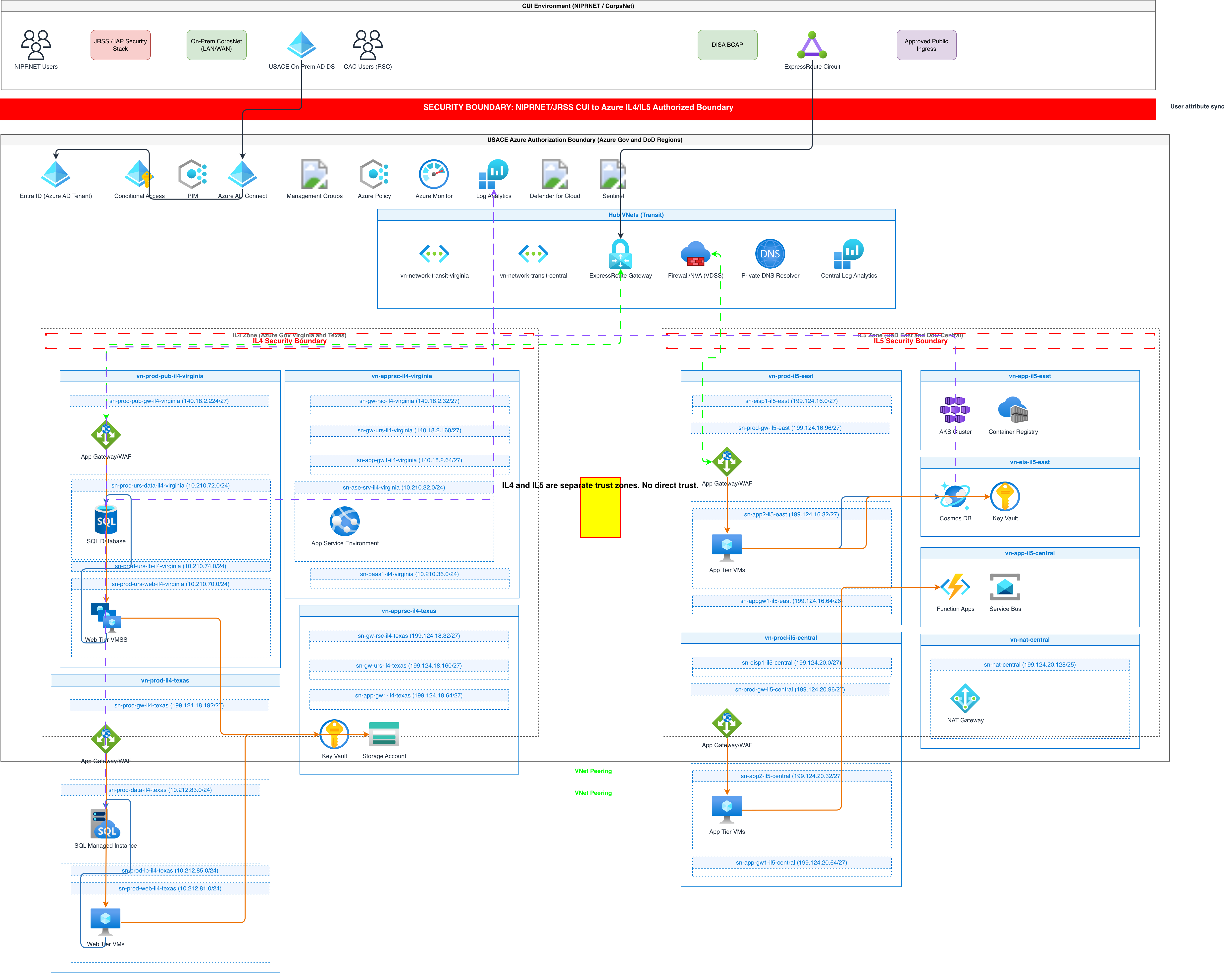

Zero Trust Architecture vs Perimeter Security vs VPN-Based Access
These three security models represent different philosophies about network trust. Zero trust verifies every request regardless of network location. Perimeter security trusts everything inside the firewall. VPN-based access extends the trusted perimeter to remote users through encrypted tunnels.
| Feature | Zero Trust Architecture | Perimeter Security | VPN-Based Access |
|---|---|---|---|
| Trust model | Never trust, always verify; every request evaluated against identity, device, and context regardless of location | Trust inside, verify outside; internal network is implicitly trusted once past the firewall boundary | Extended perimeter; remote users gain full network access after VPN authentication as if they were on-site |
| Access granularity | Per-application, per-resource; users access only specific apps based on policy evaluation results | Network-level; once inside the perimeter, users can reach any resource on the internal network | Network-level with optional ACLs; VPN grants IP-level access to entire subnets or VLANs |
| Identity verification | Continuous; re-evaluated on context changes (location shift, risk score increase, session timeout) | One-time at perimeter entry; no re-verification for lateral movement within the network | One-time at VPN connection; session persists until tunnel disconnects or times out |
| Device trust | Required; CrowdStrike, Intune, or Jamf evaluates OS patches, encryption, EDR status before access | Not evaluated; any device on the internal network is implicitly trusted | Optional; some VPN solutions check device certificates but rarely evaluate real-time posture |
| Lateral movement risk | Minimal; micro-segmentation and per-service mTLS prevent unauthorized service-to-service access | High; once inside, attackers move freely between systems without additional authentication | High; VPN grants broad network access, enabling lateral movement within accessible subnets |
| Best suited for | Remote-first orgs, multi-cloud environments, compliance-driven industries (finance, healthcare, government) | Air-gapped networks, legacy on-premises environments with no remote access requirement | Transitional state from perimeter to zero trust; temporary remote access for legacy applications |
When to use this pattern
Use a zero trust architecture diagram when you need to document how your organization enforces identity verification, device trust, and least-privilege access for every resource request. This diagram is essential for NIST 800-207 compliance evidence, FedRAMP authorization packages, SOC 2 access control documentation, and CISO board presentations on security posture. It's the right choice when migrating from VPN-based access to application-specific ZTNA connectors like Zscaler Private Access or Cloudflare Access. If your architecture still relies on traditional perimeter security with a single firewall boundary, document that with a network security diagram first, then use the zero trust diagram to map the target state.
Frequently asked questions
What NIST 800-207 components does the AI zero trust architecture diagram generator include?
This AI zero trust architecture diagram generator maps your description to the three NIST SP 800-207 core components: policy engine (decides access), policy administrator (configures data plane), and policy enforcement point (gates requests). It also renders supporting components: identity providers, device trust agents, threat intelligence feeds, and activity logging systems feeding the policy engine.
Can I show micro-segmentation in the diagram?
Yes. Describe your segmentation strategy: 'Kubernetes NetworkPolicies deny all by default with explicit allow rules per namespace' or 'Calico Enterprise with DNS-aware policies.' The AI draws isolated network zones with labeled boundaries and explicit allow-rule arrows between segments. Each zone gets a sensitivity label (public, internal, restricted, confidential).
How is mTLS represented between services?
Describe mTLS enforcement in your prompt: 'Istio PeerAuthentication strict mode with SPIFFE certificates.' The AI draws mutual TLS indicators on service-to-service connections, showing both client and server certificate validation. SPIFFE identity labels appear on each service. The Istio sidecar proxy renders as an intermediary on each connection.
Does the diagram show the policy decision flow?
Yes. The AI draws arrows from identity providers and device trust agents into the policy decision point, then from the policy decision point to policy enforcement points. Decision inputs (identity, posture, resource sensitivity, context) label the inbound arrows. The grant or deny outcome labels the outbound arrow to the enforcement point.
Can I compare current perimeter security with target zero trust state?
Yes. Describe both architectures in your prompt: 'Current state: FortiGate firewall with VPN. Target state: Okta + CrowdStrike + Zscaler ZPA with micro-segmentation.' The AI generates a side-by-side or before/after diagram showing the architectural shift. Architecture warnings highlight gaps in the current state that zero trust would address.
Related diagram generators
Generate Security Architecture Diagrams from Text with AI
Describe your trust boundaries, encryption layers, and access controls in plain English. Get a valid Draw.io security diagram with defense-in-depth zones.
Generate Network Diagrams from Text with AI
Describe your network topology in plain English. Get a valid Draw.io diagram with routers, switches, firewalls, VLAN segmentation, and labeled subnet ranges.
Generate Cloud Architecture Diagrams from Text
Describe your cloud infrastructure in plain English. Get a valid Draw.io diagram with region boundaries, availability zones, managed services, and DR paths.
Generate API Gateway Diagrams from Text with AI
Describe your API gateway routing, auth, and rate limiting in plain English. Get a valid Draw.io diagram with request flows, middleware chains, and backend services.