
Generate Security Architecture Diagrams from Text with AI
Describe your trust boundaries, encryption layers, and access controls in plain English. Get a valid Draw.io security diagram with defense-in-depth zones.
This AI security architecture diagram generator converts plain-text security descriptions into Draw.io diagrams with trust boundaries, defense-in-depth zones, and encryption flow indicators. Describe a system where CloudFront serves traffic through AWS WAF with OWASP Top 10 rule sets, ALB terminates TLS 1.3, ECS Fargate services communicate via mTLS through AWS App Mesh, IAM roles enforce least-privilege per service, and KMS envelope encryption protects data at rest in Aurora PostgreSQL and S3. The AI draws labeled trust zones, maps encryption boundaries, and connects security controls to the components they protect. Every element snaps to a 10px grid. Architecture warnings trigger for public endpoints without WAF (WARN-02) and missing security boundaries (WARN-04). The output is native .drawio XML.
What Is an AI Security Architecture Diagram Generator?
A security architecture diagram maps defensive layers, trust boundaries, encryption controls, and access policies that protect a system. Unlike a standard infrastructure diagram focused on compute and networking topology, a security diagram emphasizes where controls exist and where gaps remain. Drawing one manually means placing trust boundary rectangles around each zone, adding icons for WAFs, firewalls, IAM policies, KMS keys, and certificate authorities, then connecting each control to the resource it protects. For a mid-complexity system, this takes hours. An AI security architecture diagram generator compresses that effort. You describe your security posture in natural language. The AI identifies trust zones, maps controls to resources, and generates the diagram with proper boundary notation. Diagrams.so understands defense-in-depth layering. Mention 'CloudFront with AWS WAF using AWSManagedRulesCommonRuleSet' and the diagram places WAF at the edge perimeter. Mention 'mTLS between services via AWS App Mesh Envoy sidecars' and the diagram shows mutual TLS enforcement at the service mesh layer. Describe 'KMS with CMK alias/app-key for envelope encryption on S3 and Aurora' and encryption indicators appear on both data stores. Architecture warnings are central to security diagrams. WARN-02 flags every public endpoint without WAF protection. WARN-04 identifies missing security boundaries between zones. WARN-01 catches single-AZ deployments that create availability gaps. VLM visual validation ensures trust boundary boxes don't overlap and control labels remain readable. Opinionated mode enforces outside-in layout: internet edge, DMZ, application tier, data tier. The output is native .drawio XML with icons from 30+ libraries.
Key components
- Trust boundary zones: internet edge, DMZ, application tier, data tier with labeled dashed-line perimeters
- WAF and DDoS protection nodes: AWS WAF, CloudFront Shield Advanced, Azure Front Door WAF
- Identity and access control: IAM roles, service accounts, OIDC federation, SAML assertions
- Encryption indicators: TLS 1.3 termination points, mTLS between services, KMS envelope encryption at rest
- Network security: security groups, NACLs, private subnets, VPC endpoints, PrivateLink connections
- Logging and detection: CloudTrail, GuardDuty, Security Hub, SIEM ingestion arrows to Splunk or Elastic
- Secret management flows: Vault or AWS Secrets Manager injecting credentials into application pods
- Architecture warnings for missing WAF (WARN-02), absent trust boundaries (WARN-04), and single-AZ gaps (WARN-01)
How to generate with AI
- 1
Describe your security posture
Write your security architecture in plain English. Name the trust zones and controls explicitly. For example: 'Internet traffic hits CloudFront with AWS WAF (AWSManagedRulesCommonRuleSet and AWSManagedRulesSQLiRuleSet). ALB in public subnet terminates TLS 1.3 with ACM certificate. ECS Fargate tasks in private subnets communicate through App Mesh with mTLS enforced by Envoy sidecars. IAM task roles scoped per service: order-service can only access orders DynamoDB table. KMS CMK alias/data-key encrypts Aurora PostgreSQL and S3 buckets at rest. CloudTrail logs all API calls to S3 with immutable object lock. GuardDuty monitors for anomalous API activity.'
- 2
Select security diagram type
Choose 'Security' as the diagram type. Select your cloud provider to load vendor-specific security service icons: AWS WAF, GuardDuty, Security Hub, Azure Sentinel, GCP Security Command Center. Diagrams.so pulls from 30+ icon libraries. Enable opinionated mode for strict outside-in layout: internet edge, DMZ, application zone, data zone, with controls placed at each boundary.
- 3
Generate and audit
Click generate. The AI outputs a .drawio XML with trust boundaries as dashed-line perimeters, security controls connected to protected resources, and encryption indicators on data flows. Architecture warnings flag public endpoints without WAF (WARN-02), missing security boundaries (WARN-04), and single-AZ deployments (WARN-01). VLM visual validation ensures boundary boxes don't overlap. Use the diagram for SOC 2 audit evidence, threat model reviews, or compliance documentation.
Example prompt
Security architecture diagram for a healthcare application on AWS: Internet traffic routes through Route 53 to CloudFront with AWS WAF (OWASP Top 10 rules, rate limiting at 2000 req/min, bot control). ALB in public subnet terminates TLS 1.3 using ACM certificate. ECS Fargate services in private subnets: patient-service, appointment-service, billing-service. App Mesh with mTLS between all services via Envoy sidecars. IAM task roles: patient-service has read/write to patient-data DynamoDB table only, billing-service accesses billing DynamoDB table only. KMS CMK alias/phi-key encrypts DynamoDB tables and S3 PHI document bucket with SSE-KMS. VPC endpoints for DynamoDB, S3, and Secrets Manager (no internet egress for data access). CloudTrail with S3 object lock and 365-day retention. GuardDuty enabled with findings routed to Security Hub. Security Hub findings forwarded to Splunk SIEM via Kinesis Firehose. Show four trust zones: internet edge, DMZ (ALB), application tier (ECS), data tier (DynamoDB, S3).
Example diagrams from the gallery


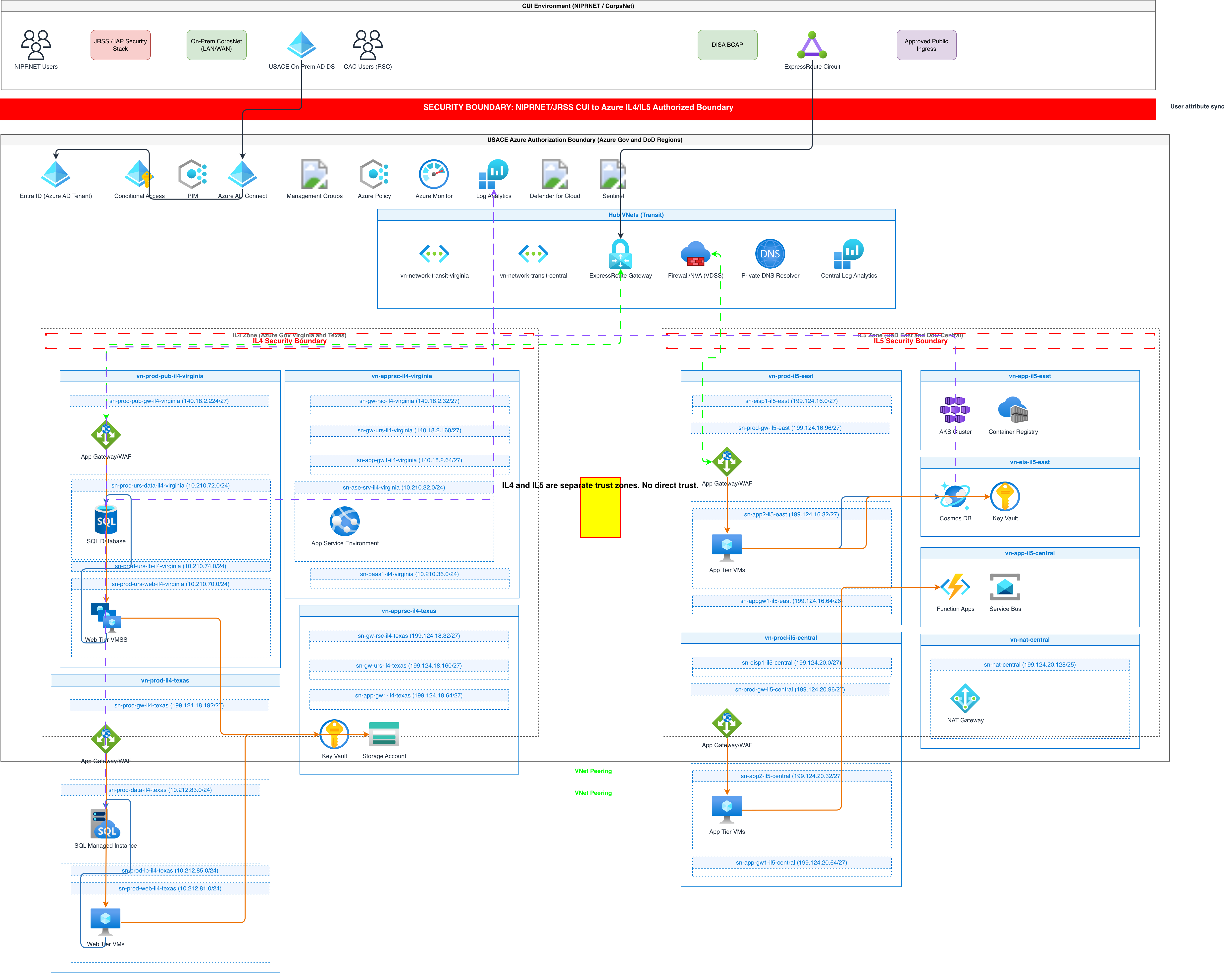

Security Architecture Diagram vs Threat Model Diagram vs Network Security Diagram
These three diagram types address security from different angles. Security architecture diagrams show defensive controls and trust boundaries. Threat model diagrams (like STRIDE-based models) focus on attack vectors and trust level transitions. Network security diagrams detail firewall rules, security groups, and packet flow between subnets.
| Feature | Security Architecture Diagram | Threat Model Diagram | Network Security Diagram |
|---|---|---|---|
| Primary focus | Defensive controls, trust boundaries, encryption layers, and access policies protecting system components | Attack vectors, threat actors, trust level transitions, and mitigations mapped to STRIDE or PASTA categories | Firewall rules, security group configurations, NACL entries, and packet flow between network segments |
| Trust boundaries | Zone-level boundaries: internet edge, DMZ, application tier, data tier with controls at each transition | Trust level transitions where data crosses from one privilege level to another (STRIDE analysis points) | Subnet and VPC boundaries with ingress/egress rules and port-level filtering |
| Key elements | WAF, IAM, KMS, mTLS, SIEM, Vault, security zones with defensive control placement | Threat actors, attack trees, STRIDE categories (spoofing, tampering, repudiation, info disclosure, DoS, elevation) | Security groups, NACLs, route tables, VPN tunnels, VPC peering, transit gateways |
| Compliance alignment | SOC 2 control mapping, HIPAA safeguard documentation, PCI DSS network segmentation evidence | Risk register documentation, OWASP Top 10 coverage evidence, pen test scope definition | PCI DSS cardholder data environment boundary, network segmentation audit evidence |
| Update triggers | New compliance requirement, security incident revealing a control gap, architecture redesign | New feature with different trust requirements, vulnerability disclosure, penetration test findings | Security group rule changes, new subnet provisioning, VPN or peering configuration updates |
| Best suited for | SOC 2 auditor walkthroughs, CISO board presentations, security review approvals for new services | Developer-led threat modeling sessions, pre-launch security reviews, red team exercise scoping | Firewall rule review meetings, network change request approvals, microsegmentation planning |
When to use this pattern
Use a security architecture diagram when you need to document the full defensive posture of a system for compliance audits, security reviews, or stakeholder communication. SOC 2 Type II audits require evidence of control placement across trust boundaries. HIPAA assessments need documentation of PHI encryption at rest and in transit. PCI DSS requires network segmentation diagrams showing cardholder data environment boundaries. Security architecture diagrams serve all three. If your focus is identifying attack vectors and prioritizing mitigations, a threat model diagram (STRIDE or PASTA methodology) is more appropriate. If you need to document specific firewall rules and security group configurations at the packet level, use a network security diagram.
Frequently asked questions
What security controls does the AI security architecture diagram generator recognize?
This AI security architecture diagram generator recognizes WAFs (AWS WAF, Azure WAF, Cloud Armor), IAM policies, KMS encryption, mTLS, VPN tunnels, security groups, NACLs, Vault secret injection, GuardDuty, Security Hub, CloudTrail, Sentinel, and SIEM integrations. Each control renders with its provider-specific icon from the 30+ available libraries.
How are trust boundaries represented in the diagram?
Trust boundaries render as labeled dashed-line perimeter boxes around each security zone: internet edge, DMZ, application tier, data tier. WARN-04 triggers when a component sits outside any trust boundary or when sensitive data crosses a boundary without an encryption indicator. The AI automatically places controls at boundary transition points.
Can I use this for SOC 2 audit documentation?
Yes. The diagram shows control placement across trust boundaries, encryption scope, access policies, and logging coverage, which are the exact elements SOC 2 auditors evaluate. Architecture warnings (WARN-01 through WARN-05) highlight gaps before the audit. Export to PNG or SVG for audit evidence packages.
Does the diagram show encryption at rest and in transit?
Yes. Describe encryption in your prompt: 'KMS CMK encrypts Aurora and S3' for at-rest, 'mTLS between services via App Mesh' for in-transit. The AI places encryption indicators on data stores and marks TLS termination points on load balancers. Arrow labels show the encryption protocol and key source.
Can I combine security and infrastructure in one diagram?
Yes. Describe both infrastructure components and security controls in the same prompt. The AI renders compute, networking, and database resources alongside WAF, IAM, and encryption controls within the same trust boundary layout. This produces a single diagram useful for both architecture reviews and security audits.
Related diagram generators
Generate Network Diagrams from Text with AI
Describe your network topology in plain English. Get a valid Draw.io diagram with routers, switches, firewalls, VLAN segmentation, and labeled subnet ranges.
Generate Cloud Architecture Diagrams from Text
Describe your cloud infrastructure in plain English. Get a valid Draw.io diagram with region boundaries, availability zones, managed services, and DR paths.
Generate Zero Trust Architecture Diagrams from Text with AI
Describe your identity verification, device trust, and micro-segmentation in plain English. Get a valid Draw.io diagram with NIST 800-207 components and policy flows.
Generate AWS architecture diagrams from text
Describe your AWS infrastructure in plain English. Get a valid Draw.io diagram with official AWS icons, VPC boundaries, and Multi-AZ placement.