
Generate Hybrid Cloud Architecture Diagrams from Text with AI
Describe your on-premises to cloud connectivity in plain English. Get a valid Draw.io diagram with data center boundaries, VPN tunnels, dedicated links, and security zones.
This hybrid cloud architecture diagram generator converts plain-text descriptions of on-premises to cloud infrastructure into Draw.io diagrams showing both environments on a single canvas. Describe a setup like an on-premises VMware vSphere cluster connected to Azure via a 10Gbps ExpressRoute circuit, with Azure Arc managing on-prem Kubernetes nodes, Active Directory syncing to Entra ID via Azure AD Connect, and DNS split-horizon resolving internal names across both environments. The AI draws data center and cloud boundaries, places icons for physical and virtual infrastructure, labels VPN tunnels and dedicated links with bandwidth and encryption details, and outputs valid mxGraphModel XML. Architecture warnings flag missing security boundaries between on-prem and cloud (WARN-04) and public endpoints without WAF (WARN-02). Grid alignment follows RULE-04.
What Is a Hybrid Cloud Architecture Diagram Generator?
A hybrid cloud architecture diagram maps the connection between on-premises data centers and one or more cloud providers. It shows physical infrastructure on one side, cloud services on the other, and the networking, identity, and data replication paths between them. Drawing these manually is tedious because you're mixing on-premises icons (rack servers, SAN arrays, firewalls) with cloud-native icons (VPCs, managed databases, serverless functions) on the same canvas. A hybrid cloud architecture diagram generator handles this from a text prompt. You describe something like: 'On-premises data center with two Dell PowerEdge R750 servers running VMware vSphere 8. NetApp AFF A250 for storage. Palo Alto PA-5260 firewall with IPsec tunnel to AWS VPN Gateway. AWS VPC (10.0.0.0/16) in us-east-1 with EKS running containerized workloads. RDS PostgreSQL 16 Multi-AZ receiving data from on-prem Oracle via DMS. Azure ExpressRoute 10Gbps to East US for Entra ID sync and Azure Arc managing on-prem vSphere.' Diagrams.so parses this and produces a diagram with correct icons for both environments from its 30+ icon libraries. On-premises infrastructure renders inside a data center boundary. Cloud services appear in provider-specific boundaries. VPN tunnels draw as dashed encrypted links. Dedicated connections (ExpressRoute, Direct Connect, FastConnect, Cloud Interconnect) render as solid lines with bandwidth labels. WARN-04 fires when traffic crosses the on-prem to cloud boundary without a firewall or inspection point. WARN-02 catches cloud endpoints exposed to the internet without WAF. VLM visual validation detects overlapping icons at boundary edges. The .drawio output preserves both on-prem and cloud icon sets.
Key components
- On-premises data center boundary with rack servers, storage arrays, firewalls, and internal network icons
- Cloud provider boundaries (AWS VPC, Azure VNet, GCP VPC, OCI VCN) with region and zone labels
- VPN tunnel connections as dashed lines with IPsec/IKEv2 encryption labels and bandwidth annotations
- Dedicated connectivity icons for ExpressRoute (10Gbps), Direct Connect (1-10Gbps), FastConnect, and Cloud Interconnect
- Identity sync arrows showing Active Directory to Entra ID (Azure AD Connect), AWS IAM Identity Center, or GCP Workforce Identity
- Azure Arc, AWS Outposts, and Google Anthos icons showing cloud control plane extending into on-premises
- DNS split-horizon indicators showing internal vs external resolution paths across environments
- Architecture warnings for missing on-prem to cloud security boundaries (WARN-04) and exposed public endpoints (WARN-02)
How to generate with AI
- 1
Describe your hybrid infrastructure
Write your on-premises and cloud setup in plain English. Be specific about physical hardware, cloud services, and connectivity. For example: 'On-premises data center in Dallas with Cisco UCS C240 M7 servers running Red Hat OpenShift 4.14. Palo Alto PA-3260 firewall. 10Gbps AWS Direct Connect to us-east-1 VPC (10.0.0.0/16). EKS cluster in private subnets receiving container workloads migrated from on-prem OpenShift. Active Directory on-prem syncing to AWS IAM Identity Center via SAML. Split-horizon DNS with Route 53 Resolver endpoints.'
- 2
Select architecture diagram type
Choose 'Architecture' as the diagram type. Select a cloud provider if your hybrid setup targets a single provider, or omit the filter for multi-provider hybrid. Diagrams.so loads both on-premises infrastructure icons and cloud-specific icons from its 30+ libraries. Enable opinionated mode to enforce on-prem on the left and cloud on the right with the connectivity layer clearly between them.
- 3
Generate and verify security boundaries
Click generate. The AI produces .drawio XML with data center boundaries, cloud provider boundaries, VPN or dedicated connection links, identity sync arrows, and security zone labels. Architecture warnings flag missing firewalls between on-prem and cloud (WARN-04) and cloud endpoints without WAF (WARN-02). VLM visual validation catches overlapping icons where environments connect. Download as .drawio for editing, or export to PNG or SVG.
Example prompt
Hybrid cloud architecture for enterprise migration. On-premises data center in Chicago: Two Cisco UCS C480 M5 rack servers running VMware vSphere 8 with 12 production VMs. NetApp FAS8700 SAN (200TB). Palo Alto PA-5260 HA pair as perimeter firewall. Core switch: Cisco Nexus 9336C-FX2. Internal DNS: Windows Server 2022 AD-integrated DNS. Active Directory 2022 forest with 3 domain controllers. AWS us-east-1: Direct Connect 10Gbps via Equinix Chicago CH3. VPC 10.0.0.0/16. Transit Gateway connecting to VPC. EKS 1.29 cluster in private subnets (3 node groups, m6i.xlarge) running containerized versions of 4 migrated applications. RDS PostgreSQL 16 Multi-AZ for migrated Oracle data via AWS DMS ongoing replication. S3 for backup target with on-prem Veeam agent. Azure East US: ExpressRoute 1Gbps via same Equinix facility. Azure AD Connect syncing on-prem AD to Entra ID. Azure Arc managing on-prem vSphere cluster from Azure portal. Azure Monitor agent on on-prem servers. Connectivity: On-prem firewall has two tunnels: primary Direct Connect to AWS, secondary ExpressRoute to Azure. BGP failover between circuits. Split-horizon DNS: on-prem resolves internal.company.com locally, Route 53 Resolver inbound endpoint for cloud-to-on-prem DNS. Show the migration data flow from on-prem Oracle via DMS to RDS.
Example diagrams from the gallery


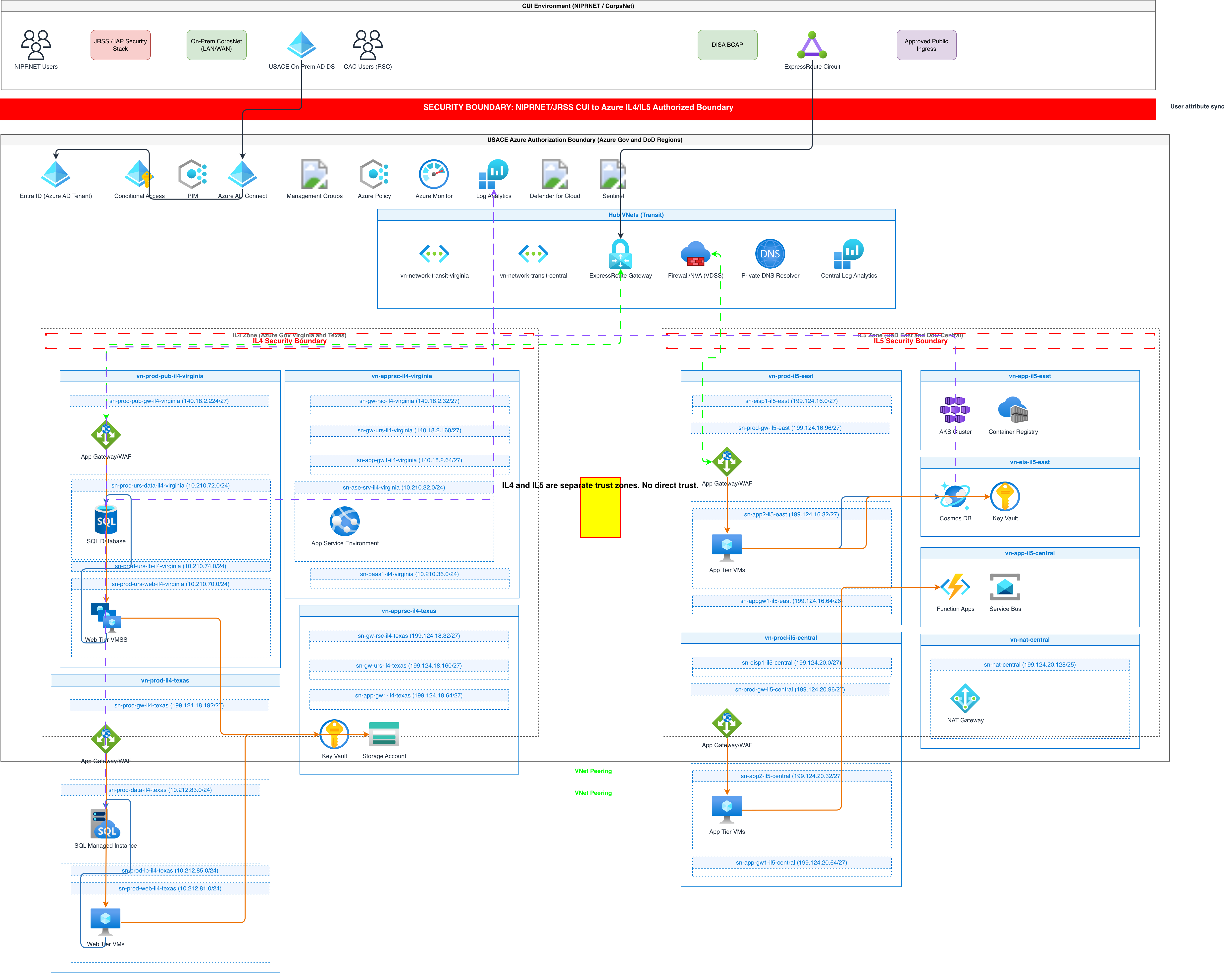

Hybrid Cloud via VPN vs Dedicated Connection vs Cloud-on-Premises (Outposts/Stack/Anthos)
Hybrid cloud connectivity comes in three tiers. VPN tunnels run over the public internet with encryption. Dedicated connections provide private physical circuits with guaranteed bandwidth. Cloud-on-premises solutions bring cloud services directly into your data center. Each tier carries different latency, cost, security, and diagram complexity trade-offs.
| Feature | Hybrid via VPN | Hybrid via Dedicated Connection | Cloud-on-Premises |
|---|---|---|---|
| Connectivity method | IPsec or WireGuard tunnels over the public internet; encrypted but shares bandwidth with other traffic | Private physical circuits: AWS Direct Connect, Azure ExpressRoute, GCP Cloud Interconnect, OCI FastConnect | Cloud hardware deployed in your data center: AWS Outposts, Azure Stack HCI, Google Anthos on bare metal |
| Latency profile | Variable: 10-50ms typical, depends on internet path, ISP peering, and encryption overhead | Predictable: 1-5ms typical between colocation and cloud region, with SLA-backed performance | Sub-millisecond for local workloads; cloud API calls still traverse WAN to the provider's control plane |
| Bandwidth options | Limited by internet uplink: typically 100Mbps to 1Gbps; throughput drops under congestion | 1Gbps to 100Gbps dedicated; link aggregation for higher throughput; no contention with public traffic | Local data plane runs at LAN speed (10-100Gbps); limited by WAN link for control plane and cloud sync |
| Security model | Encrypted tunnel over public internet; firewall rules at both ends; traffic visible to ISP as encrypted blobs | Private circuit not traversing public internet; optional MACsec encryption at Layer 2; VLAN isolation | Data stays in your facility; cloud control plane encrypted over WAN; compliance with data residency requirements |
| Diagram representation | Dashed encrypted line from on-prem firewall to cloud VPN gateway with tunnel ID and PSK reference labels | Solid thick line from on-prem router through colocation to cloud gateway with bandwidth and BGP ASN labels | Cloud boundary extends into the data center boundary; Outposts/Stack rack icon shown inside on-prem zone |
| Best suited for | Dev/test environments, branch offices, initial cloud migration POC, backup replication under 1Gbps | Production workloads, real-time data replication, low-latency database access, PCI/HIPAA traffic | Data sovereignty requirements, ultra-low-latency local processing, air-gapped environments needing cloud APIs |
When to use this pattern
Use a hybrid cloud architecture diagram when you need to document the connection between on-premises data centers and cloud providers, including networking, identity, data replication, and security boundaries. It's the right choice for migration planning, DR setup documentation, and compliance audits showing where data resides. If your infrastructure is entirely in the cloud with no on-prem components, use a cloud architecture or multi-cloud diagram instead. If you're focused on the on-prem network topology without any cloud involvement, a standard network diagram fits better. Keep hybrid diagrams focused on the boundary between environments rather than deep-diving into either side's internal topology.
Frequently asked questions
Can the generator show both on-prem and cloud infrastructure?
Yes. Diagrams.so loads on-premises infrastructure icons (servers, storage, firewalls, switches) alongside cloud-specific icons from its 30+ libraries. This hybrid cloud architecture diagram generator places on-prem resources inside a data center boundary and cloud resources inside provider boundaries. VPN or dedicated links connect the two with labeled arrows.
How does the AI handle Azure Arc and AWS Outposts?
Describe the cloud-on-premises service in your prompt. The AI renders Azure Arc as a management plane arrow from Azure extending into the on-prem data center boundary. AWS Outposts appear as a cloud-branded rack icon inside the data center. Both show control plane connections back to the provider's region over the hybrid link.
Can I show identity sync between Active Directory and cloud?
Yes. Specify your AD sync method in the prompt. The AI draws Azure AD Connect as a sync arrow from on-prem domain controllers to Entra ID. SAML federation to AWS IAM Identity Center or GCP Workforce Identity renders as authentication flow arrows. Each sync or federation path carries protocol labels.
What architecture warnings apply to hybrid diagrams?
WARN-04 fires when traffic crosses the on-premises to cloud boundary without a firewall, inspection point, or security zone separation. WARN-02 flags cloud endpoints exposed to the internet without WAF. WARN-01 catches cloud-side resources in a single availability zone. These warnings annotate without blocking diagram generation.
Can I include migration data flows in the diagram?
Yes. Describe the migration tooling and data direction. The AI draws AWS DMS, Azure Database Migration Service, or GCP Database Migration arrows from on-prem source databases to cloud target databases. Replication arrows carry labels showing ongoing sync versus one-time migration cutover, with bandwidth and lag annotations.
Related diagram generators
Generate Multi-Cloud Architecture Diagrams from Text with AI
Describe infrastructure spanning AWS, Azure, GCP, and OCI. Get a valid Draw.io diagram with correct provider icons, cross-cloud networking, and unified identity flows.
Generate Cloud Architecture Diagrams from Text
Describe your cloud infrastructure in plain English. Get a valid Draw.io diagram with region boundaries, availability zones, managed services, and DR paths.
Generate Network Diagrams from Text with AI
Describe your network topology in plain English. Get a valid Draw.io diagram with routers, switches, firewalls, VLAN segmentation, and labeled subnet ranges.
Generate Security Architecture Diagrams from Text with AI
Describe your trust boundaries, encryption layers, and access controls in plain English. Get a valid Draw.io security diagram with defense-in-depth zones.