
Generate Microservices Architecture Diagrams from Text
Describe your service boundaries in plain English. Get a valid Draw.io diagram with API gateways, message brokers, database-per-service patterns, and service mesh routing.
This AI microservices diagram generator converts plain-text service descriptions into Draw.io diagrams showing bounded contexts, API gateways, message brokers, and data ownership. Describe something like an order service owning a PostgreSQL 15 database, a payment service calling Stripe via a circuit breaker, an inventory service consuming Kafka events from the order-created topic, and an Envoy sidecar proxy handling mTLS between all services. The AI draws each service with its own database, routes synchronous calls through the API gateway, and maps asynchronous event flows through the broker. Grid alignment follows RULE-04. Architecture warnings catch public endpoints without WAF (WARN-02) and missing security boundaries between service domains (WARN-04). Output is native .drawio XML ready for Draw.io, Confluence, or version control.
What Is an AI Microservices Diagram Generator?
A microservices architecture diagram shows how independently deployable services communicate, own their data, and handle failures. It's more specific than a generic system architecture diagram. You see service boundaries drawn around bounded contexts, each service paired with its own datastore, synchronous request-reply paths through an API gateway, and asynchronous event streams flowing through message brokers. Building this manually requires placing dozens of components, routing arrows between services, and maintaining visual clarity as the service count grows. An AI microservices diagram generator takes a text description and produces the diagram. You write: 'Order service (Java Spring Boot) owns orders-db (PostgreSQL 15). Payment service (Node.js) calls Stripe and Adyen, owns payments-db (MongoDB 7). Inventory service (Go) owns inventory-db (PostgreSQL 15). Notification service (Python FastAPI) consumes from Kafka topics: order-created, payment-completed, shipment-updated. API Gateway (Kong) routes external traffic with rate limiting at 1000 req/s. Envoy service mesh handles inter-service mTLS and retries.' Diagrams.so parses this and maps each service to a labeled container with its database inside. Kafka topics render as named channels with consumer group annotations. The API gateway sits at the system boundary. Envoy sidecars appear as small proxy boxes attached to each service. RULE-06 groups each service with its datastore. Opinionated mode enforces left-to-right flow from gateway to services to event bus. VLM visual validation catches label overlaps when ten or more services crowd the canvas. WARN-04 flags services that communicate directly without going through the gateway or mesh.
Key components
- Service boundaries as labeled containers with technology stack annotations (Spring Boot, FastAPI, Go)
- Database-per-service pattern showing each service paired with its own datastore instance
- API gateway (Kong, AWS API Gateway, Envoy) with rate limiting and routing rule labels
- Message brokers (Kafka, RabbitMQ, Pub/Sub) with named topics and consumer group annotations
- Saga orchestration flows with compensation steps labeled on rollback arrows
- Service mesh sidecars (Envoy, Linkerd) attached to each service with mTLS indicators
- Circuit breaker annotations on synchronous calls with fallback path labels
- Event sourcing flows showing append-only event stores and projection rebuilders
How to generate with AI
- 1
Describe your service boundaries
Write your microservices layout in plain English. Name each service, its technology, its database, and its communication patterns. For example: 'Order service (Java Spring Boot) owns orders-db (PostgreSQL 15). Publishes order-created events to Kafka topic. Payment service (Node.js) subscribes to order-created, calls Stripe API with circuit breaker, publishes payment-completed. Inventory service (Go) subscribes to order-created and reserves stock in inventory-db (PostgreSQL 15). Kong API Gateway handles external routing with OAuth2 token validation.'
- 2
Select microservices diagram type
Choose 'Microservices' as the diagram type. Diagrams.so loads icons appropriate for service-oriented architectures: service containers, database cylinders, message broker symbols, and API gateway shapes from its 30+ icon libraries. Pick a cloud provider if your services run on managed platforms like EKS, AKS, or GKE. Enable opinionated mode for strict left-to-right flow from API gateway through services to event streams.
- 3
Generate and trace event flows
Click generate. The AI outputs a .drawio XML file with service containers, database-per-service pairings, API gateway routing, and message broker topics with consumer arrows. Architecture warnings flag direct service-to-service calls bypassing the mesh (WARN-04), public endpoints without WAF (WARN-02), and databases shared between services. VLM visual validation detects overlapping labels on dense service maps. Download as .drawio, PNG, or SVG.
Example prompt
E-commerce microservices platform: Kong API Gateway with OAuth2 plugin and rate limiting (1000 req/s). Services: Product Catalog (Go, gRPC, owns catalog-db PostgreSQL 15 with Elasticsearch 8 search index), Order Management (Java Spring Boot, REST, owns orders-db PostgreSQL 15, publishes to Kafka topic order-events), Payment Processing (Node.js, REST, owns payments-db MongoDB 7, integrates Stripe and Adyen with circuit breakers, publishes payment-events), Inventory (Rust, gRPC, owns inventory-db PostgreSQL 15, subscribes to order-events for stock reservation), Notification (Python FastAPI, subscribes to order-events and payment-events, sends via SendGrid and Firebase Cloud Messaging), Shipping (Go, REST, owns shipping-db PostgreSQL 15, integrates FedEx and UPS APIs, publishes shipment-events). Envoy service mesh with mTLS between all services. Saga pattern for order flow: create order, reserve inventory, process payment. Compensation: release inventory if payment fails, cancel order if inventory unavailable. Jaeger for distributed tracing. Show bounded context boundaries around each service and its database.
Example diagrams from the gallery
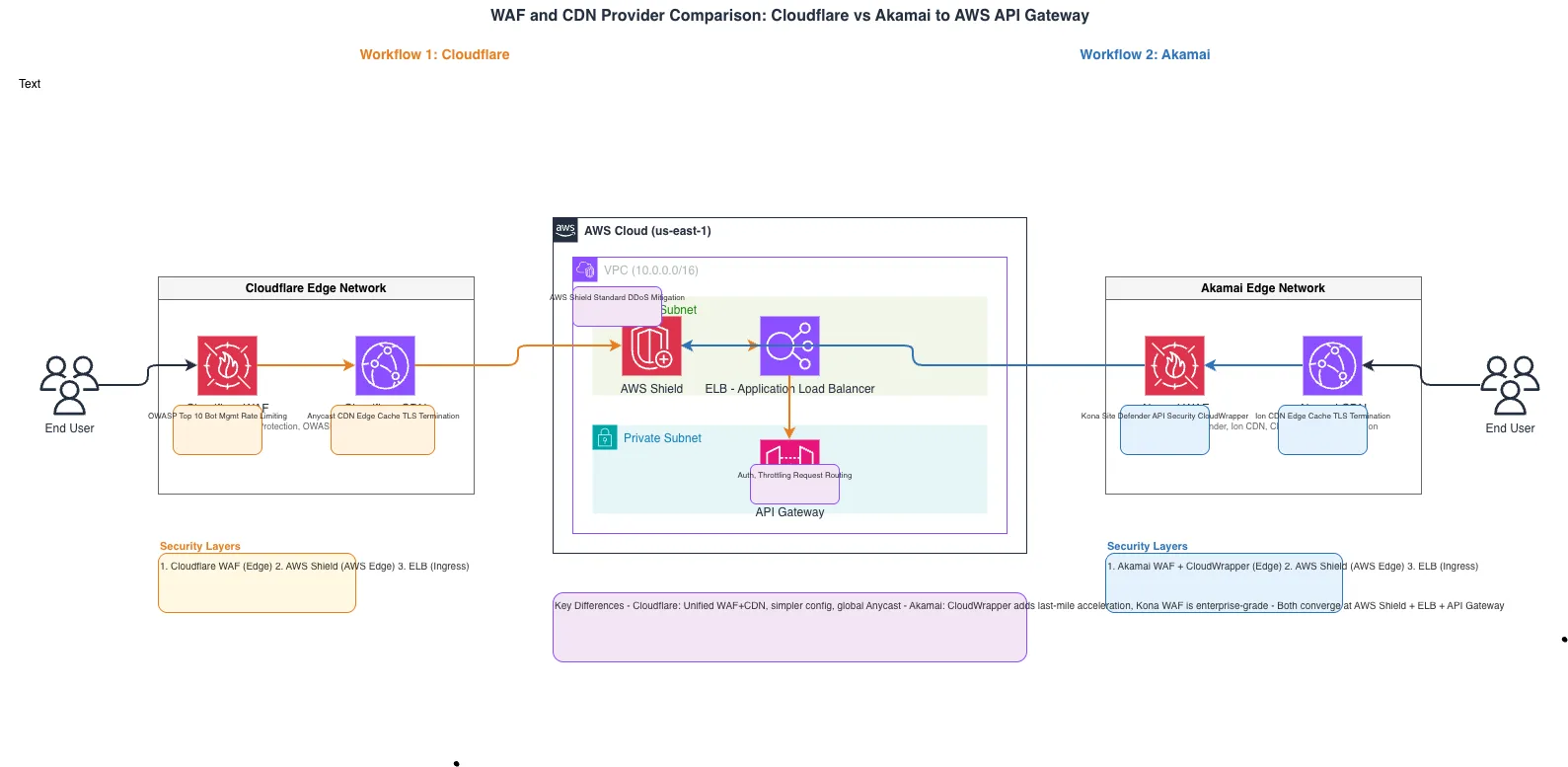
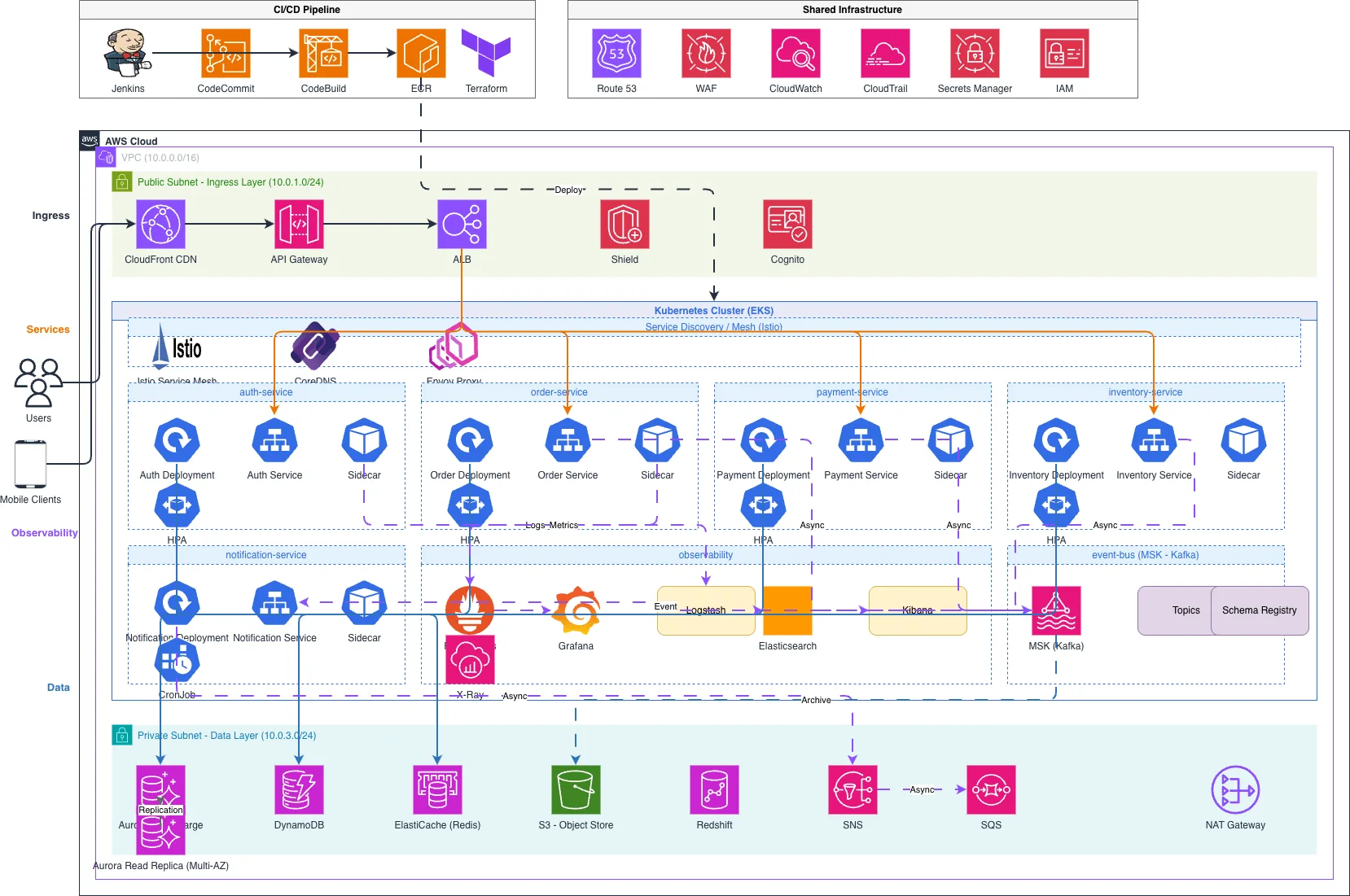
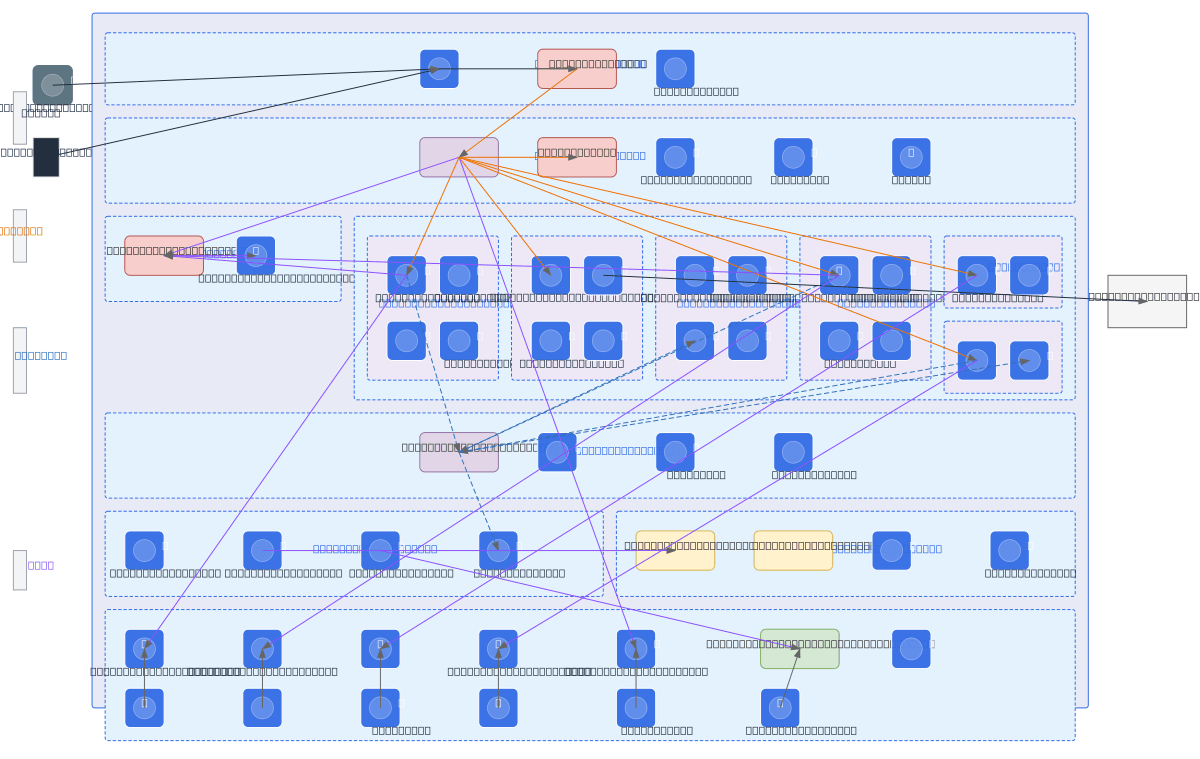

Microservices Architecture vs Monolith vs Modular Monolith
These three architectural styles represent different tradeoffs between service independence and operational complexity. Microservices distribute everything. Monoliths keep everything together. Modular monoliths enforce internal boundaries while deploying as a single unit. Each style produces a fundamentally different diagram.
| Feature | Microservices Architecture | Monolith | Modular Monolith |
|---|---|---|---|
| Deployment unit | Each service deploys independently; Order service ships without touching Payment service | Single deployable artifact (JAR, binary, container) containing all modules and shared database | Single deployable artifact with enforced module boundaries; modules can't import each other's internals |
| Data ownership | Database-per-service; Order service owns orders-db, Payment service owns payments-db, no shared tables | Single shared database; all modules read and write the same tables with foreign key relationships | Shared database with schema-per-module; each module owns its tables, cross-module joins discouraged |
| Communication pattern | Network calls: REST, gRPC, Kafka events; requires API gateway, service discovery, circuit breakers | In-process method calls; no serialization overhead, no network failure modes | In-process calls through defined module interfaces; async via in-memory event bus (MediatR, Spring Events) |
| Consistency model | Eventual consistency via saga pattern or event choreography; distributed transactions rare and discouraged | ACID transactions across all tables; single database commit guarantees consistency | ACID within modules; cross-module consistency via domain events committed in the same transaction |
| Diagram complexity | Many boxes, each with its own database; arrows for sync calls and async events; service mesh overlay | One large box with internal module labels; single database cylinder; few external arrows | One outer box containing module containers; shared database with schema boundaries; internal event arrows |
| When to choose | Multiple teams needing independent release cycles; polyglot tech stacks; 10+ services with clear domain boundaries | Small team (under 8); early product with unclear domain boundaries; need fast iteration without distributed systems overhead | Medium team wanting module boundaries without network complexity; planning future extraction to microservices |
When to use this pattern
Use a microservices architecture diagram when you need to communicate service boundaries, data ownership, and inter-service communication patterns to engineering teams. It's the right choice for design reviews where you're debating service decomposition, evaluating whether to split a service further, or planning saga orchestration for a new workflow. Platform teams use it to map API gateway routing, service mesh topology, and Kafka topic ownership. If your application is a monolith or modular monolith, this diagram type adds false complexity. Use a system architecture diagram instead. For infrastructure concerns like VPCs and availability zones, use a cloud architecture diagram. Don't combine microservice detail with infrastructure detail in one diagram.
Frequently asked questions
How does the AI microservices diagram generator handle database-per-service?
Each service you describe gets its own database icon placed inside the service boundary container. This AI microservices diagram generator follows RULE-06 to group a service with its datastore. If two services share a database, WARN-04 flags it as a missing boundary. Specify the database engine (PostgreSQL 15, MongoDB 7) for accurate icon selection.
Can I show saga patterns and compensation flows?
Yes. Describe the saga steps and their compensating actions in your prompt. The AI renders the happy path as forward arrows between services and compensation steps as labeled rollback arrows. For example, 'if payment fails, release reserved inventory' appears as a reverse arrow from Payment to Inventory with a compensation label.
How does the diagram represent asynchronous vs synchronous communication?
Synchronous calls (REST, gRPC) render as solid arrows between services or through the API gateway. Asynchronous flows through Kafka, RabbitMQ, or Pub/Sub render as arrows passing through a broker icon with named topics. Consumer groups and delivery semantics (at-least-once, exactly-once) appear as labels on subscriber arrows.
Can I include service mesh and sidecar proxies?
Yes. Mention your service mesh (Envoy, Linkerd, Istio) in the prompt. The AI attaches sidecar proxy icons to each service container. mTLS connections between sidecars render as encrypted channel indicators. Traffic policies like retries, timeouts, and circuit breaker thresholds appear as annotations on the mesh connections.
What if I have more than 15 services?
The 5,000-character prompt limit handles roughly 15 to 20 services with their databases and communication patterns. For larger systems, break the diagram into domain-level views: one for the Order domain, one for Fulfillment, one for Identity. Link them using shared topic names or API gateway routes. VLM visual validation flags overlaps on crowded canvases.
Related diagram generators
Generate System Architecture Diagrams from Text
Describe your system's components in plain English. Get a valid Draw.io diagram with services, databases, message queues, caches, and API connections.
Generate Kubernetes Diagrams from Text with AI
Describe your Kubernetes cluster in plain English. Get a valid Draw.io diagram with CNCF icons, namespace boundaries, deployments, services, and ingress controllers.
Generate API Gateway Diagrams from Text with AI
Describe your API gateway routing, auth, and rate limiting in plain English. Get a valid Draw.io diagram with request flows, middleware chains, and backend services.
Generate Event-Driven Architecture Diagrams from Text with AI
Describe your event producers, brokers, and consumers in plain English. Get a valid Draw.io diagram with Kafka topics, saga patterns, and DLQ flows.
Format converters
Convert PlantUML to an editable .drawio diagram
Paste your PlantUML and get a native .drawio you can edit — real draggable shapes and connectors instead of a rendered PNG, ready for Draw.io.
Convert Terraform to an architecture diagram
Paste your Terraform configuration and get a native, editable .drawio architecture diagram — with official cloud icons, VPC boundaries, and the connections drawn for you.