
Generate Azure landing zone diagrams from text
Describe your Azure management group hierarchy, hub-spoke network topology, and policy assignments in plain English. Get a valid Draw.io diagram with official Azure icons.
Diagrams.so's Azure landing zone diagram generator converts plain-text descriptions of your Azure tenant structure into Draw.io diagrams with correct management group hierarchies, subscription placement, and hub-spoke networking. Describe a setup like 'Tenant Root Group with Platform and Workload management groups, Platform containing Identity, Management, and Connectivity subscriptions, Connectivity hosting a hub VNet with Azure Firewall Premium and ExpressRoute gateway.' The AI builds the hierarchy tree, places subscriptions under the right management groups, and draws hub-spoke VNet peering with Azure Firewall routing. You can start from plain English, a voice note, or a whiteboard photo. Architecture warnings flag missing network security boundaries (WARN-04) and public endpoints without Azure Front Door WAF policies (WARN-02). Every element snaps to a 10px grid, and the output is native, editable .drawio XML with official Azure icons.
What Is an Azure Landing Zone Diagram?
An Azure landing zone is a pre-configured Azure environment that follows the Cloud Adoption Framework (CAF) with governance, networking, identity, and security baked in from day one. Rather than a single flat subscription, it is a modular design meant to scale as you add workloads. The diagram captures how management groups nest under the Tenant Root Group, where subscriptions sit in that hierarchy, which Azure Policies are assigned at each scope, and how hub-spoke VNet topology connects platform services to application workloads. Management groups form the backbone of the hierarchy. The Tenant Root Group sits at the top, and up to six levels of management groups can nest beneath it, though CAF recommends keeping the tree shallow — typically Platform, Workload (often split into Corp and Online), Sandbox, and Decommissioned. Governance flows downward: a policy or role assigned at a parent scope is inherited by every subscription and resource below it, so a deny-public-IP policy placed on the Workload group covers every application subscription at once. The diagram makes this inheritance visible by drawing each group as a nested container, with policy assignments annotated on the scope where they live. CAF treats the subscription as a unit of management, billing, and scale — a model often called subscription democratization. Instead of cramming everything into one subscription and hitting resource limits, each workload team gets its own application landing zone subscription and scales by adding more subscriptions, not by resizing. The design separates platform landing zones — the shared foundation delivered by the Identity, Management, and Connectivity subscriptions (DNS, monitoring, Log Analytics, Entra ID, and hub networking) — from application landing zones, the workload-specific subscriptions that consume those shared services. Rendering that split clearly is one of the hardest parts of a landing zone diagram to draw by hand. Networking usually follows one of two topologies. Traditional hub-spoke centers on a self-managed hub VNet in the Connectivity subscription that hosts Azure Firewall, an ExpressRoute or VPN gateway, and Azure Bastion; spoke VNets peer to the hub and use User Defined Routes to force egress through the firewall. Azure Virtual WAN is the alternative — a Microsoft-managed hub with built-in routing that suits organizations with many branch sites or a global footprint. The generator can draw either: describe a hub VNet and it wires up peering and route tables, or describe a Virtual WAN hub and it lays out the managed topology. Building any of this manually is tedious. You need to represent a tree of management groups (Platform, Workload, Sandbox, Decommissioned), show subscription placement, draw VNet peering between hub and spoke networks, attach Azure Firewall with route tables forcing traffic through the firewall, and annotate Entra ID integration for identity. Diagrams.so automates all of it. Describe your hierarchy in plain English and the AI maps each management group to a container, places subscriptions inside, and draws hub-spoke peering with User Defined Routes pointing to the firewall private IP. The generator distinguishes platform landing zones (shared services like DNS, monitoring, and identity) from application landing zones (workload-specific subscriptions). Governance is expressed through Azure Policy. Individual policies and initiatives (grouped sets of policies) are assigned at management group, subscription, or resource group scope, and their effect — deny, audit, deployIfNotExists, or modify — determines whether a non-compliant resource is blocked, flagged, or auto-remediated. Diagramming these assignments lets reviewers trace which guardrails apply where before anything is deployed. RULE-02 enforces official Azure icons for Azure Firewall, ExpressRoute, Azure Policy, Entra ID, and Azure Monitor. RULE-06 groups resources by management group scope. Opinionated mode enforces the CAF-recommended hierarchy. Architecture warning WARN-04 fires when spoke VNets lack NSGs on their subnets. WARN-02 catches application landing zones exposing public IPs without WAF. WARN-01 flags single-region hub deployments without geo-redundancy. VLM visual validation detects overlapping policy labels on dense hierarchies. The .drawio output opens in Draw.io, VS Code, or Confluence for landing zone design reviews.
Key components
- Management group hierarchy tree from Tenant Root Group through Platform, Workload, Sandbox, and Decommissioned groups
- Subscription placement containers showing each subscription nested under its management group with naming conventions
- Azure Policy assignments at management group scope with initiative labels (e.g., Azure Security Benchmark, CIS)
- Hub VNet with Azure Firewall Premium in AzureFirewallSubnet, ExpressRoute or VPN Gateway in GatewaySubnet, and Azure Bastion
- Spoke VNets peered to hub with User Defined Routes (0.0.0.0/0 next-hop Azure Firewall private IP)
- Entra ID integration showing tenant-level identity with Conditional Access Policies and PIM role assignments
- Platform landing zone separation: Identity, Management, and Connectivity subscriptions as distinct containers
- Architecture warnings for missing NSGs (WARN-04), public endpoints without WAF (WARN-02), and single-region hub (WARN-01)
How to generate with AI
- 1
Describe your landing zone hierarchy
Write your Azure tenant structure in plain English. Be specific about management group names and subscription placement. For example: 'Tenant Root Group at the top. Under it, Platform management group containing three subscriptions: sub-identity (Entra ID Domain Services, Conditional Access), sub-management (Log Analytics workspace, Azure Monitor, Microsoft Defender for Cloud), sub-connectivity (hub VNet 10.0.0.0/16 with Azure Firewall Premium and ExpressRoute to on-premises). Workload management group containing Corp and Online child groups. Corp has sub-app-prod and sub-app-dev. Online has sub-web-prod. Sandbox management group with sub-sandbox-01. Azure Policy: deny public IPs assigned at Workload scope, audit unencrypted storage at Tenant Root Group.'
- 2
Select architecture type and Azure provider
Choose 'Architecture' as the diagram type and 'Azure' as the cloud provider. Diagrams.so loads the official Microsoft Azure Icon Set with icons for management groups, subscriptions, Azure Firewall, ExpressRoute, Entra ID, and Azure Policy. Enable opinionated mode to enforce CAF-aligned hierarchy layout with platform services on the left and application workloads on the right.
- 3
Generate and review
Click generate. The AI produces .drawio XML with a management group tree, subscription containers, hub-spoke network topology with VNet peering arrows, Azure Firewall route tables, and policy assignment annotations. Architecture warnings flag spokes without NSGs (WARN-04), exposed public endpoints (WARN-02), and single-region hubs (WARN-01). VLM visual validation catches overlapping labels. Download as .drawio for editing, or export to PNG or SVG for CAF design review sessions.
Example prompt
Azure landing zone following Cloud Adoption Framework. Tenant Root Group with Azure Security Benchmark policy initiative. Platform management group: sub-identity subscription with Entra ID Domain Services, Conditional Access Policies, and PIM; sub-management subscription with Log Analytics workspace (90-day retention), Microsoft Defender for Cloud P2, Azure Monitor action groups; sub-connectivity subscription with hub VNet (10.0.0.0/16), Azure Firewall Premium in AzureFirewallSubnet (10.0.0.0/26) with TLS inspection enabled, ExpressRoute Gateway in GatewaySubnet (10.0.1.0/27) connected to on-premises via 1Gbps circuit, Azure Bastion in AzureBastionSubnet (10.0.2.0/26), Azure DNS Private Resolver. Workload management group with Corp and Online child groups. Corp management group: sub-erp-prod with spoke VNet (10.1.0.0/16) peered to hub, UDR 0.0.0.0/0 to Azure Firewall, NSG on all subnets. Online management group: sub-web-prod with spoke VNet (10.2.0.0/16) peered to hub, Azure Front Door Premium with WAF in prevention mode routing to App Service in snet-web (10.2.1.0/24). Sandbox management group: sub-sandbox-01 with policy denying ExpressRoute and VNet peering. Deny public IP policy assigned at Workload scope. Audit tag policy at Tenant Root Group.
Example diagrams from the gallery

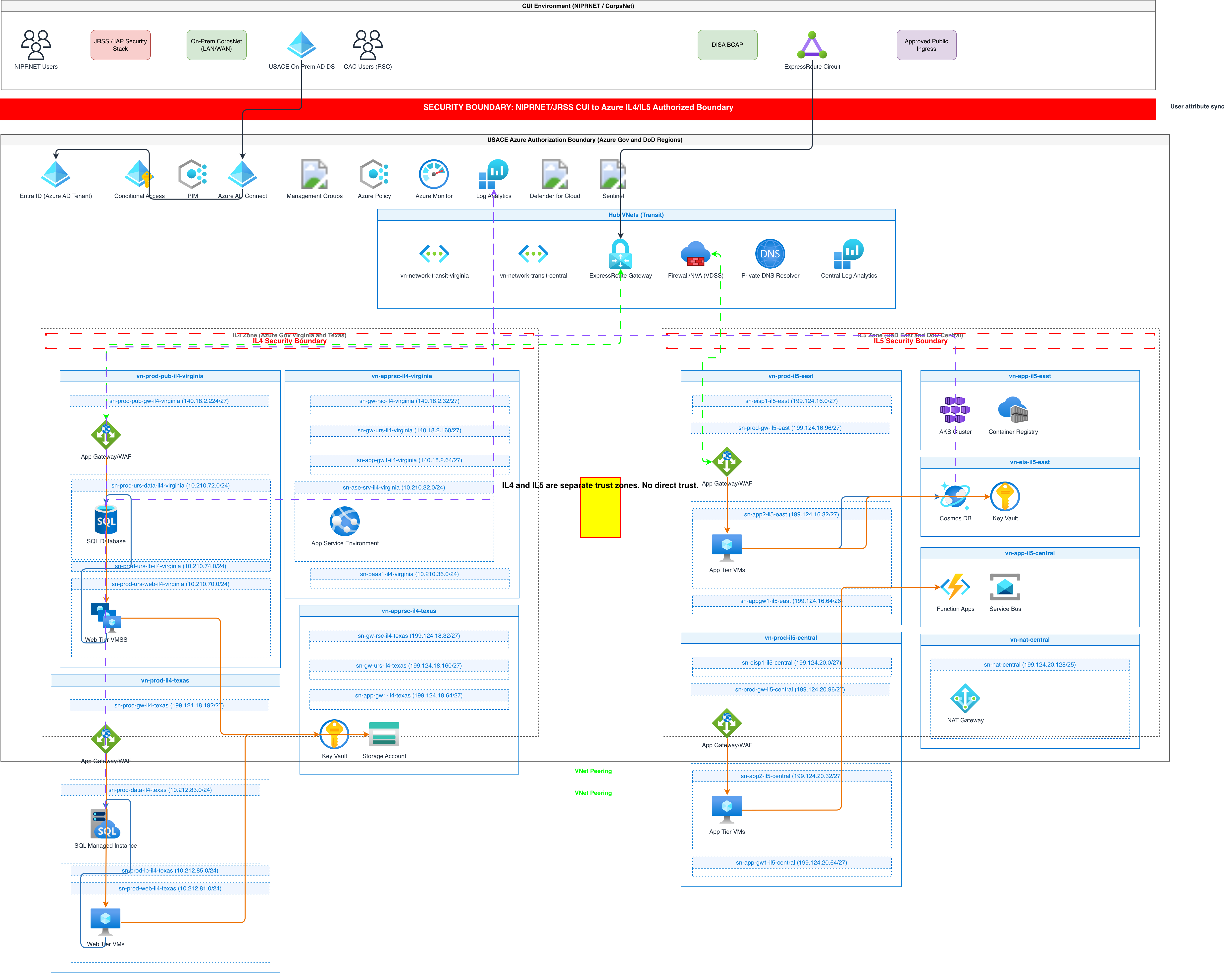


Azure Landing Zone vs AWS Control Tower vs GCP Organization Hierarchy
Each cloud provider structures multi-account governance differently. Azure uses management groups with Azure Policy. AWS uses Organizations with Service Control Policies and Control Tower guardrails. GCP uses organizations, folders, and Organization Policies. The hierarchy depth, policy inheritance model, and networking differ across all three.
| Feature | Azure Landing Zone | AWS Control Tower | GCP Organization Hierarchy |
|---|---|---|---|
| Governance hierarchy | Tenant Root Group > management groups (up to 6 levels deep) > subscriptions > resource groups; Azure Policy assigned at any scope | Organization root > organizational units (up to 5 levels) > accounts; Service Control Policies at OU or account level | Organization > folders (up to 10 levels) > projects; Organization Policies inherit downward with folder-level overrides |
| Policy enforcement | Azure Policy initiatives with deny, audit, deployIfNotExists effects; exemptions at child scope; compliance dashboard per scope | SCPs restrict API calls at OU boundaries; AWS Config rules for detective controls; Control Tower guardrails as pre-packaged bundles | Organization Policy constraints (boolean or list-based); custom constraints via CEL expressions; tags-based conditional enforcement |
| Network topology | Hub-spoke with Azure Firewall in Connectivity subscription; VNet peering with UDRs; Azure Virtual WAN as alternative | Transit Gateway in shared networking account; VPC attachments per workload account; AWS Network Firewall for inspection | Shared VPC in host project; service projects attach to shared subnets; Cloud Interconnect in dedicated project |
| Identity integration | Entra ID as single identity plane; Conditional Access at tenant level; PIM for just-in-time role elevation | AWS IAM Identity Center (SSO) federated to external IdP; permission sets per account; cross-account roles | Google Cloud Identity or Workspace; IAM roles at org/folder/project scope; Workforce Identity Federation for external IdPs |
| Diagram layout pattern | Tree hierarchy on the left, hub-spoke network on the right; subscriptions as bounded regions inside management groups | OU tree on the left, Transit Gateway star topology on the right; accounts as VPC boxes connected to TGW | Org/folder tree on the left, Shared VPC flat layout on the right; projects as containers with subnet labels |
| Automated deployment | Azure Landing Zone Accelerator (Bicep/Terraform modules); ALZ portal experience for guided setup | Account Factory vends accounts with pre-configured VPCs, SSO, and guardrails; Customizations for CT pipeline | Cloud Foundation Toolkit Terraform modules; Fabric FAST for end-to-end org setup |
When to use this pattern
Use an Azure landing zone diagram when designing or documenting your Azure tenant governance structure. It's the right choice for CAF adoption workshops, subscription vending strategy reviews, and Azure Policy compliance audits. The diagram shows stakeholders how management groups enforce policy inheritance, where subscriptions live, and how hub-spoke networking routes traffic through Azure Firewall. Concrete scenarios include migrating off a single flat subscription into a CAF-aligned, multi-subscription structure, where the diagram becomes the target-state map the platform team builds toward. It helps during security and compliance reviews — SOC 2, ISO 27001, or an internal audit — by making policy guardrails and network isolation boundaries auditable at a glance. It is valuable when onboarding a new business unit or integrating an acquired company, since each needs its own application landing zone subscriptions placed under the right management group. Reach for it when you are weighing a move from classic hub-spoke to Azure Virtual WAN as your branch count grows, or preparing a design review with a Microsoft FastTrack engineer or CSP partner who expects to see the hierarchy and connectivity model up front. If you only need to document a single application's infrastructure, use an Azure architecture diagram instead. If your focus is purely on VNet connectivity without the governance hierarchy, an Azure networking diagram fits better. Landing zone diagrams are most valuable during initial cloud adoption or when onboarding new business units that need their own subscription structure.
Frequently asked questions
What does the Azure landing zone diagram generator include?
This Azure landing zone diagram generator produces management group hierarchies, subscription placement, hub-spoke VNet topology with Azure Firewall, policy assignments at each scope, and Entra ID integration. It follows CAF conventions and uses official Azure icons from Diagrams.so's 30+ icon libraries. RULE-06 groups resources by management group scope automatically.
Can I customize the management group hierarchy?
Yes. Describe any management group structure in your prompt. The CAF-recommended groups are Platform, Workload, Sandbox, and Decommissioned, but you can add custom groups like Corp, Online, or SAP. The AI nests them under the Tenant Root Group exactly as you specify. Each group renders as a labeled container.
How are Azure Policy assignments shown?
Policy assignments appear as annotations on the management group or subscription where they're assigned. The AI labels each assignment with the initiative or policy name and its effect (deny, audit, deployIfNotExists). Policy inheritance is implied by the hierarchy. Exemptions at child scopes get a distinct label.
Does the diagram show hub-spoke networking?
Yes. Describe your hub VNet with Azure Firewall and ExpressRoute or VPN Gateway, then list spoke VNets with their CIDR ranges. The AI draws VNet peering arrows with bidirectional labels and User Defined Routes showing 0.0.0.0/0 to the firewall private IP. WARN-04 flags spokes missing NSG rules on subnets.
What architecture warnings apply to landing zone diagrams?
WARN-01 flags single-region hub VNets without geo-redundant failover. WARN-02 catches application workloads with public endpoints lacking Azure Front Door WAF. WARN-04 detects spoke subnets without NSG rules. WARN-03 identifies Azure SQL databases in workload subscriptions without geo-replication. Warnings appear as non-blocking annotations.
Related diagram generators
Generate Azure Architecture Diagrams from Text with AI
Describe your Azure infrastructure in plain English. Get a valid Draw.io diagram with official Azure icons, VNet boundaries, resource groups, and NSG rules.
Generate Azure networking diagrams from text
Describe your Azure network topology in plain English. Get a valid Draw.io diagram with hub-spoke VNets, Azure Firewall rules, NSG flows, and Private Link endpoints.
Generate Cloud Architecture Diagrams from Text
Describe your cloud infrastructure in plain English. Get a valid Draw.io diagram with region boundaries, availability zones, managed services, and DR paths.
Generate Multi-Cloud Architecture Diagrams from Text with AI
Describe infrastructure spanning AWS, Azure, GCP, and OCI. Get a valid Draw.io diagram with correct provider icons, cross-cloud networking, and unified identity flows.