Zero Trust Architecture - Full Stack

GENERALArchitectureadvanced
Zero Trust Architecture - Full Stack — GENERAL architecture diagram

About This Architecture

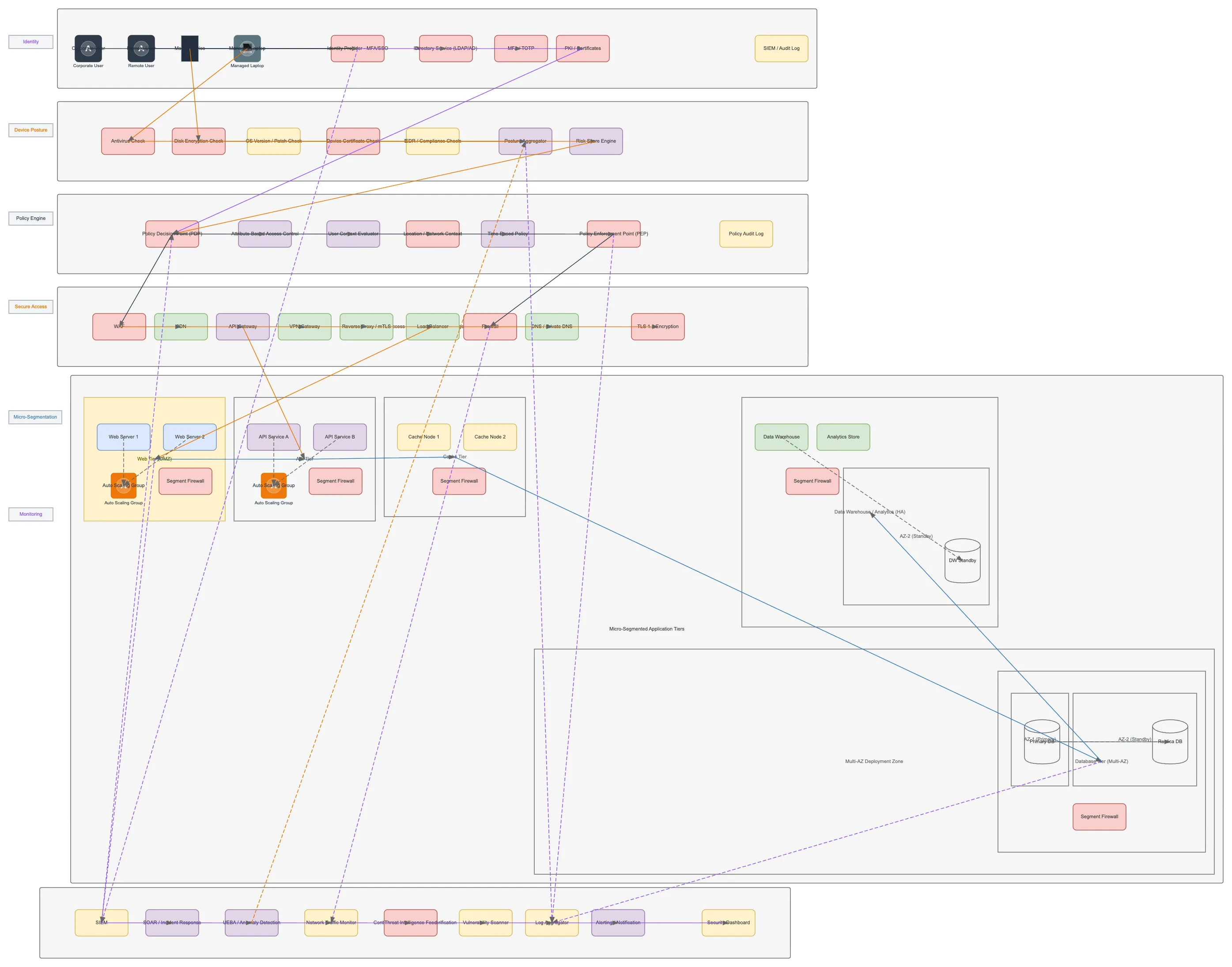
Zero Trust Architecture - Full Stack implements continuous identity verification, device posture checks, and micro-segmentation across all network tiers. Identity providers, MFA/SSO, and PKI certificates authenticate users and devices, feeding a Policy Engine that evaluates risk scores and context before granting least-privilege access through secure gateways. Application tiers—Web, API, Cache, and Database—are isolated by segment firewalls enforcing attribute-based access control and mTLS encryption. Continuous monitoring via SIEM, UEBA, and threat intelligence detects anomalies and enforces real-time policy adjustments. Fork this diagram to customize policies, add your IdP integrations, or document your organization's zero-trust rollout.

People also ask

How do I design a zero-trust architecture that verifies identity and device posture before granting access to micro-segmented application tiers?

This diagram shows a complete zero-trust stack: Identity Providers and MFA/PKI authenticate users and devices; a Policy Engine evaluates risk scores and context via a Policy Decision Point; Secure Access Gateways enforce least-privilege access through WAF, API Gateway, and Reverse Proxy with mTLS; and micro-segmented tiers (Web, API, Cache, Database) are isolated by segment firewalls. Continuous m

zero-trustsecurityidentity-verificationmicro-segmentationpolicy-enginecontinuous-monitoring
Domain:
Security
Audience:
Security architects designing zero-trust network access and identity verification systems

Generated by Diagrams.so — AI architecture diagram generator with native Draw.io output. Fork this diagram, remix it, or download as .drawio, PNG, or SVG.

Generate your own architecturediagram →

Zero Trust Architecture - Full Stack architecture diagram

About This Architecture

Zero Trust Architecture - Full Stack implements continuous identity verification, device posture checks, and micro-segmentation across all network tiers. Identity providers, MFA/SSO, and PKI certificates authenticate users and devices, feeding a Policy Engine that evaluates risk scores and context before granting least-privilege access through secure gateways. Application tiers—Web, API, Cache, and Database—are isolated by segment firewalls enforcing attribute-based access control and mTLS encryption. Continuous monitoring via SIEM, UEBA, and threat intelligence detects anomalies and enforces real-time policy adjustments. Fork this diagram to customize policies, add your IdP integrations, or document your organization's zero-trust rollout.

People also ask

How do I design a zero-trust architecture that verifies identity and device posture before granting access to micro-segmented application tiers?

This diagram shows a complete zero-trust stack: Identity Providers and MFA/PKI authenticate users and devices; a Policy Engine evaluates risk scores and context via a Policy Decision Point; Secure Access Gateways enforce least-privilege access through WAF, API Gateway, and Reverse Proxy with mTLS; and micro-segmented tiers (Web, API, Cache, Database) are isolated by segment firewalls. Continuous m

Zero Trust Architecture - Full Stack

Autoadvancedzero-trustsecurityidentity-verificationmicro-segmentationpolicy-enginecontinuous-monitoring
Domain: SecurityAudience: Security architects designing zero-trust network access and identity verification systems
0 views0 favoritesPublic

Created by

June 19, 2026

Updated

June 19, 2026 at 12:30 PM

Type

architecture

Need a custom architecture diagram?

Describe your architecture in plain English and get a production-ready Draw.io diagram in seconds. Works for AWS, Azure, GCP, Kubernetes, and more.

Generate with AI