XML Record Retrieval and Editor Architecture

GENERALArchitectureadvanced
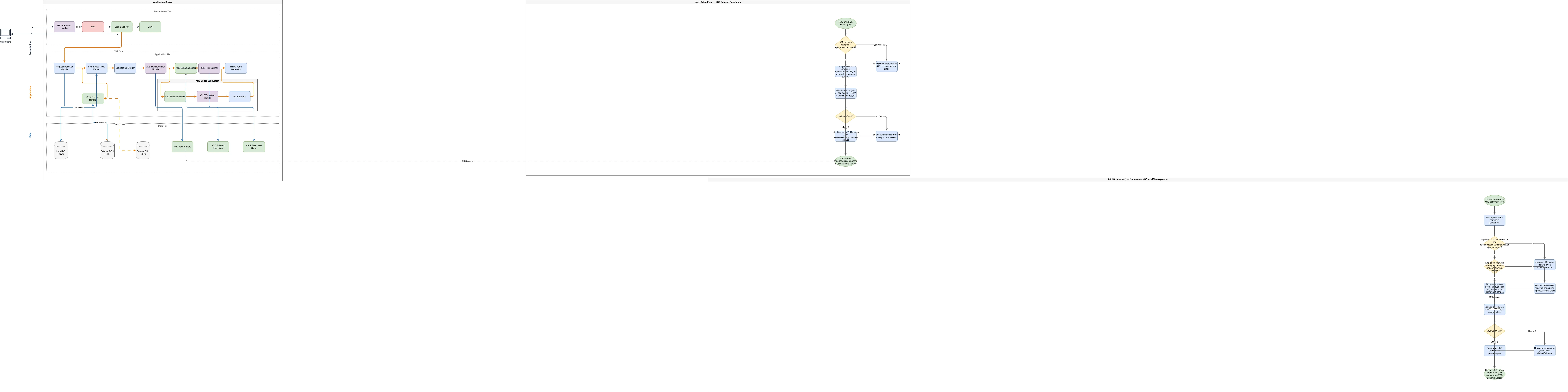
XML Record Retrieval and Editor Architecture — GENERAL architecture diagram

About This Architecture

Multi-tier XML record retrieval and editor architecture with presentation, application, and data layers handling HTTP requests through WAF and load balancing. The application tier parses XML via PHP, builds DOM objects, applies XSD schema validation and XSLT transformations to generate HTML forms for client editing. Data tier integrates local and external SRU protocol databases, XML record stores, and schema/stylesheet repositories to support federated XML document management. This architecture demonstrates enterprise patterns for secure, scalable XML processing with schema-driven validation and presentation layer abstraction. Fork this diagram on Diagrams.so to customize database endpoints, add caching layers, or extend the SRU protocol handlers for your metadata systems. The separation of XSD schema loading, XSLT transformation, and form generation enables reusable component design across multiple XML document types.

People also ask

How do you design a scalable architecture for retrieving, validating, and editing XML records from federated databases?

This diagram shows a three-tier architecture where the presentation tier handles HTTP requests through WAF and load balancing, the application tier parses XML, validates against XSD schemas, applies XSLT transformations, and generates HTML forms, while the data tier manages local and external SRU protocol databases plus XML record and schema repositories. The separation of concerns enables reusabl

XML architectureSRU protocolXSD validationXSLT transformationmulti-tier applicationdatabase integration
Domain:
Software Architecture
Audience:
backend architects designing XML data retrieval and editing systems

Generated by Diagrams.so — AI architecture diagram generator with native Draw.io output. Fork this diagram, remix it, or download as .drawio, PNG, or SVG.

Generate your own architecture diagram →

About This Architecture

Multi-tier XML record retrieval and editor architecture with presentation, application, and data layers handling HTTP requests through WAF and load balancing. The application tier parses XML via PHP, builds DOM objects, applies XSD schema validation and XSLT transformations to generate HTML forms for client editing. Data tier integrates local and external SRU protocol databases, XML record stores, and schema/stylesheet repositories to support federated XML document management. This architecture demonstrates enterprise patterns for secure, scalable XML processing with schema-driven validation and presentation layer abstraction. Fork this diagram on Diagrams.so to customize database endpoints, add caching layers, or extend the SRU protocol handlers for your metadata systems. The separation of XSD schema loading, XSLT transformation, and form generation enables reusable component design across multiple XML document types.

People also ask

How do you design a scalable architecture for retrieving, validating, and editing XML records from federated databases?

This diagram shows a three-tier architecture where the presentation tier handles HTTP requests through WAF and load balancing, the application tier parses XML, validates against XSD schemas, applies XSLT transformations, and generates HTML forms, while the data tier manages local and external SRU protocol databases plus XML record and schema repositories. The separation of concerns enables reusabl

XML Record Retrieval and Editor Architecture

AutoadvancedXML architectureSRU protocolXSD validationXSLT transformationmulti-tier applicationdatabase integration
Domain: Software ArchitectureAudience: backend architects designing XML data retrieval and editing systems
0 views0 favoritesPublic

Created by

May 7, 2026

Updated

May 7, 2026 at 7:40 PM

Type

architecture

Need a custom architecture diagram?

Describe your architecture in plain English and get a production-ready Draw.io diagram in seconds. Works for AWS, Azure, GCP, Kubernetes, and more.

Generate with AI