
About This Architecture
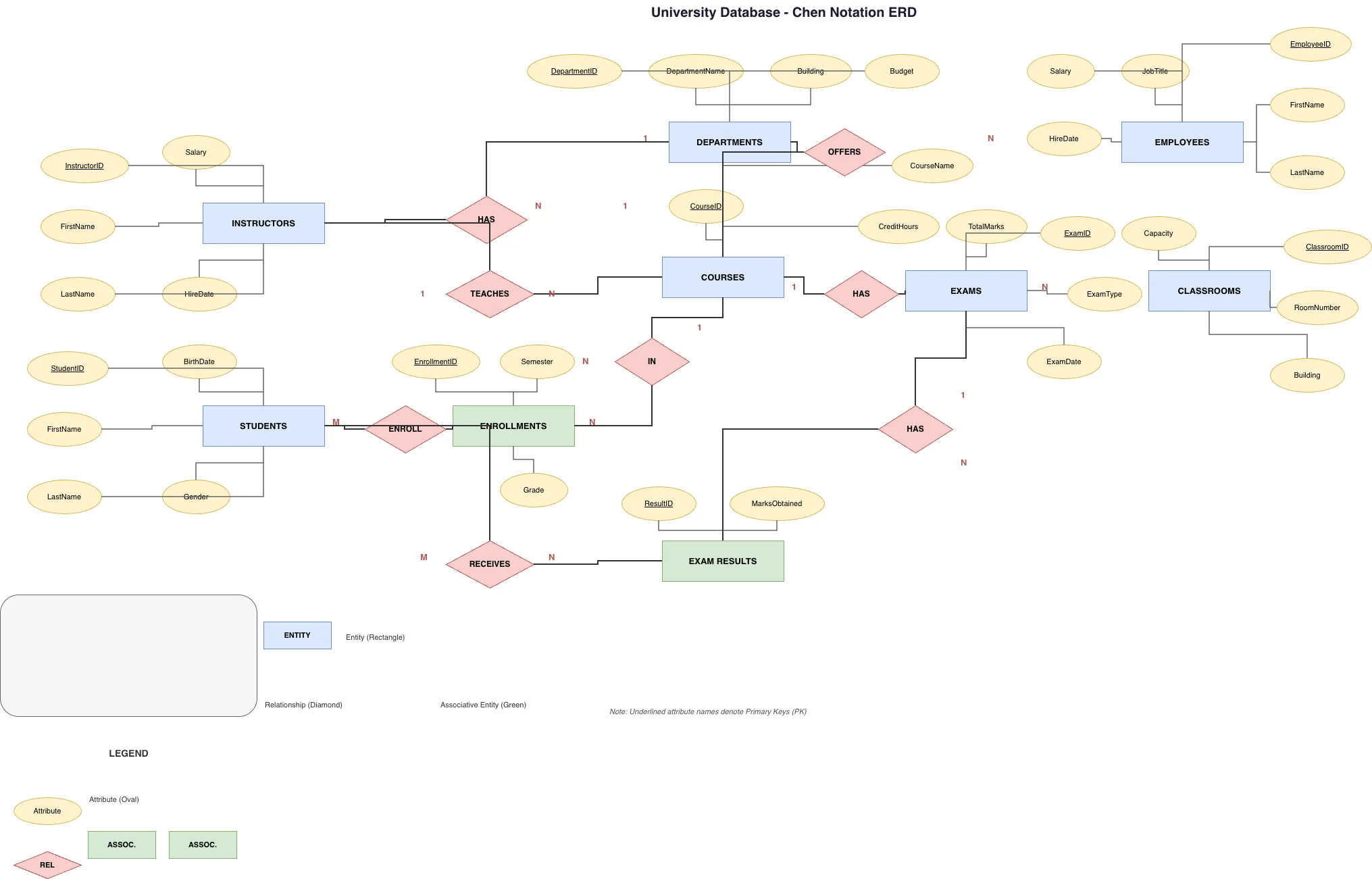
Chen notation entity-relationship diagram modeling a comprehensive university database with seven core entities: DEPARTMENTS, INSTRUCTORS, COURSES, STUDENTS, ENROLLMENTS, EXAMS, and EXAM RESULTS. Data flows through relationships like HAS (departments to instructors), OFFERS (departments to courses), TEACHES (instructors to courses), ENROLL (students to enrollments), and RECEIVES (students to exam results), capturing the complete academic lifecycle. This ERD demonstrates normalization best practices and cardinality constraints essential for designing scalable, maintainable institutional databases. Fork this diagram on Diagrams.so to customize entity attributes, add new relationships like PREREQUISITES or GRADING_SCALES, or export as .drawio/.svg for documentation. The associative ENROLLMENTS and EXAM RESULTS entities resolve many-to-many relationships, a foundational pattern for academic information systems.