
About This Architecture
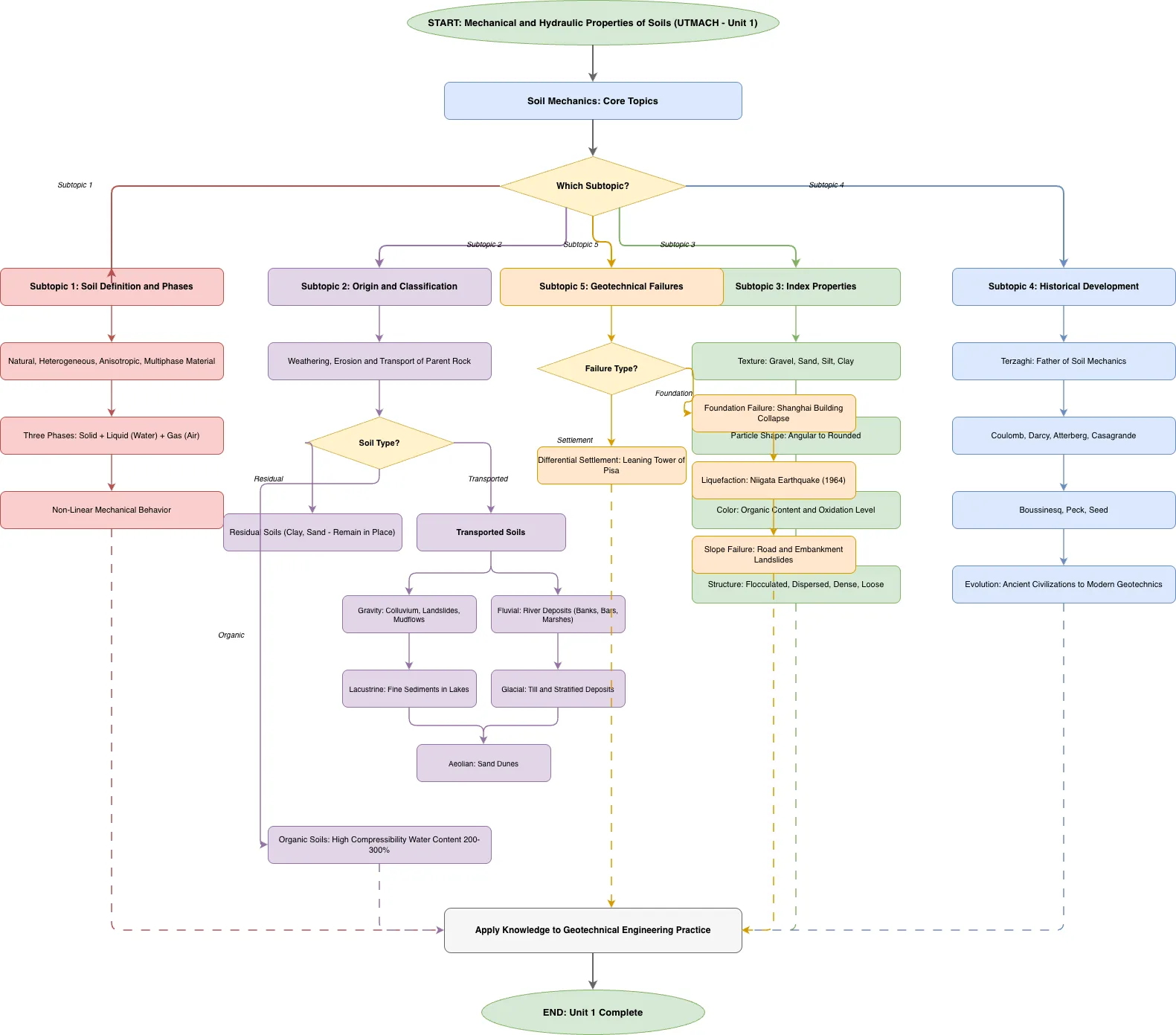
Soil Mechanics Unit 1 flowchart from UTMACH covers mechanical and hydraulic properties of soils through five interconnected subtopics: soil definition and phases, origin and classification, index properties, historical development, and geotechnical failures. The diagram traces soil as a natural, heterogeneous, multiphase material composed of solid, liquid, and gas phases, then branches into residual and transported soil types formed by weathering, erosion, gravity, fluvial, lacustrine, glacial, and aeolian processes. Students explore index properties including texture, particle shape, color, and structure, learn foundational contributors like Terzaghi, Coulomb, and Casagrande, and examine real-world failures such as differential settlement, foundation collapse, liquefaction, and slope instability. This structured learning path bridges soil science fundamentals with practical geotechnical engineering applications. Fork and customize this flowchart on Diagrams.so to create study guides, lecture slides, or exam preparation materials tailored to your curriculum.