
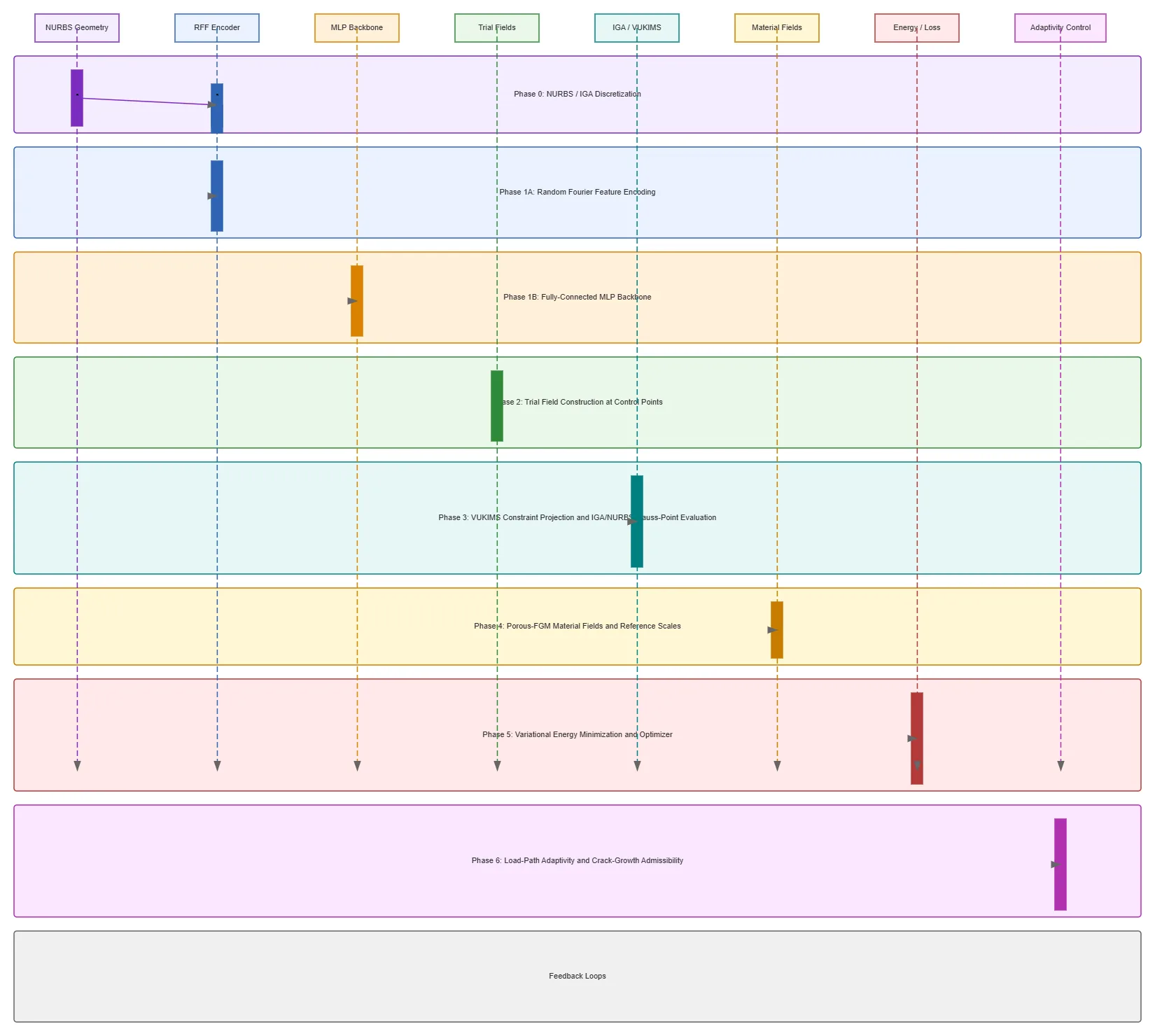
About This Architecture
Physics-informed neural network (PINN) pipeline for porous functionally graded material (FGM) fracture mechanics combines NURBS geometry discretization, random Fourier feature encoding, and MLP backbone networks to predict trial fields at IGA control points. The architecture enforces VUKIMS constraints, evaluates material properties across porous-FGM domains, and minimizes variational energy through adaptive optimization. Feedback loops enable load-path adaptivity and crack-growth admissibility constraints, critical for accurate fracture propagation prediction in heterogeneous materials. Fork this diagram on Diagrams.so to customize phases, add OCI compute resources, or integrate with your scientific computing workflow. This sequence-based pipeline demonstrates how modern deep learning can embed domain-specific physics constraints for engineering-grade accuracy.