
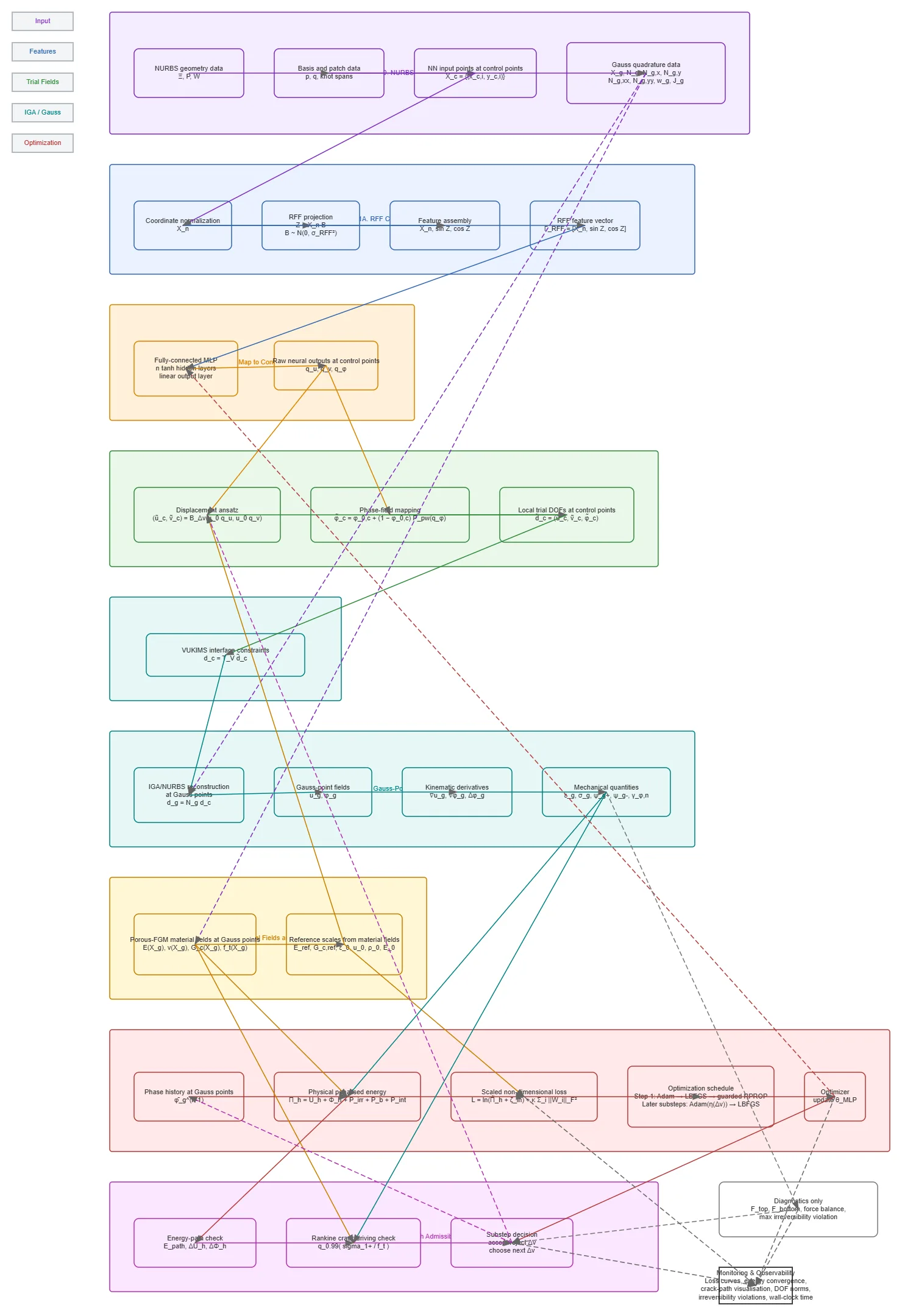
About This Architecture
Physics-informed neural network (PINN) pipeline for phase-field fracture modeling using isogeometric analysis (IGA) and random Fourier features on OCI. The architecture flows from NURBS geometry discretization through RFF-enhanced coordinate features into a fully-connected MLP that maps to control-point degrees of freedom, then constructs trial fields with displacement and phase-field ansatze. Gauss-point evaluation reconstructs fields across the domain, computes kinematic derivatives and mechanical quantities, and feeds them into a variational optimization loop with porous-FGM material heterogeneity and crack-growth admissibility checks. This approach combines classical finite-element rigor with neural network expressivity, enabling efficient surrogate modeling of complex fracture propagation in heterogeneous materials. Fork and customize this diagram on Diagrams.so to adapt the pipeline for your material model, boundary conditions, or optimization schedule. The modular design separates geometry preprocessing, feature engineering, neural mapping, and physics-constrained loss computation, making it ideal for research teams extending PINN methods to multi-physics or topology-optimization workflows.