
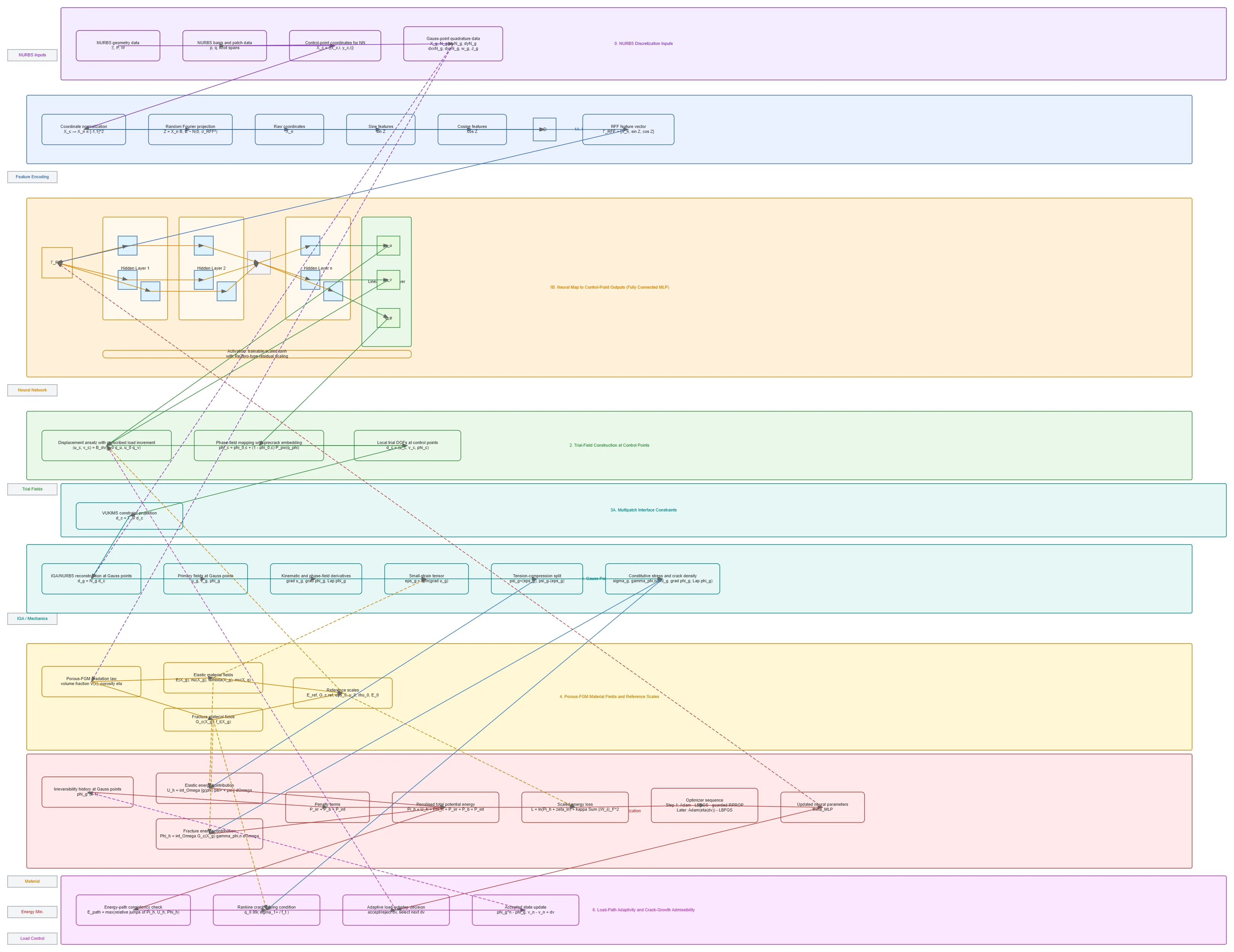
About This Architecture
Physics-informed neural network (PINN) architecture for phase-field fracture modeling using isogeometric analysis (IGA) with NURBS discretization and OCI compute infrastructure. The pipeline encodes spatial coordinates via random Fourier features into a fully connected MLP that predicts control-point displacements, phase-field values, and their derivatives, which are reconstructed at Gauss points using IGA basis functions. Variational energy minimization combines elastic strain energy, fracture energy, and penalty terms into a scaled loss function optimized sequentially with Adam, LBFGS, and guarded RPROP. This architecture bridges deep learning and computational mechanics, enabling efficient surrogate modeling of complex fracture behavior in heterogeneous porous and functionally graded materials. Fork this diagram on Diagrams.so to customize material laws, add multipatch constraints, or adapt the neural network topology for your specific fracture mechanics problem. The design demonstrates how to embed mechanical irreversibility constraints and material heterogeneity directly into the neural training loop.