OCI Dual-Region DRG Remote Peering - 12 VCNs

OCINetworkintermediate
OCI Dual-Region DRG Remote Peering - 12 VCNs — OCI network diagram

About This Architecture

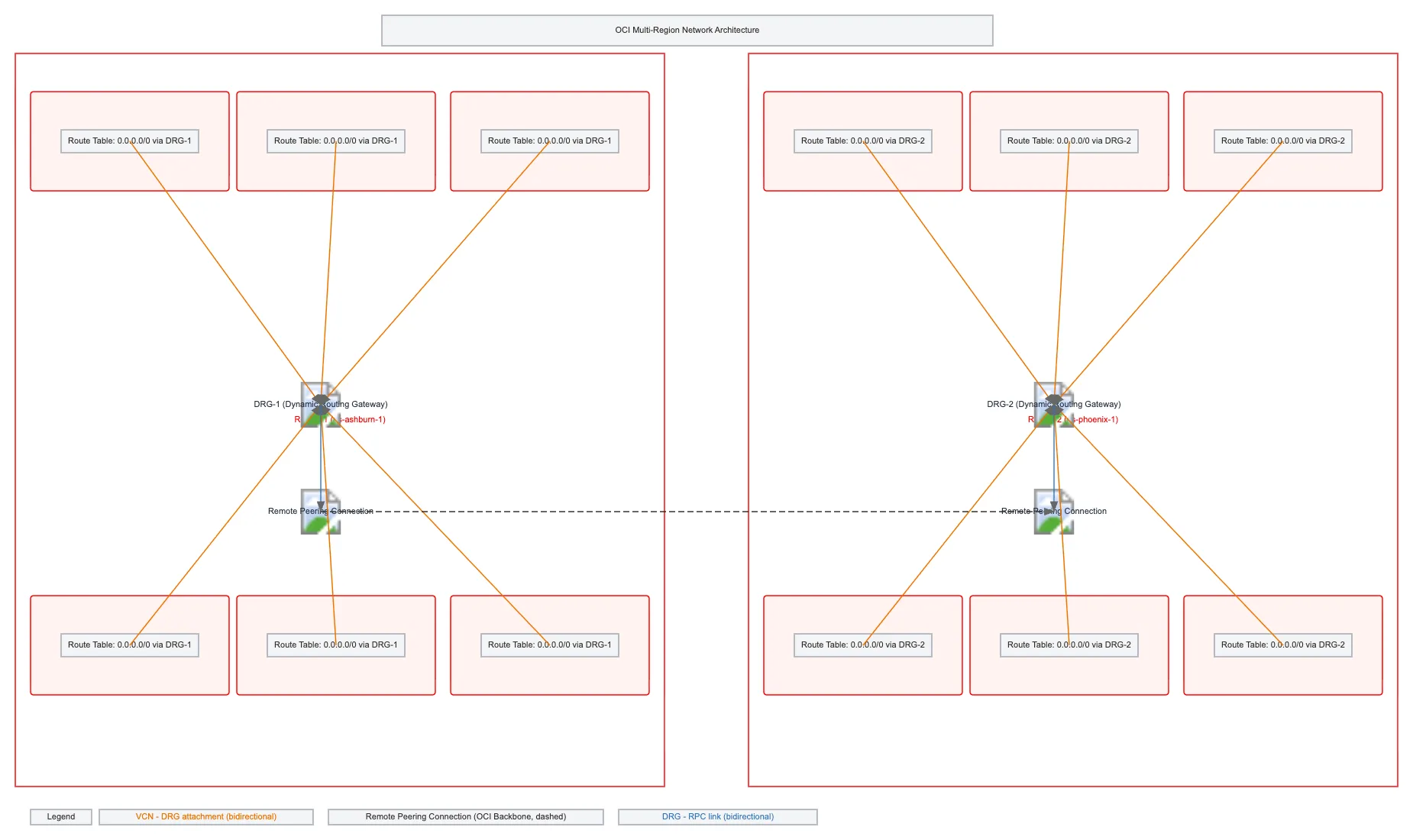
OCI dual-region architecture with 12 VCNs connected via Dynamic Routing Gateways and Remote Peering Connections across us-ashburn-1 and us-phoenix-1. Six VCNs in Region 1 (10.1.0.0/16 through 10.6.0.0/16) attach to DRG-1, while six VCNs in Region 2 (10.11.0.0/16 through 10.16.0.0/16) attach to DRG-2, with all traffic routed through their respective DRGs. The two DRGs connect via Remote Peering Connection over the OCI backbone, enabling seamless inter-region communication and centralized routing policy enforcement. This hub-and-spoke pattern with remote peering provides high availability, simplified network management, and disaster recovery capabilities across geographically distributed regions. Fork and customize this diagram on Diagrams.so to match your own VCN CIDR blocks, add security rules, or extend to additional regions.

People also ask

How do I connect multiple VCNs across two OCI regions using Dynamic Routing Gateways and Remote Peering?

This diagram shows a hub-and-spoke topology where six VCNs in Region 1 attach to DRG-1 and six VCNs in Region 2 attach to DRG-2. The two DRGs connect via Remote Peering Connection over the OCI backbone, enabling all VCNs to communicate across regions with centralized routing through their respective gateways.

OCInetworkingmulti-regiondisaster-recoveryDRGremote-peering
Domain:
Cloud Oci
Audience:
OCI network architects designing multi-region disaster recovery and hub-and-spoke topologies

Generated by Diagrams.so — AI architecture diagram generator with native Draw.io output. Fork this diagram, remix it, or download as .drawio, PNG, or SVG.

Generate your own networkdiagram →

OCI Dual-Region DRG Remote Peering - 12 VCNs — OCI architecture diagram

About This Architecture

OCI dual-region architecture with 12 VCNs connected via Dynamic Routing Gateways and Remote Peering Connections across us-ashburn-1 and us-phoenix-1. Six VCNs in Region 1 (10.1.0.0/16 through 10.6.0.0/16) attach to DRG-1, while six VCNs in Region 2 (10.11.0.0/16 through 10.16.0.0/16) attach to DRG-2, with all traffic routed through their respective DRGs. The two DRGs connect via Remote Peering Connection over the OCI backbone, enabling seamless inter-region communication and centralized routing policy enforcement. This hub-and-spoke pattern with remote peering provides high availability, simplified network management, and disaster recovery capabilities across geographically distributed regions. Fork and customize this diagram on Diagrams.so to match your own VCN CIDR blocks, add security rules, or extend to additional regions.

People also ask

How do I connect multiple VCNs across two OCI regions using Dynamic Routing Gateways and Remote Peering?

This diagram shows a hub-and-spoke topology where six VCNs in Region 1 attach to DRG-1 and six VCNs in Region 2 attach to DRG-2. The two DRGs connect via Remote Peering Connection over the OCI backbone, enabling all VCNs to communicate across regions with centralized routing through their respective gateways.

OCI Dual-Region DRG Remote Peering - 12 VCNs

OCIintermediatenetworkingmulti-regiondisaster-recoveryDRGremote-peering
Domain: Cloud OciAudience: OCI network architects designing multi-region disaster recovery and hub-and-spoke topologies
0 views0 favoritesPublic

Created by

June 30, 2026

Updated

June 30, 2026 at 3:12 PM

Type

network

Need a custom architecture diagram?

Describe your architecture in plain English and get a production-ready Draw.io diagram in seconds. Works for AWS, Azure, GCP, Kubernetes, and more.

Generate with AI