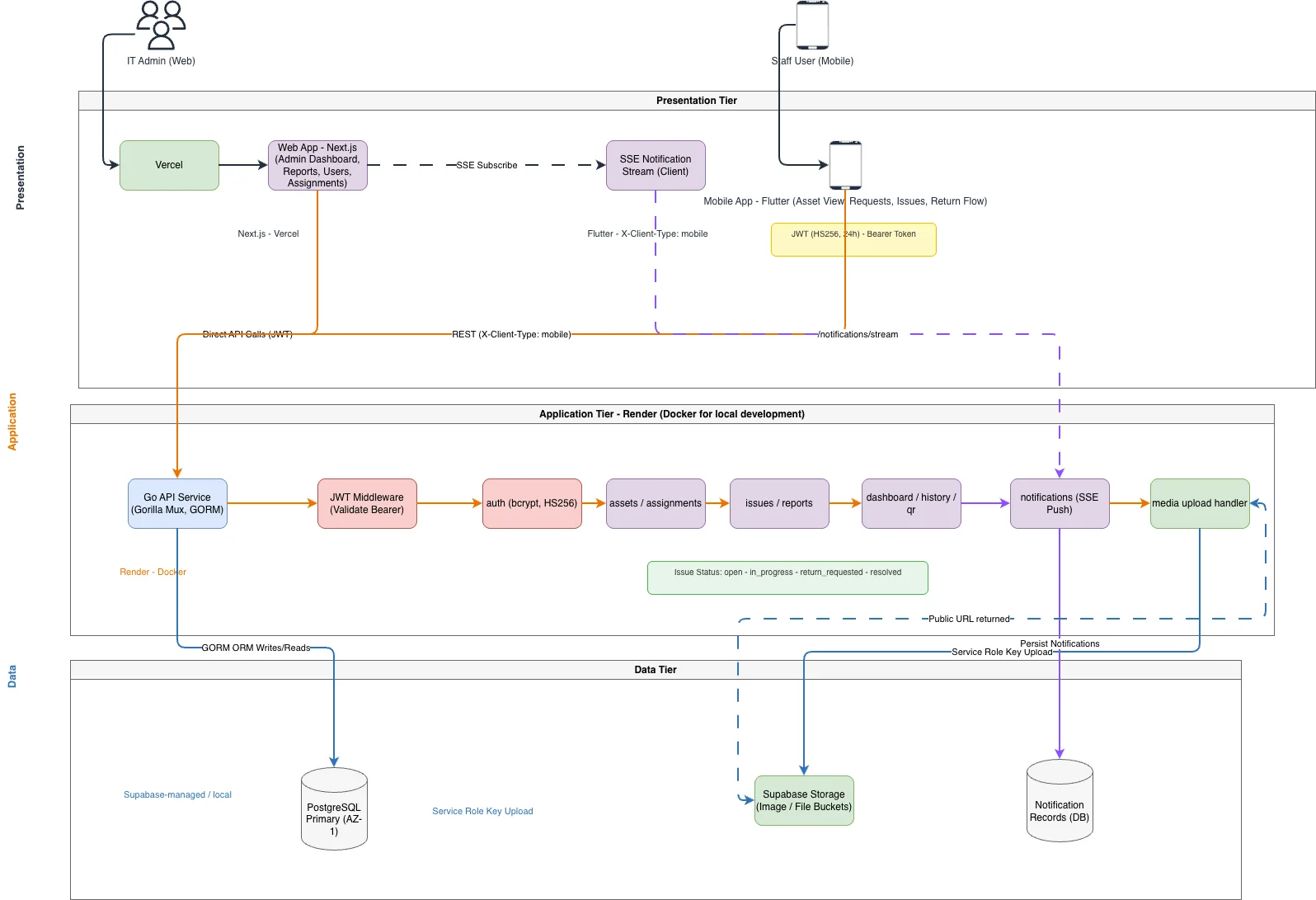
MIRA - Web, Mobile, API and Supabase Architecture

MULTIArchitectureadvanced
MIRA - Web, Mobile, API and Supabase Architecture — MULTI architecture diagram

About This Architecture

MIRA is a three-tier asset management platform combining a Next.js admin dashboard, Flutter mobile app, and Go API backend with JWT authentication and real-time SSE notifications. IT admins access the web interface through Netlify CDN/WAF, while field staff use the Flutter mobile app to manage assets, requests, and issues—both clients authenticate via HS256 JWT tokens and communicate with a Gorilla Mux Go service. The Go API validates bearer tokens, orchestrates CRUD operations across PostgreSQL, and streams notifications via SSE, with media uploads handled through Supabase Storage buckets. This architecture demonstrates a production-ready pattern for cross-platform apps requiring real-time collaboration, role-based access, and secure file handling. Fork this diagram on Diagrams.so to customize authentication flows, add additional microservices, or adapt the notification layer for your team's requirements.

People also ask

How do you architect a multi-platform asset management system with Next.js, Flutter, and Go that includes real-time notifications and secure file uploads?

MIRA demonstrates a production architecture where a Next.js admin dashboard and Flutter mobile app both authenticate via JWT bearer tokens to a Go API service (Gorilla Mux + GORM), which validates requests through JWT middleware and manages assets, issues, and notifications in PostgreSQL. Real-time updates flow via SSE push notifications, while media uploads are securely handled through Supabase S

Next.jsFlutterGoSupabaseJWT authenticationSSE notifications
Domain:
Cloud Multi
Audience:
Full-stack engineers building multi-platform asset management systems with Next.js, Flutter, and Go

Generated by Diagrams.so — AI architecture diagram generator with native Draw.io output. Fork this diagram, remix it, or download as .drawio, PNG, or SVG.

Generate your own architecture diagram →

About This Architecture

MIRA is a three-tier asset management platform combining a Next.js admin dashboard, Flutter mobile app, and Go API backend with JWT authentication and real-time SSE notifications. IT admins access the web interface through Netlify CDN/WAF, while field staff use the Flutter mobile app to manage assets, requests, and issues—both clients authenticate via HS256 JWT tokens and communicate with a Gorilla Mux Go service. The Go API validates bearer tokens, orchestrates CRUD operations across PostgreSQL, and streams notifications via SSE, with media uploads handled through Supabase Storage buckets. This architecture demonstrates a production-ready pattern for cross-platform apps requiring real-time collaboration, role-based access, and secure file handling. Fork this diagram on Diagrams.so to customize authentication flows, add additional microservices, or adapt the notification layer for your team's requirements.

People also ask

How do you architect a multi-platform asset management system with Next.js, Flutter, and Go that includes real-time notifications and secure file uploads?

MIRA demonstrates a production architecture where a Next.js admin dashboard and Flutter mobile app both authenticate via JWT bearer tokens to a Go API service (Gorilla Mux + GORM), which validates requests through JWT middleware and manages assets, issues, and notifications in PostgreSQL. Real-time updates flow via SSE push notifications, while media uploads are securely handled through Supabase S

MIRA - Web, Mobile, API and Supabase Architecture

MultiadvancedNext.jsFlutterGoSupabaseJWT authenticationSSE notifications
Domain: Cloud MultiAudience: Full-stack engineers building multi-platform asset management systems with Next.js, Flutter, and Go
0 views0 favoritesPublic

Created by

April 21, 2026

Updated

April 21, 2026 at 7:55 AM

Type

architecture

Need a custom architecture diagram?

Describe your architecture in plain English and get a production-ready Draw.io diagram in seconds. Works for AWS, Azure, GCP, Kubernetes, and more.

Generate with AI