Library System Mind Map

AWSArchitecturesimple
Library System Mind Map — AWS architecture diagram

About This Architecture

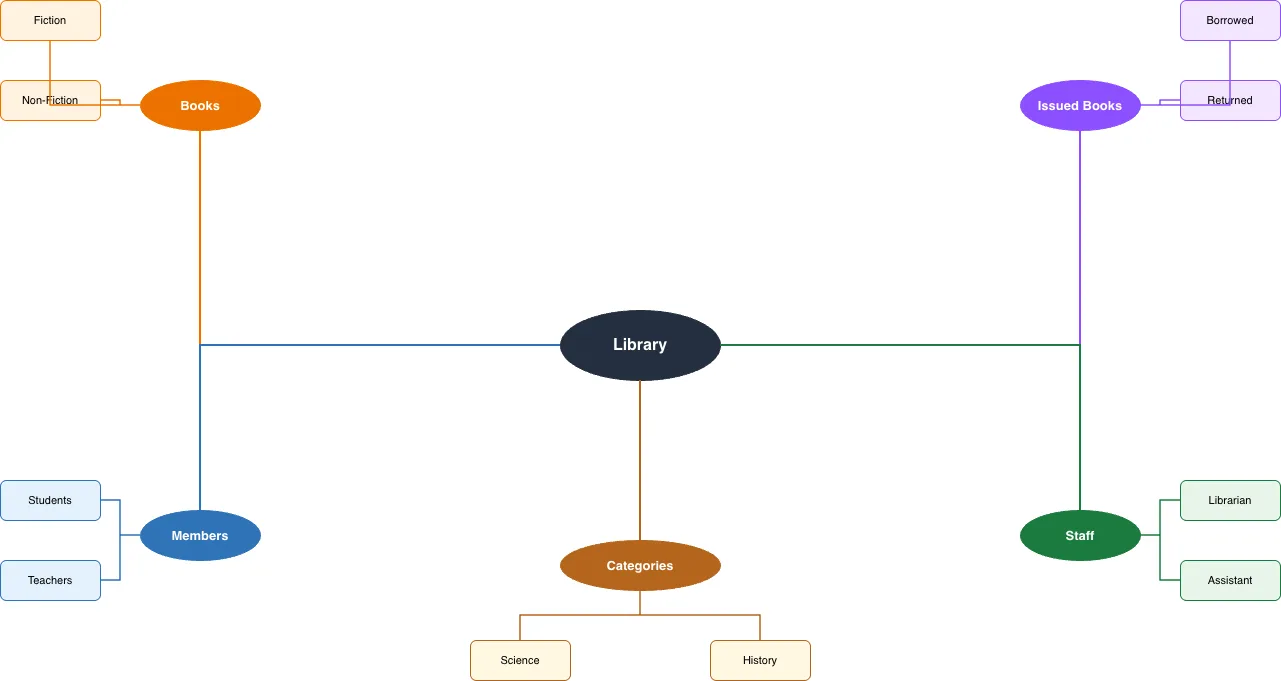
Library management system mind map organizing core entities: Library as the root node branches into Books, Members, Issued Books, Staff, and Categories. Books subdivide into Fiction and Non-Fiction; Members into Students and Teachers; Issued Books into Borrowed and Returned states; Staff into Librarian and Assistant roles; Categories into Science and History. This hierarchical structure demonstrates entity relationships and organizational logic essential for building scalable library platforms. Fork this diagram on Diagrams.so to customize for your institution's specific workflows, add additional member types, or extend category taxonomies. The mind map serves as a blueprint for database schema design, API endpoints, and user role management in library management applications.

People also ask

What are the core components and relationships in a library management system architecture?

A library system mind map organizes five primary entities: Books (Fiction/Non-Fiction), Members (Students/Teachers), Issued Books (Borrowed/Returned states), Staff (Librarian/Assistant), and Categories (Science/History). This hierarchical structure clarifies entity relationships and data flows essential for designing databases, APIs, and user management workflows in library platforms.

library-managementsystem-architecturemind-mapdatabase-designentity-relationshipssoftware-design
Domain:
Software Architecture
Audience:
software architects designing library management systems

Generated by Diagrams.so — AI architecture diagram generator with native Draw.io output. Fork this diagram, remix it, or download as .drawio, PNG, or SVG.

Generate your own architecture diagram →

About This Architecture

Library management system mind map organizing core entities: Library as the root node branches into Books, Members, Issued Books, Staff, and Categories. Books subdivide into Fiction and Non-Fiction; Members into Students and Teachers; Issued Books into Borrowed and Returned states; Staff into Librarian and Assistant roles; Categories into Science and History. This hierarchical structure demonstrates entity relationships and organizational logic essential for building scalable library platforms. Fork this diagram on Diagrams.so to customize for your institution's specific workflows, add additional member types, or extend category taxonomies. The mind map serves as a blueprint for database schema design, API endpoints, and user role management in library management applications.

People also ask

What are the core components and relationships in a library management system architecture?

A library system mind map organizes five primary entities: Books (Fiction/Non-Fiction), Members (Students/Teachers), Issued Books (Borrowed/Returned states), Staff (Librarian/Assistant), and Categories (Science/History). This hierarchical structure clarifies entity relationships and data flows essential for designing databases, APIs, and user management workflows in library platforms.

Library System Mind Map

AWSsimplelibrary-managementsystem-architecturemind-mapdatabase-designentity-relationshipssoftware-design
Domain: Software ArchitectureAudience: software architects designing library management systems
0 views0 favoritesPublic

Created by

May 4, 2026

Updated

May 4, 2026 at 8:39 PM

Type

architecture

Need a custom architecture diagram?

Describe your architecture in plain English and get a production-ready Draw.io diagram in seconds. Works for AWS, Azure, GCP, Kubernetes, and more.

Generate with AI