Hospital Management System Architecture

GENERALArchitectureadvanced
Hospital Management System Architecture — GENERAL architecture diagram

About This Architecture

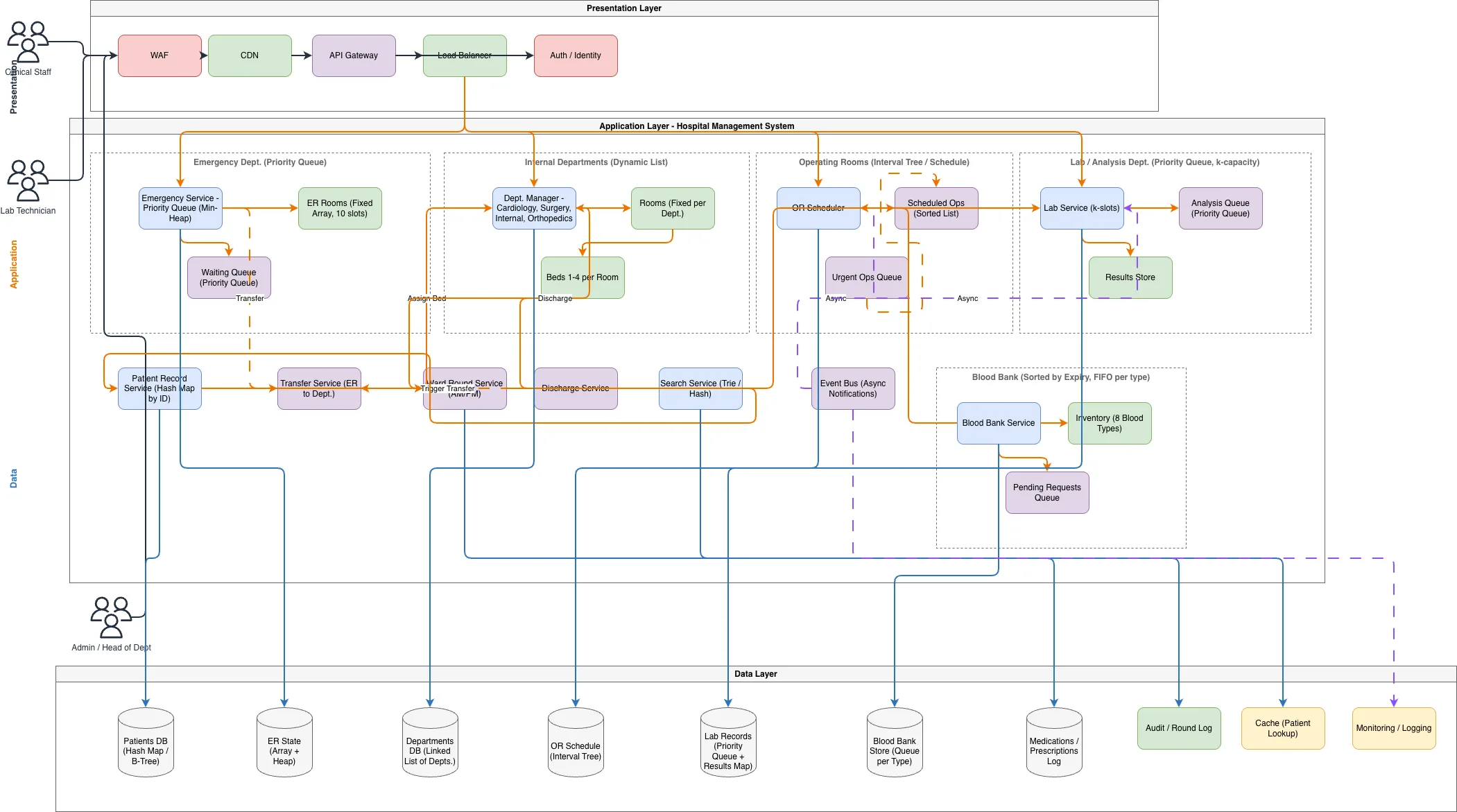
Hospital Management System architecture integrates clinical workflows across Emergency, Departments, Operating Rooms, and Lab services using priority queues, interval trees, and hash maps for efficient patient routing and resource allocation. Clinical Staff, Admin, and Lab Technicians authenticate via WAF and API Gateway, then route through Load Balancer to specialized services: Emergency Service manages triage with min-heap priority queues and ER room allocation, Department Managers oversee Cardiology, Surgery, Internal, and Orthopedics with fixed bed assignments, OR Scheduler maintains operating room schedules via interval trees, and Lab Service processes analysis requests with k-capacity slots. Patient records, ER state, department databases, and blood bank inventory are persisted in the Data Layer using hash maps, B-trees, linked lists, and type-specific queues, with caching and audit logging for compliance. This architecture demonstrates how data structures (priority queues, tries, interval trees) optimize real-time clinical decision-making, reduce patient wait times, and ensure resource utilization across a multi-department hospital. Fork this diagram on Diagrams.so to customize department configurations, adjust queue capacities, or integrate additional clinical services like pharmacy or radiology. The design balances immediate emergency response with scheduled procedures, making it ideal for mid-to-large hospitals managing complex patient flows.

People also ask

How should a hospital management system architecture handle emergency triage, department workflows, and operating room scheduling simultaneously?

This diagram shows a layered hospital architecture where Emergency Service uses min-heap priority queues for triage, Department Managers oversee bed allocation across Cardiology, Surgery, Internal, and Orthopedics, and OR Scheduler manages operating room availability via interval trees. The API Gateway and Load Balancer distribute requests from Clinical Staff, Admin, and Lab Technicians to special

healthcare-ithospital-managementsystem-architectureclinical-workflowssoftware-design
Domain:
Software Architecture
Audience:
Healthcare IT architects designing hospital management systems

Generated by Diagrams.so — AI architecture diagram generator with native Draw.io output. Fork this diagram, remix it, or download as .drawio, PNG, or SVG.

Generate your own architecture diagram →

About This Architecture

Hospital Management System architecture integrates clinical workflows across Emergency, Departments, Operating Rooms, and Lab services using priority queues, interval trees, and hash maps for efficient patient routing and resource allocation. Clinical Staff, Admin, and Lab Technicians authenticate via WAF and API Gateway, then route through Load Balancer to specialized services: Emergency Service manages triage with min-heap priority queues and ER room allocation, Department Managers oversee Cardiology, Surgery, Internal, and Orthopedics with fixed bed assignments, OR Scheduler maintains operating room schedules via interval trees, and Lab Service processes analysis requests with k-capacity slots. Patient records, ER state, department databases, and blood bank inventory are persisted in the Data Layer using hash maps, B-trees, linked lists, and type-specific queues, with caching and audit logging for compliance. This architecture demonstrates how data structures (priority queues, tries, interval trees) optimize real-time clinical decision-making, reduce patient wait times, and ensure resource utilization across a multi-department hospital. Fork this diagram on Diagrams.so to customize department configurations, adjust queue capacities, or integrate additional clinical services like pharmacy or radiology. The design balances immediate emergency response with scheduled procedures, making it ideal for mid-to-large hospitals managing complex patient flows.

People also ask

How should a hospital management system architecture handle emergency triage, department workflows, and operating room scheduling simultaneously?

This diagram shows a layered hospital architecture where Emergency Service uses min-heap priority queues for triage, Department Managers oversee bed allocation across Cardiology, Surgery, Internal, and Orthopedics, and OR Scheduler manages operating room availability via interval trees. The API Gateway and Load Balancer distribute requests from Clinical Staff, Admin, and Lab Technicians to special

Hospital Management System Architecture

Autoadvancedhealthcare-ithospital-managementsystem-architectureclinical-workflowssoftware-design
Domain: Software ArchitectureAudience: Healthcare IT architects designing hospital management systems
0 views0 favoritesPublic

Created by

May 20, 2026

Updated

May 20, 2026 at 11:21 AM

Type

architecture

Need a custom architecture diagram?

Describe your architecture in plain English and get a production-ready Draw.io diagram in seconds. Works for AWS, Azure, GCP, Kubernetes, and more.

Generate with AI