GKE Node Pool Architecture — Zone Layout per Env

GCPArchitectureintermediate
GKE Node Pool Architecture — Zone Layout per Env — GCP architecture diagram

About This Architecture

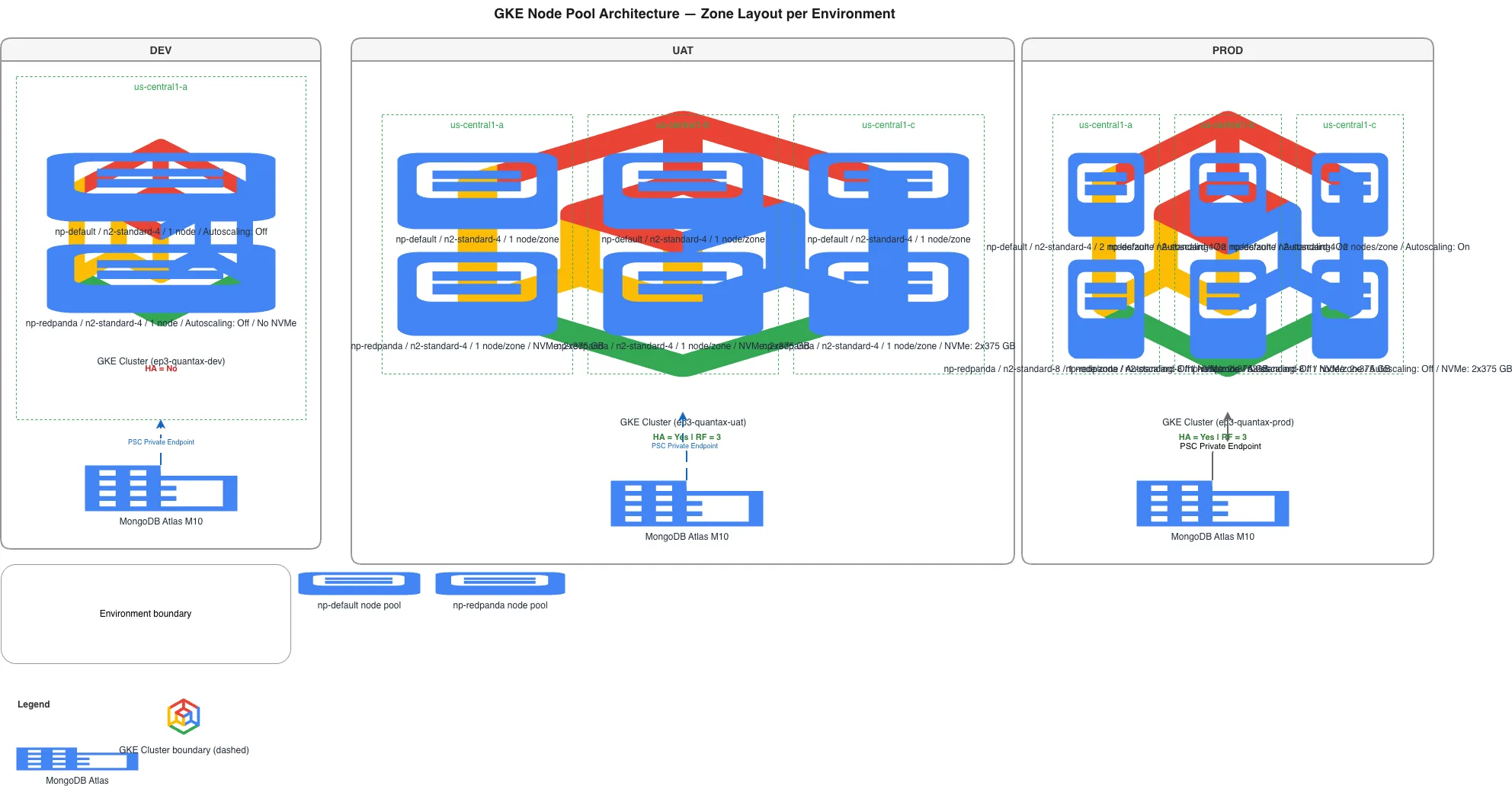
Multi-environment GKE node pool architecture spanning DEV, UAT, and PROD with zone-distributed deployments across us-central1. DEV runs single-zone, single-node pools (np-default, np-redpanda) with autoscaling disabled, while UAT and PROD scale across three zones (a, b, c) with HA-enabled Redpanda clusters (RF=3) and MongoDB Atlas M10 backends. PROD differentiates with n2-standard-8 nodes, autoscaling on np-default, and NVMe storage for Redpanda stateful workloads. This architecture demonstrates progressive resilience: DEV prioritizes cost, UAT validates HA patterns, and PROD enforces multi-zone redundancy with compute autoscaling for variable load. Fork and customize this diagram on Diagrams.so to model your own environment-specific node pool strategies, storage configurations, and scaling policies.

People also ask

How should I structure GKE node pools across multiple zones for high availability in production while keeping development costs low?

This diagram shows a progressive HA strategy: DEV uses single-zone, single-node pools with autoscaling off for cost efficiency; UAT and PROD span three zones (us-central1-a/b/c) with Redpanda RF=3 for data redundancy and MongoDB Atlas M10 for managed databases. PROD adds n2-standard-8 nodes with autoscaling enabled on np-default to handle variable workloads while keeping Redpanda nodes fixed for p

GKEKubernetesGCPnode-poolshigh-availabilitymulti-zone
Domain:
Kubernetes
Audience:
GKE cluster administrators and platform engineers managing multi-environment Kubernetes deployments

Generated by Diagrams.so — AI architecture diagram generator with native Draw.io output. Fork this diagram, remix it, or download as .drawio, PNG, or SVG.

Generate your own architecture diagram →

About This Architecture

Multi-environment GKE node pool architecture spanning DEV, UAT, and PROD with zone-distributed deployments across us-central1. DEV runs single-zone, single-node pools (np-default, np-redpanda) with autoscaling disabled, while UAT and PROD scale across three zones (a, b, c) with HA-enabled Redpanda clusters (RF=3) and MongoDB Atlas M10 backends. PROD differentiates with n2-standard-8 nodes, autoscaling on np-default, and NVMe storage for Redpanda stateful workloads. This architecture demonstrates progressive resilience: DEV prioritizes cost, UAT validates HA patterns, and PROD enforces multi-zone redundancy with compute autoscaling for variable load. Fork and customize this diagram on Diagrams.so to model your own environment-specific node pool strategies, storage configurations, and scaling policies.

People also ask

How should I structure GKE node pools across multiple zones for high availability in production while keeping development costs low?

This diagram shows a progressive HA strategy: DEV uses single-zone, single-node pools with autoscaling off for cost efficiency; UAT and PROD span three zones (us-central1-a/b/c) with Redpanda RF=3 for data redundancy and MongoDB Atlas M10 for managed databases. PROD adds n2-standard-8 nodes with autoscaling enabled on np-default to handle variable workloads while keeping Redpanda nodes fixed for p

GKE Node Pool Architecture — Zone Layout per Env

GCPintermediateGKEKubernetesnode-poolshigh-availabilitymulti-zone
Domain: KubernetesAudience: GKE cluster administrators and platform engineers managing multi-environment Kubernetes deployments
0 views0 favoritesPublic

Created by

May 7, 2026

Updated

May 7, 2026 at 7:35 PM

Type

architecture

Need a custom architecture diagram?

Describe your architecture in plain English and get a production-ready Draw.io diagram in seconds. Works for AWS, Azure, GCP, Kubernetes, and more.

Generate with AI