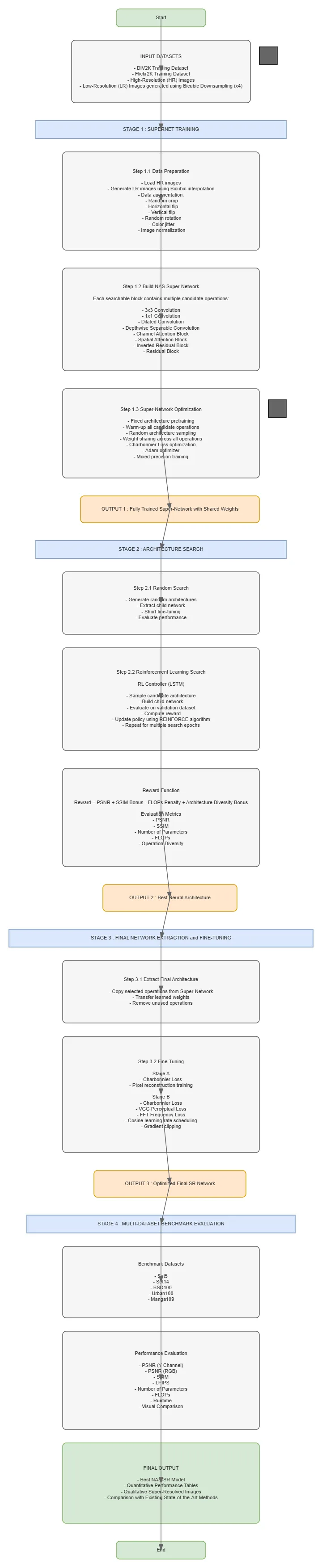
End-to-End NAS-SR Methodology Flowchart
About This Architecture
End-to-end NAS-SR methodology orchestrates four stages: supernet training on DIV2K and Flickr2K datasets, architecture search via random sampling and reinforcement learning with PSNR/SSIM rewards, final network extraction and fine-tuning with Charbonnier loss, and multi-dataset benchmark evaluation on Set5, Set14, BSD100, Urban100, and Manga109. The pipeline leverages shared weights across searchable blocks to reduce computational overhead while exploring candidate architectures. This approach balances image quality metrics (PSNR, SSIM, LPIPS) against FLOPs penalties and architectural diversity, enabling practitioners to discover efficient super-resolution models without exhaustive training. Fork and customize this flowchart to adapt the search space, reward function, or benchmark datasets for your specific super-resolution task.
People also ask
What is the complete workflow for neural architecture search in image super-resolution, and how do you balance PSNR/SSIM metrics against computational efficiency?
The NAS-SR methodology spans four stages: supernet training on DIV2K and Flickr2K, RL-based architecture search with PSNR/SSIM rewards and FLOPs penalties, fine-tuning the selected architecture with Charbonnier loss, and evaluation on Set5, Set14, BSD100, Urban100, and Manga109. This diagram shows how shared weights reduce search cost while the reward function balances image quality against model
- Domain:
- Ml Pipeline
- Audience:
- Machine learning engineers designing neural architecture search pipelines for image super-resolution
Generated by Diagrams.so — AI architecture diagram generator with native Draw.io output. Fork this diagram, remix it, or download as .drawio, PNG, or SVG.