E-Commerce Database ER Diagram — OCI architecture diagram

About This Architecture

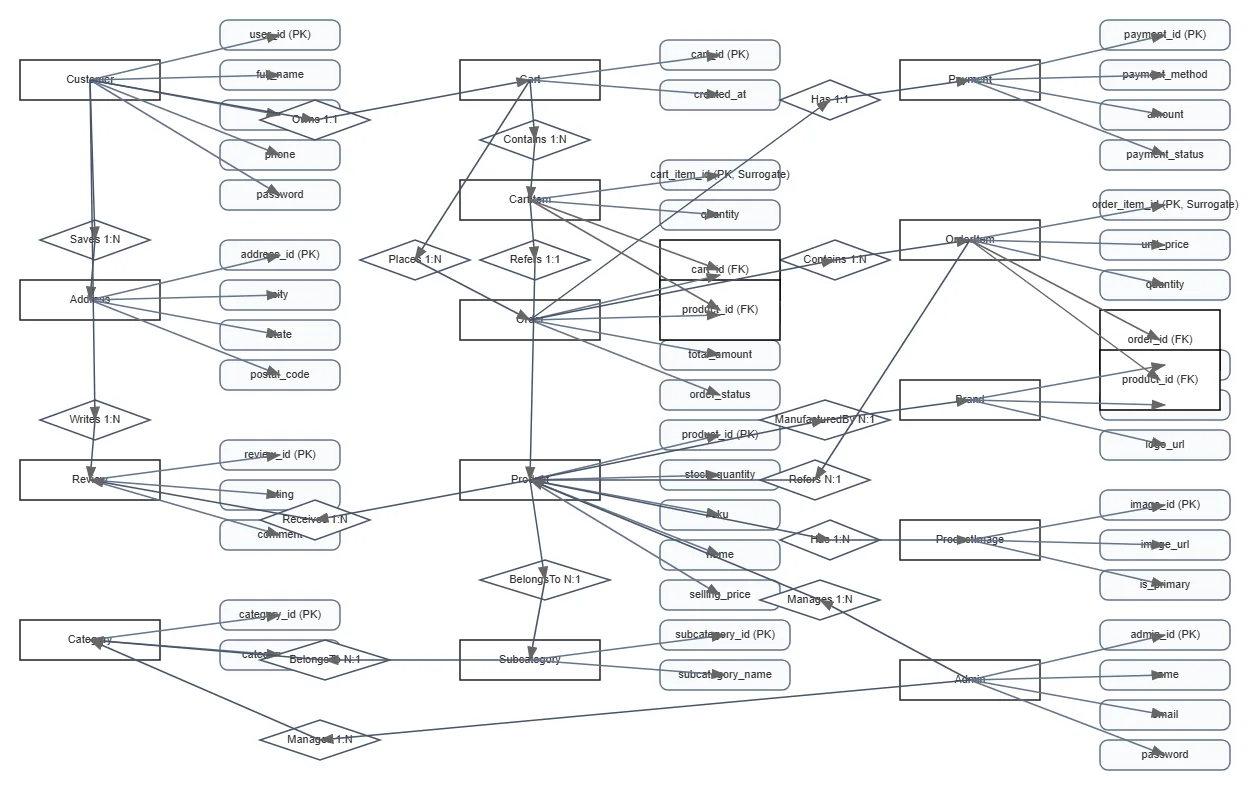
Normalized e-commerce relational database schema with Customer, Product, Order, and Payment entities connected through carefully designed foreign keys and cardinality constraints. Data flows from Customer through Cart and CartItem to Order and OrderItem, with Products linked via Category, Subcategory, and Brand hierarchies, while Payments and Reviews attach to Orders and Products respectively. This schema enforces referential integrity, eliminates data redundancy, and supports complex queries for inventory, order fulfillment, and customer analytics on OCI databases. Fork this diagram on Diagrams.so to customize table structures, add indexes, or adapt it for your e-commerce platform's specific requirements. Consider partitioning Orders and OrderItems by date and denormalizing frequently-joined views for reporting workloads.

People also ask

What does a normalized e-commerce database schema look like with customers, products, orders, and payments?

This ER diagram shows a normalized e-commerce schema where Customer entities place Orders containing OrderItems linked to Products, with Cart and CartItem entities for shopping workflows, Payment records for transactions, Reviews for product feedback, and Brand/Category/Subcategory hierarchies for product organization. All relationships enforce cardinality constraints (1:N, N:1, 1:1) to maintain d

E-Commerce Database ER Diagram

OCIintermediatedatabase-designER-diagrame-commercerelational-schemanormalization
Domain: Data EngineeringAudience: Database architects and e-commerce platform engineers designing normalized relational schemas on OCI
1 views0 favoritesPublic

Created by

August 9, 2026

Updated

August 12, 2026 at 10:50 PM

Type

flowchart

Need a custom architecture diagram?

Describe your architecture in plain English and get a production-ready Draw.io diagram in seconds. Works for AWS, Azure, GCP, Kubernetes, and more.

Generate with AI

AI-generated. Verify before production use. Learn more

Report this diagram