
About This Architecture
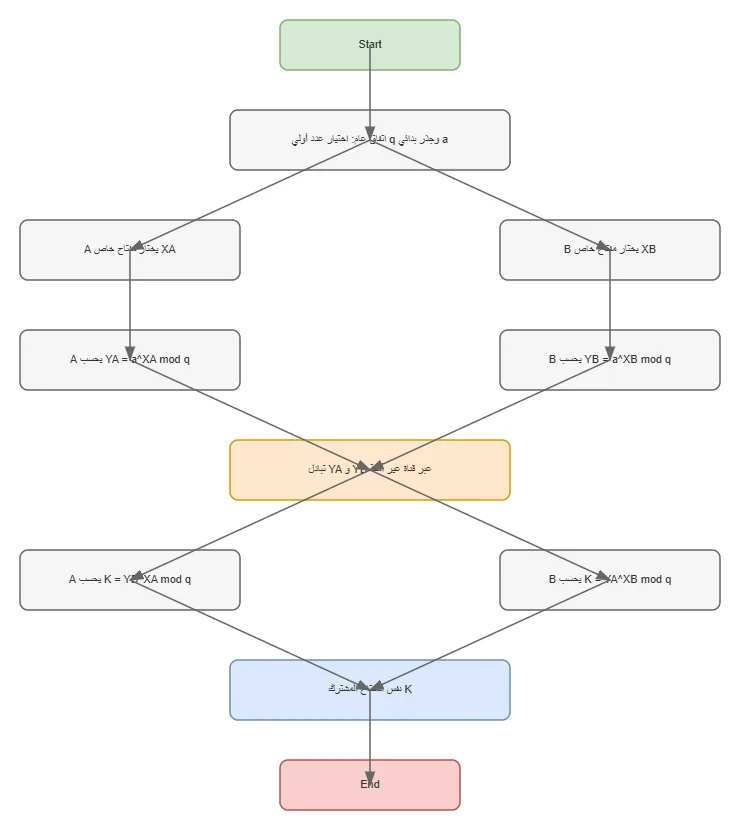
Diffie-Hellman key exchange is a foundational cryptographic protocol enabling two parties to establish a shared secret over an insecure channel without prior communication. Party A and B each select private keys (XA, XB), compute public values (YA, YB) using modular exponentiation with a shared prime q and primitive root a, then exchange these public values. Both parties independently compute the identical shared key K using their private key and the received public value, leveraging the mathematical property that a^(XA·XB) mod q yields the same result regardless of computation order. This protocol solves the key distribution problem in symmetric cryptography and forms the basis for modern protocols like TLS and IPsec. Fork this diagram on Diagrams.so to customize parameters, add attack scenarios, or integrate into security training materials.