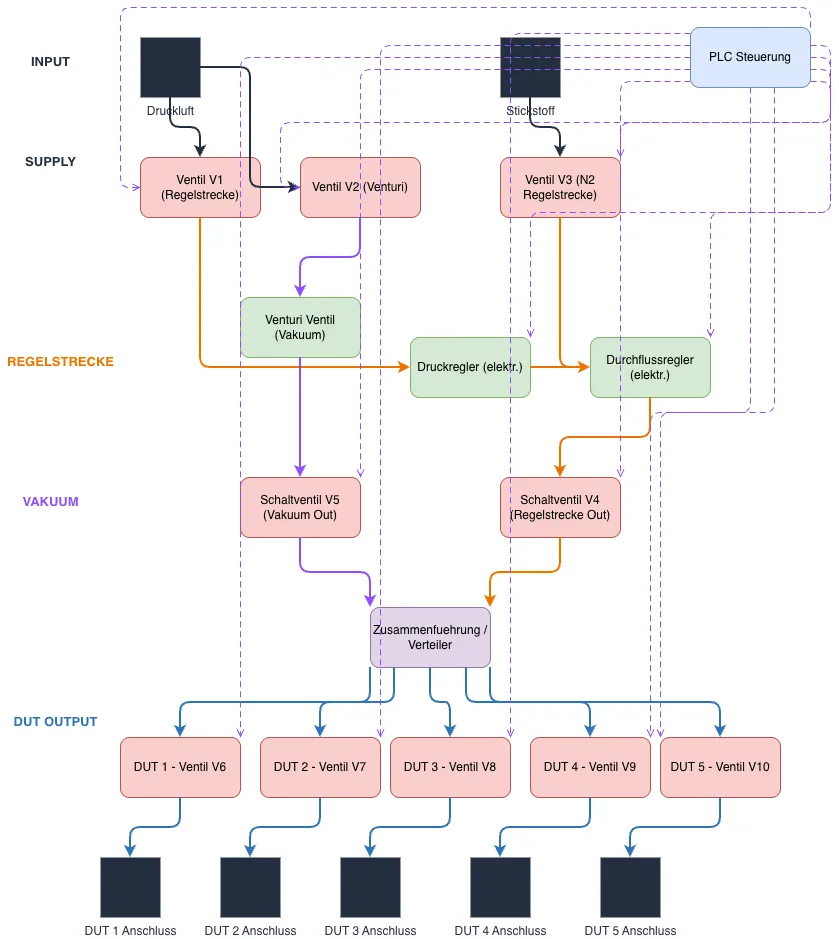
Dichteprüfvorrichtung - SPS-gesteuert architecture diagram

About This Architecture

PLC-controlled density test apparatus with dual pneumatic supply paths: compressed air through pressure regulation and nitrogen through flow control, converging at a manifold to feed five parallel test ports via solenoid valves. The system integrates a Venturi vacuum generator for negative pressure testing, with all pneumatic components—V1 through V10 solenoid valves, electronic pressure and flow regulators—orchestrated by a central PLC controller. This architecture enables simultaneous multi-unit leak detection with independent pressure and vacuum control, critical for high-throughput manufacturing test environments. Fork this diagram on Diagrams.so to customize valve counts, add sensor feedback loops, or integrate data logging interfaces. The modular manifold design allows scaling from 5 to N test ports without redesigning core pneumatic logic.

People also ask

How do I design a PLC-controlled pneumatic leak test system with multiple test ports and independent pressure and vacuum control?

This diagram shows a complete PLC-controlled architecture using compressed air and nitrogen supplies, electronic pressure and flow regulators, a Venturi vacuum generator, and five parallel solenoid valves (V6–V10) feeding independent test ports. The PLC orchestrates all pneumatic components, enabling simultaneous multi-unit leak detection with separate positive and negative pressure paths.

Dichteprüfvorrichtung - SPS-gesteuert

Autoadvancedpneumatic-systemsPLC-controlleak-testingsolenoid-valvesmanufacturing-automationmechanical-engineering
Domain: Mechanical EngineeringAudience: mechanical engineers and test technicians designing PLC-controlled pneumatic leak test systems
0 views0 favoritesPublic

Created by

April 30, 2026

Updated

June 17, 2026 at 10:17 AM

Type

architecture

Need a custom architecture diagram?

Describe your architecture in plain English and get a production-ready Draw.io diagram in seconds. Works for AWS, Azure, GCP, Kubernetes, and more.

Generate with AI