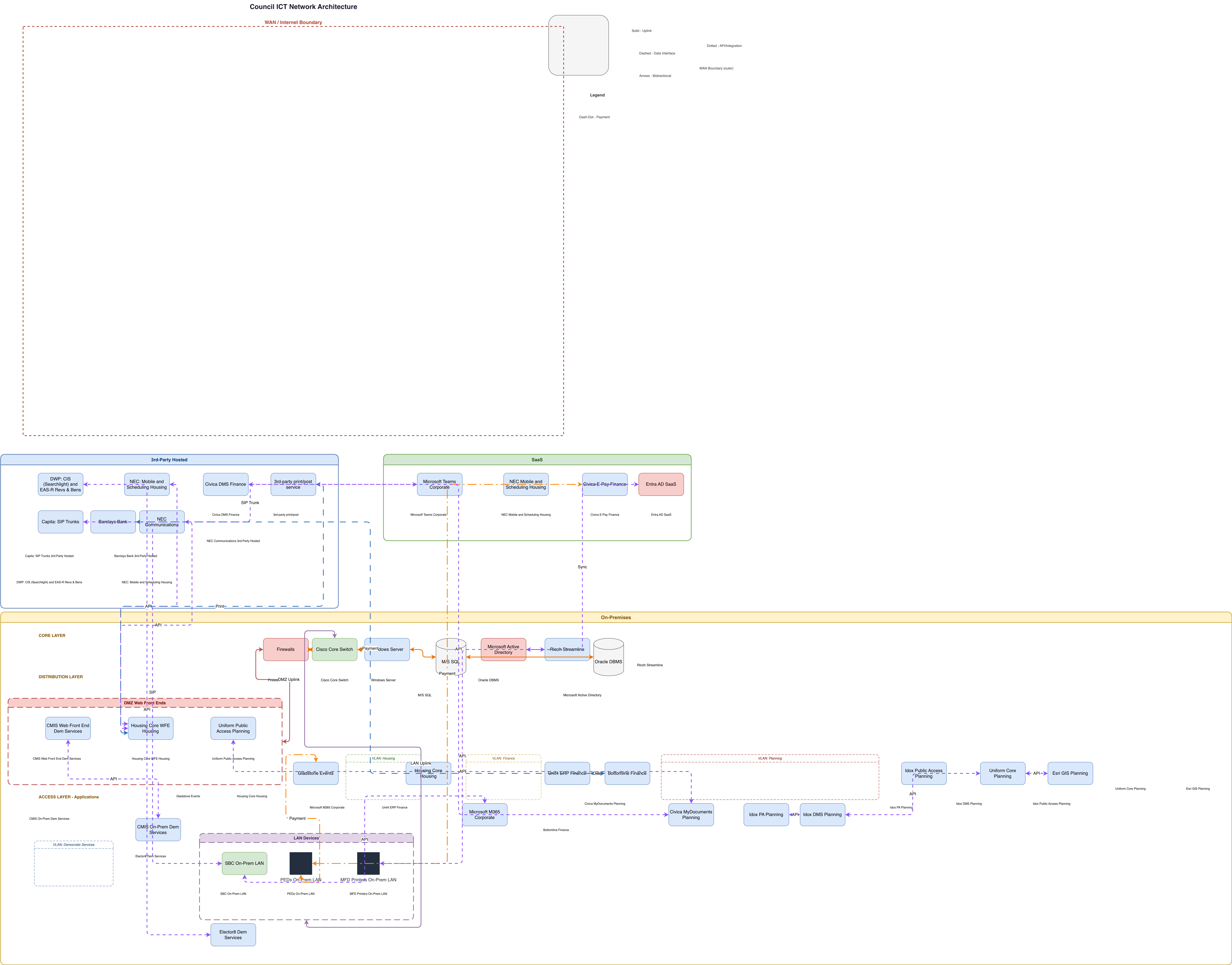
Council ICT Network Architecture
About This Architecture
Council ICT Network Architecture integrates on-premises core infrastructure with third-party SaaS and hosted services across democratic services, housing, finance, and planning domains. The three-layer design—core firewalls and switches, DMZ web front ends, and access-layer applications—separates trust boundaries using VLANs and connection types (uplinks, data interfaces, APIs, payment channels). This architecture demonstrates how councils balance legacy systems like Oracle DBMS and Microsoft Active Directory with modern cloud services including Microsoft Teams, Entra AD, and Civica E-Pay. Fork this diagram on Diagrams.so to customize for your council's specific applications, third-party integrations, or security policies. The legend-driven connection types enable clear documentation of data flows and compliance requirements across public-sector workloads.
People also ask
How should a local council design a network architecture that integrates legacy on-premises systems with modern cloud services while maintaining security boundaries?
This council ICT network architecture uses a three-layer design with firewalls and core switches protecting legacy systems (Oracle DBMS, Active Directory), a DMZ hosting web front ends for public-facing services, and access-layer applications segmented by VLAN. Connection types—solid uplinks, dashed data interfaces, dotted APIs, and dash-dot payment channels—clearly document trust boundaries and c
- Domain:
- Networking
- Audience:
- Local government IT architects and network engineers designing council ICT infrastructure
Generated by Diagrams.so — AI architecture diagram generator with native Draw.io output. Fork this diagram, remix it, or download as .drawio, PNG, or SVG.