Cloudflare vs Akamai WAF and CDN to AWS API

AWSMicroservicesadvanced
Cloudflare vs Akamai WAF and CDN to AWS API — AWS microservices diagram

About This Architecture

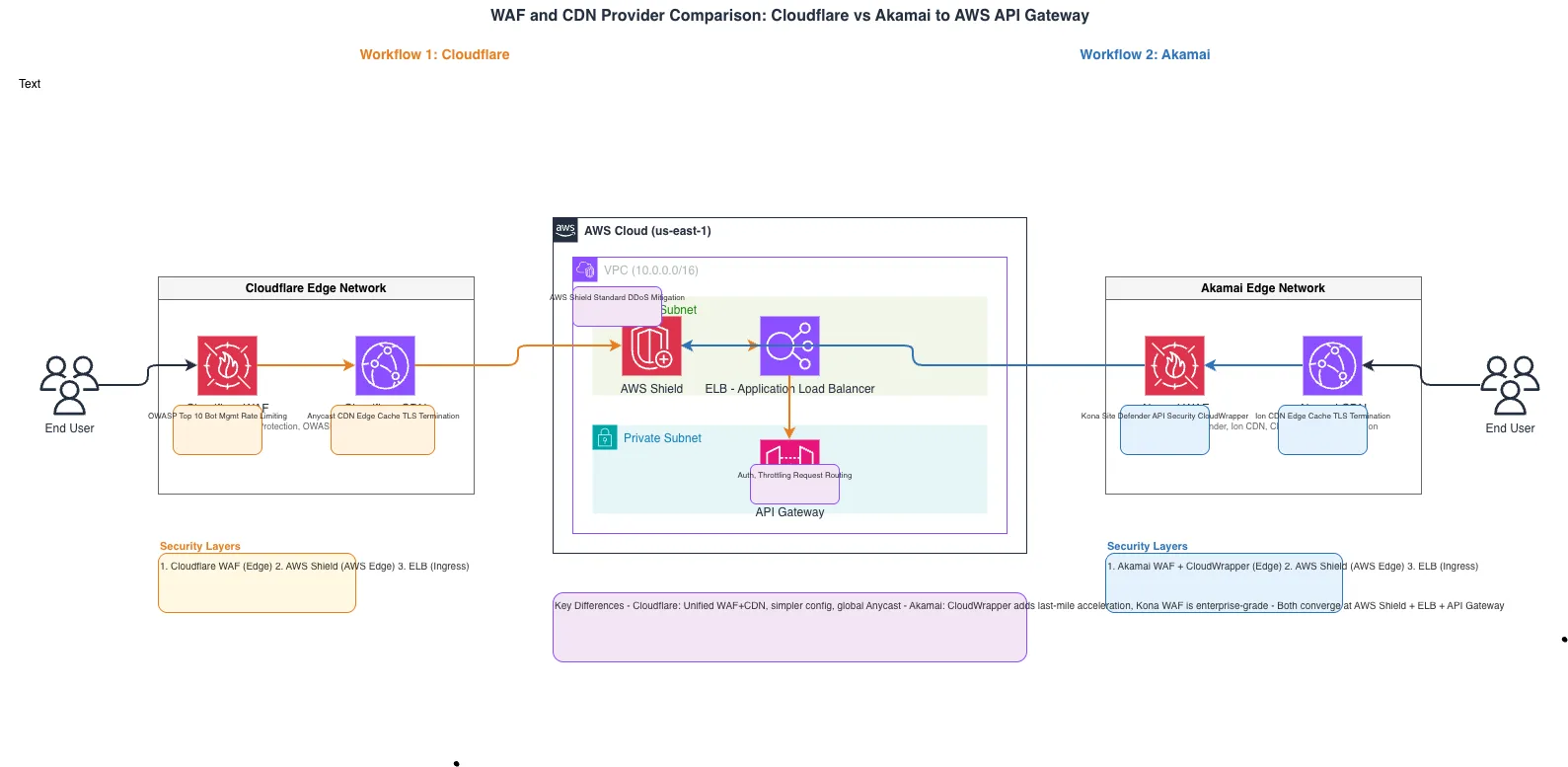
Cloudflare vs Akamai WAF and CDN comparison routing traffic through AWS API Gateway shows two distinct edge security architectures. Cloudflare delivers unified WAF, CDN, and DDoS protection via global Anycast edge, while Akamai layers Kona Site Defender WAF with Ion CDN and CloudWrapper acceleration before reaching AWS Shield and Application Load Balancer. Both workflows converge at AWS Shield Standard and ELB ingress, demonstrating defense-in-depth with Layer 7 OWASP rule enforcement, bot management, and rate limiting at the edge. Choose this diagram to fork and customize for your edge security strategy, comparing unified versus modular WAF-CDN architectures. Cloudflare's simpler configuration suits rapid deployments; Akamai's specialized modules appeal to enterprises requiring granular API security and acceleration tuning.

People also ask

Should I use Cloudflare or Akamai WAF and CDN in front of my AWS API Gateway?

This diagram compares Cloudflare's unified WAF-CDN-DDoS edge architecture via global Anycast against Akamai's modular approach using Kona Site Defender, Ion CDN, and CloudWrapper. Both route through AWS Shield and ELB; Cloudflare offers simpler configuration and faster deployment, while Akamai provides specialized API security and granular acceleration tuning for enterprise requirements.

AWSCloudflareAkamaiWAFCDNAPI Gateway
Domain:
Cloud Aws
Audience:
AWS solutions architects evaluating WAF and CDN providers for API protection

Generated by Diagrams.so — AI architecture diagram generator with native Draw.io output. Fork this diagram, remix it, or download as .drawio, PNG, or SVG.

Generate your own microservices diagram →

About This Architecture

Cloudflare vs Akamai WAF and CDN comparison routing traffic through AWS API Gateway shows two distinct edge security architectures. Cloudflare delivers unified WAF, CDN, and DDoS protection via global Anycast edge, while Akamai layers Kona Site Defender WAF with Ion CDN and CloudWrapper acceleration before reaching AWS Shield and Application Load Balancer. Both workflows converge at AWS Shield Standard and ELB ingress, demonstrating defense-in-depth with Layer 7 OWASP rule enforcement, bot management, and rate limiting at the edge. Choose this diagram to fork and customize for your edge security strategy, comparing unified versus modular WAF-CDN architectures. Cloudflare's simpler configuration suits rapid deployments; Akamai's specialized modules appeal to enterprises requiring granular API security and acceleration tuning.

People also ask

Should I use Cloudflare or Akamai WAF and CDN in front of my AWS API Gateway?

This diagram compares Cloudflare's unified WAF-CDN-DDoS edge architecture via global Anycast against Akamai's modular approach using Kona Site Defender, Ion CDN, and CloudWrapper. Both route through AWS Shield and ELB; Cloudflare offers simpler configuration and faster deployment, while Akamai provides specialized API security and granular acceleration tuning for enterprise requirements.

Cloudflare vs Akamai WAF and CDN to AWS API

AWSadvancedCloudflareAkamaiWAFCDNAPI Gateway
Domain: Cloud AwsAudience: AWS solutions architects evaluating WAF and CDN providers for API protection
0 views0 favoritesPublic

Created by

May 5, 2026

Updated

May 5, 2026 at 5:10 AM

Type

microservices

Need a custom architecture diagram?

Describe your architecture in plain English and get a production-ready Draw.io diagram in seconds. Works for AWS, Azure, GCP, Kubernetes, and more.

Generate with AI