
About This Architecture
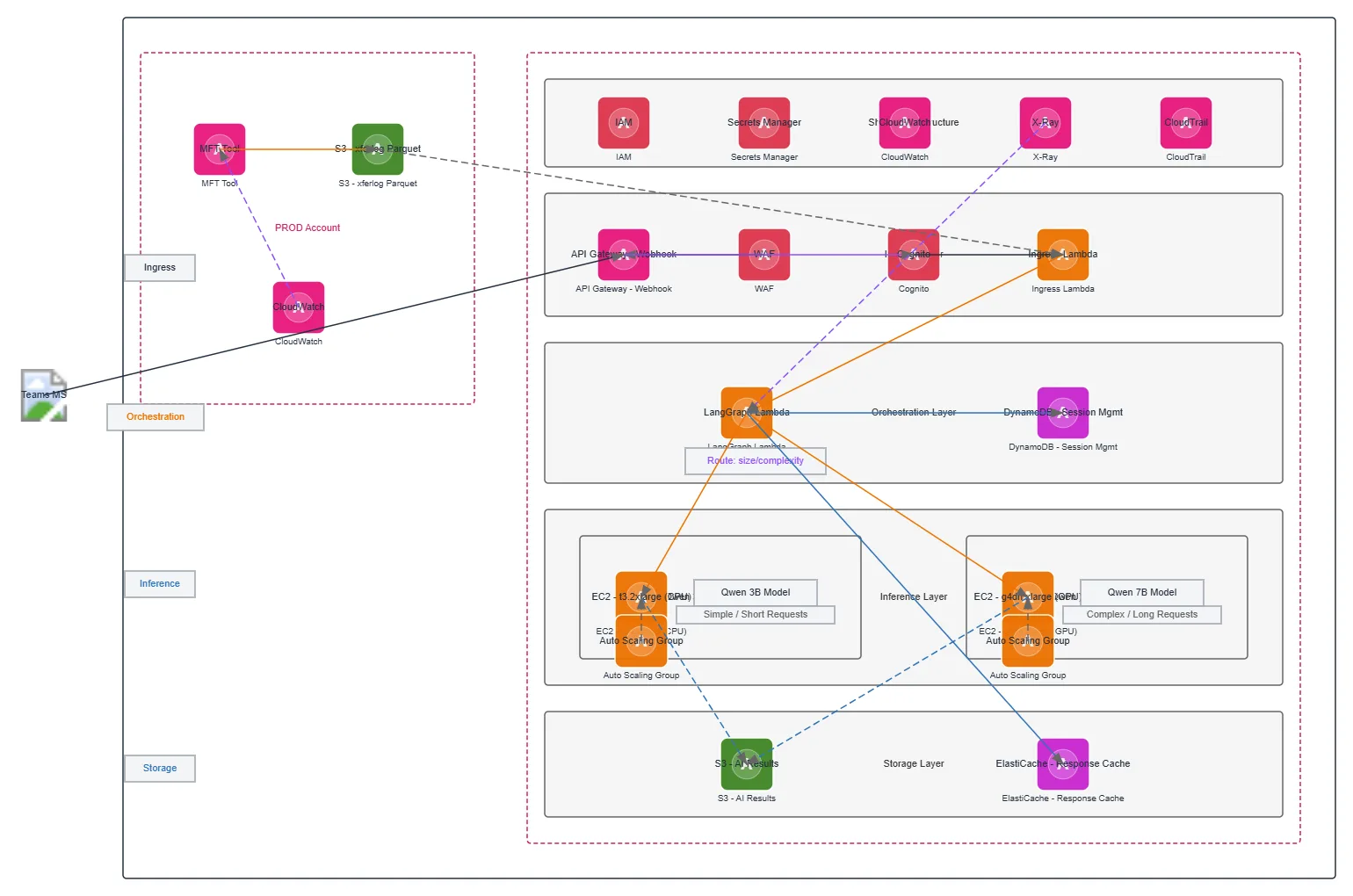
Multi-account AWS microservices architecture routing inference requests across CPU and GPU compute tiers using LangGraph orchestration and Qwen models. Teams MS sends webhook requests through API Gateway and WAF, authenticated via Cognito, then routed by LangGraph Lambda to either t3.2xlarge CPU instances for simple requests or g4dn.xlarge GPU instances for complex workloads. Session state persists in DynamoDB, inference results cache in ElastiCache, and observability spans CloudWatch, X-Ray, and CloudTrail across PROD and AI accounts. This pattern demonstrates cost-optimized inference scaling, least-privilege cross-account IAM, and request-complexity-driven routing for production AI workloads. Fork and customize this diagram on Diagrams.so to adapt compute tiers, add additional inference models, or integrate your own orchestration logic.