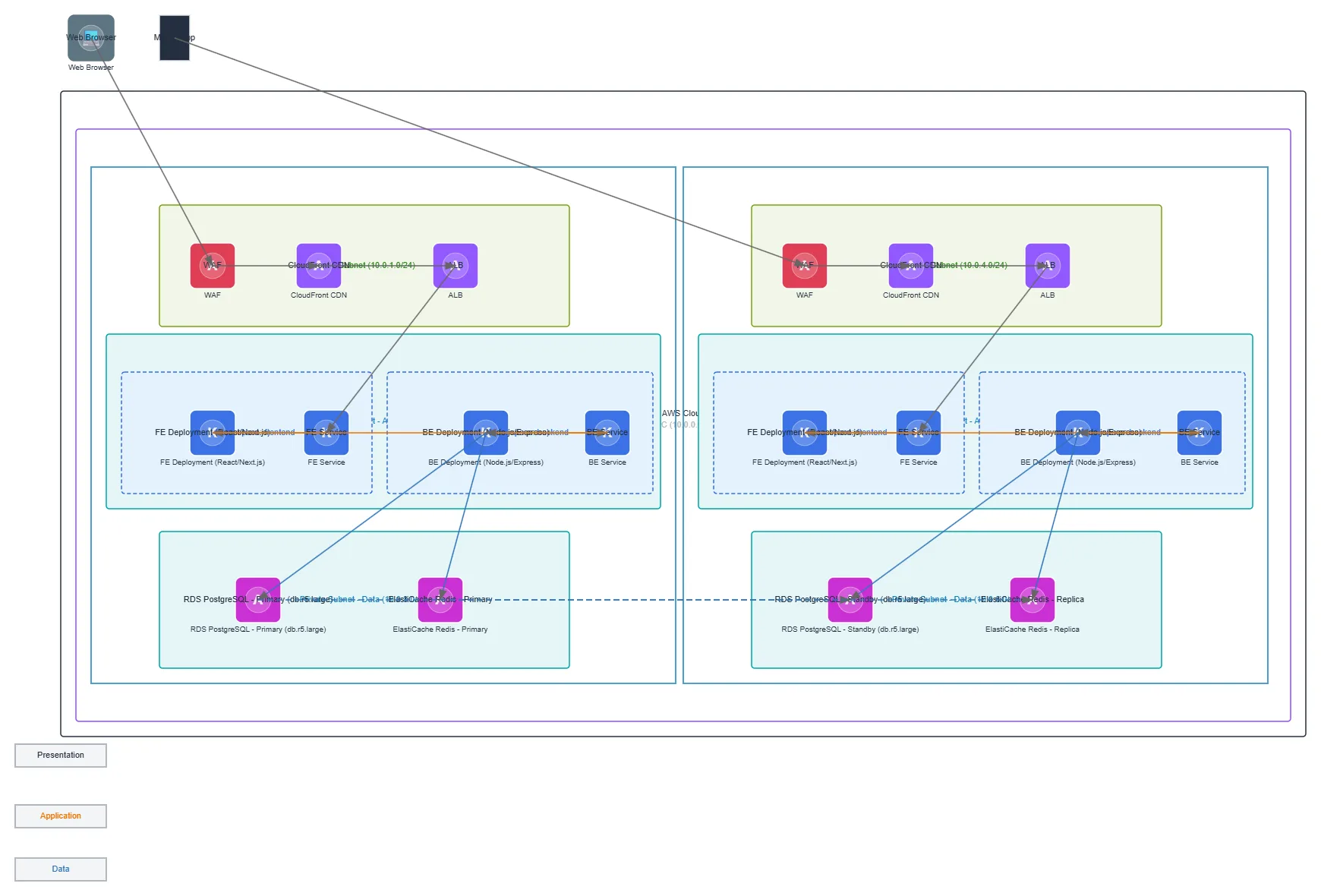
AWS Multi-AZ Application Architecture (K8s)

AWSArchitectureadvanced
AWS Multi-AZ Application Architecture (K8s) — AWS architecture diagram

About This Architecture

Multi-AZ Kubernetes application architecture on AWS with CloudFront CDN, WAF, and Application Load Balancer protecting React/Next.js and Node.js/Express microservices across two availability zones. Traffic flows from web and mobile clients through WAF and CloudFront to ALBs in public subnets, routing to frontend and backend Kubernetes services in private subnets within separate namespaces. RDS PostgreSQL primary-standby replication and ElastiCache Redis primary-replica caching in dedicated data subnets ensure database resilience and performance across AZ-1 and AZ-2. This architecture demonstrates AWS best practices for fault tolerance, auto-scaling, and separation of concerns using Kubernetes namespaces and VPC subnet isolation. Fork this diagram on Diagrams.so to customize instance types, add auto-scaling policies, or integrate additional AWS services like Secrets Manager or CloudWatch monitoring. Consider adding NAT Gateways in public subnets for secure outbound traffic from private application subnets.

People also ask

How do I architect a highly available Kubernetes application on AWS across multiple availability zones?

This diagram shows a multi-AZ Kubernetes architecture where CloudFront and WAF protect traffic routed through Application Load Balancers to frontend and backend services in private subnets. RDS PostgreSQL primary-standby and ElastiCache Redis primary-replica deployments in separate data subnets ensure database and cache resilience across AZ-1 and AZ-2.

AWSKubernetesMulti-AZHigh AvailabilityMicroservicesRDS
Domain:
Cloud Aws
Audience:
AWS solutions architects designing highly available Kubernetes applications

Generated by Diagrams.so — AI architecture diagram generator with native Draw.io output. Fork this diagram, remix it, or download as .drawio, PNG, or SVG.

Generate your own architecturediagram →

AWS Multi-AZ Application Architecture (K8s) — AWS architecture diagram

About This Architecture

Multi-AZ Kubernetes application architecture on AWS with CloudFront CDN, WAF, and Application Load Balancer protecting React/Next.js and Node.js/Express microservices across two availability zones. Traffic flows from web and mobile clients through WAF and CloudFront to ALBs in public subnets, routing to frontend and backend Kubernetes services in private subnets within separate namespaces. RDS PostgreSQL primary-standby replication and ElastiCache Redis primary-replica caching in dedicated data subnets ensure database resilience and performance across AZ-1 and AZ-2. This architecture demonstrates AWS best practices for fault tolerance, auto-scaling, and separation of concerns using Kubernetes namespaces and VPC subnet isolation. Fork this diagram on Diagrams.so to customize instance types, add auto-scaling policies, or integrate additional AWS services like Secrets Manager or CloudWatch monitoring. Consider adding NAT Gateways in public subnets for secure outbound traffic from private application subnets.

People also ask

How do I architect a highly available Kubernetes application on AWS across multiple availability zones?

This diagram shows a multi-AZ Kubernetes architecture where CloudFront and WAF protect traffic routed through Application Load Balancers to frontend and backend services in private subnets. RDS PostgreSQL primary-standby and ElastiCache Redis primary-replica deployments in separate data subnets ensure database and cache resilience across AZ-1 and AZ-2.

AWS Multi-AZ Application Architecture (K8s)

AWSadvancedKubernetesMulti-AZHigh AvailabilityMicroservicesRDS
Domain: Cloud AwsAudience: AWS solutions architects designing highly available Kubernetes applications
0 views0 favoritesPublic

Created by

June 27, 2026

Updated

June 27, 2026 at 12:27 PM

Type

architecture

Need a custom architecture diagram?

Describe your architecture in plain English and get a production-ready Draw.io diagram in seconds. Works for AWS, Azure, GCP, Kubernetes, and more.

Generate with AI