AWS Full-Stack Web App - ECS, RDS, Cognito

AWSArchitectureadvanced
AWS Full-Stack Web App - ECS, RDS, Cognito — AWS architecture diagram

About This Architecture

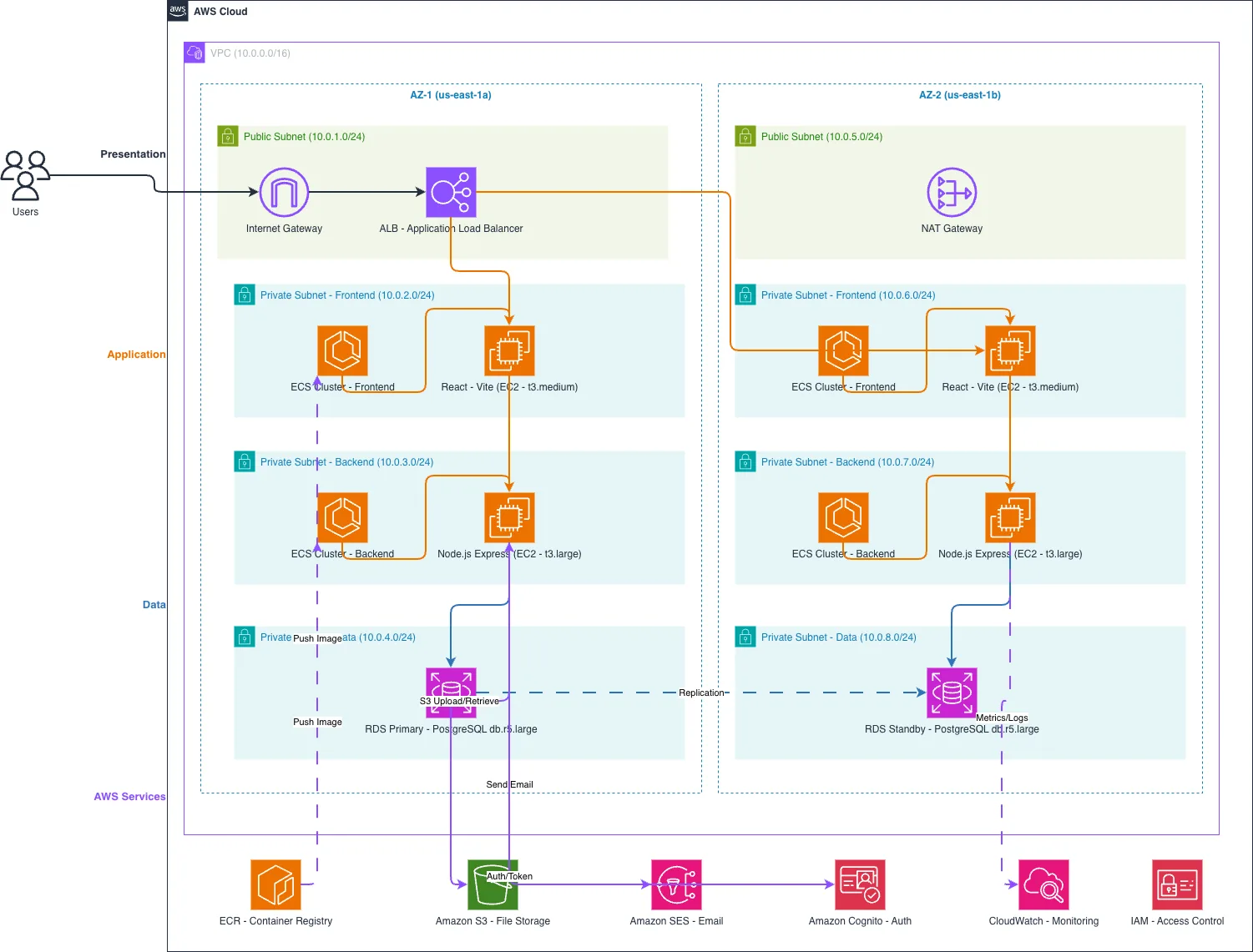
Multi-tier web application architecture spanning two AWS availability zones with React-Vite frontend, Node.js Express backend, and PostgreSQL RDS database. Traffic flows through an Internet Gateway and Application Load Balancer to frontend ECS clusters, which communicate with backend services that connect to a highly available RDS primary-standby setup. The architecture integrates Amazon Cognito for authentication, S3 for file storage, SES for email, and CloudWatch for observability, all orchestrated through ECR container registry and IAM access controls. This design demonstrates production best practices including multi-AZ redundancy, private subnet isolation, and managed service integration. Fork and customize this diagram on Diagrams.so to adapt instance types, subnet ranges, or add additional AWS services like ElastiCache or Lambda.

People also ask

How do I architect a production AWS full-stack web application with React frontend, Node.js backend, and PostgreSQL database across multiple availability zones?

This diagram shows a multi-AZ AWS architecture with React-Vite frontend and Node.js Express backend deployed in ECS clusters, connected through an Application Load Balancer to users. The backend communicates with a highly available RDS PostgreSQL setup (primary-standby), while Cognito handles authentication, S3 stores files, and CloudWatch monitors the entire system.

AWSECSRDSCognitofull-stackmulti-AZ
Domain:
Cloud Aws
Audience:
AWS solutions architects designing production-grade full-stack web applications

Generated by Diagrams.so — AI architecture diagram generator with native Draw.io output. Fork this diagram, remix it, or download as .drawio, PNG, or SVG.

Generate your own architecture diagram →

About This Architecture

Multi-tier web application architecture spanning two AWS availability zones with React-Vite frontend, Node.js Express backend, and PostgreSQL RDS database. Traffic flows through an Internet Gateway and Application Load Balancer to frontend ECS clusters, which communicate with backend services that connect to a highly available RDS primary-standby setup. The architecture integrates Amazon Cognito for authentication, S3 for file storage, SES for email, and CloudWatch for observability, all orchestrated through ECR container registry and IAM access controls. This design demonstrates production best practices including multi-AZ redundancy, private subnet isolation, and managed service integration. Fork and customize this diagram on Diagrams.so to adapt instance types, subnet ranges, or add additional AWS services like ElastiCache or Lambda.

People also ask

How do I architect a production AWS full-stack web application with React frontend, Node.js backend, and PostgreSQL database across multiple availability zones?

This diagram shows a multi-AZ AWS architecture with React-Vite frontend and Node.js Express backend deployed in ECS clusters, connected through an Application Load Balancer to users. The backend communicates with a highly available RDS PostgreSQL setup (primary-standby), while Cognito handles authentication, S3 stores files, and CloudWatch monitors the entire system.

AWS Full-Stack Web App - ECS, RDS, Cognito

AWSadvancedECSRDSCognitofull-stackmulti-AZ
Domain: Cloud AwsAudience: AWS solutions architects designing production-grade full-stack web applications
0 views0 favoritesPublic

Created by

April 21, 2026

Updated

April 21, 2026 at 8:23 PM

Type

architecture

Need a custom architecture diagram?

Describe your architecture in plain English and get a production-ready Draw.io diagram in seconds. Works for AWS, Azure, GCP, Kubernetes, and more.

Generate with AI