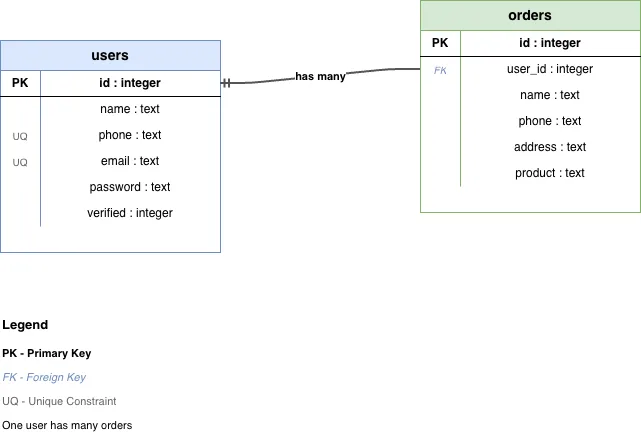
Users and Orders ER Diagram

GENERALErsimple
Users and Orders ER Diagram — GENERAL er diagram

About This Architecture

Users and Orders ER diagram models a one-to-many relationship between user accounts and customer orders using relational database design principles. The users table stores authentication credentials, contact information, and verification status with id as primary key and unique constraints on phone and email fields. The orders table captures order details including user_id as a foreign key linking back to users, enabling efficient queries across customer purchase history. This schema demonstrates normalized database design that prevents data duplication while maintaining referential integrity across user and order records. Fork this diagram on Diagrams.so to customize field types, add order status tracking, or extend with payment and shipping tables for your application.

People also ask

How do you design a database schema for users and orders with proper relationships and constraints?

This ER diagram shows a normalized schema where the users table stores user credentials and contact info with id as primary key and unique constraints on phone and email. The orders table links to users via a foreign key on user_id, enabling one user to have many orders while maintaining referential integrity.

ER diagramdatabase schemarelational databasee-commerceSQL design
Domain:
Data Engineering
Audience:
Backend developers and database designers building user-centric e-commerce or SaaS applications

Generated by Diagrams.so — AI architecture diagram generator with native Draw.io output. Fork this diagram, remix it, or download as .drawio, PNG, or SVG.

Generate your own er diagram →

About This Architecture

Users and Orders ER diagram models a one-to-many relationship between user accounts and customer orders using relational database design principles. The users table stores authentication credentials, contact information, and verification status with id as primary key and unique constraints on phone and email fields. The orders table captures order details including user_id as a foreign key linking back to users, enabling efficient queries across customer purchase history. This schema demonstrates normalized database design that prevents data duplication while maintaining referential integrity across user and order records. Fork this diagram on Diagrams.so to customize field types, add order status tracking, or extend with payment and shipping tables for your application.

People also ask

How do you design a database schema for users and orders with proper relationships and constraints?

This ER diagram shows a normalized schema where the users table stores user credentials and contact info with id as primary key and unique constraints on phone and email. The orders table links to users via a foreign key on user_id, enabling one user to have many orders while maintaining referential integrity.

Users and Orders ER Diagram

AutosimpleER diagramdatabase schemarelational databasee-commerceSQL design
Domain: Data EngineeringAudience: Backend developers and database designers building user-centric e-commerce or SaaS applications
0 views0 favoritesPublic

Created by

May 17, 2026

Updated

May 17, 2026 at 2:37 PM

Type

er

Need a custom architecture diagram?

Describe your architecture in plain English and get a production-ready Draw.io diagram in seconds. Works for AWS, Azure, GCP, Kubernetes, and more.

Generate with AI