Simulation Engine Thread Flowchart

GENERALFlowchartintermediate
Simulation Engine Thread Flowchart — GENERAL flowchart diagram

About This Architecture

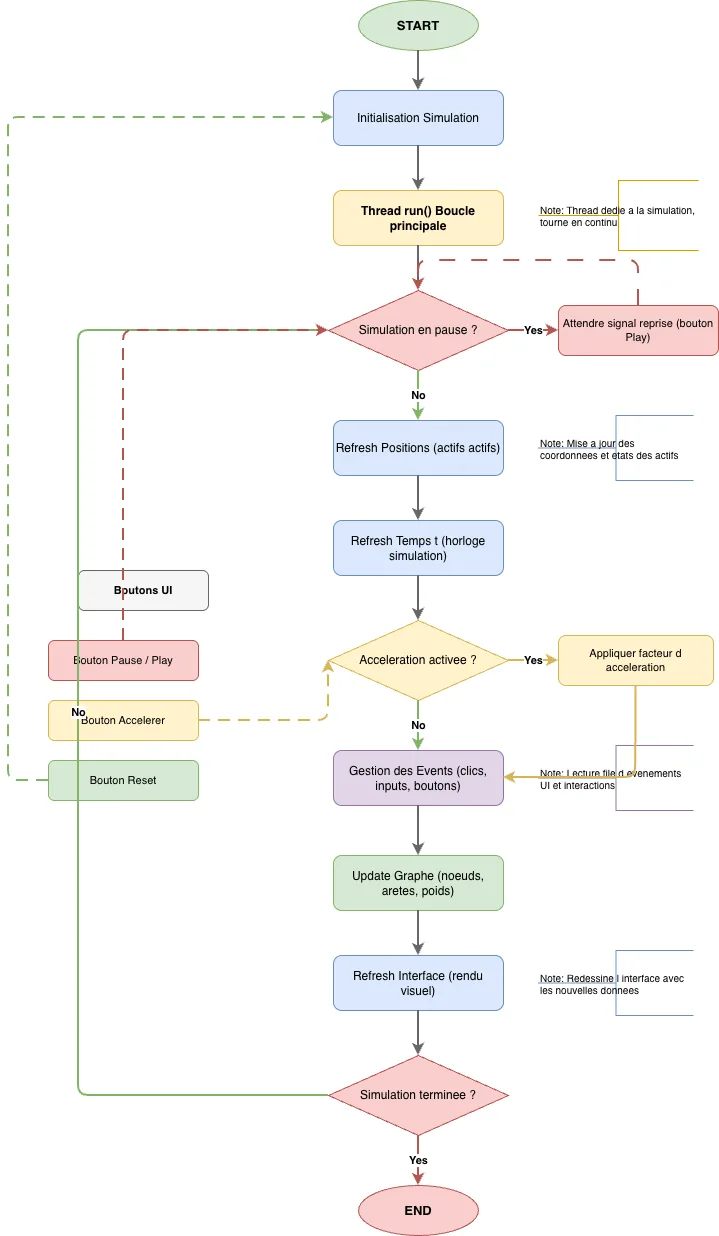
Real-time simulation engine with dedicated thread loop managing actor positions, time acceleration, and UI event handling. The main thread continuously refreshes actor coordinates, simulation clock, and graph structure while responding to pause/play, acceleration, and reset controls. Event-driven architecture processes user interactions and updates the visual interface each frame, enabling responsive interactive simulations. Fork this flowchart on Diagrams.so to customize state transitions, add physics substeps, or integrate networking for multiplayer scenarios. This pattern scales to complex agent-based models by separating simulation logic from rendering and input handling.

People also ask

How should I structure a real-time simulation engine with a dedicated thread that handles pause/play, time acceleration, and UI events?

This flowchart shows a dedicated simulation thread running a continuous loop that refreshes actor positions, applies time acceleration when enabled, processes UI events (pause/play, accelerate, reset), updates the graph structure, and renders the interface each frame. The architecture separates simulation logic from rendering and input handling, enabling responsive interactive systems.

simulation-enginethreadinggame-loopevent-handlingreal-time-systemsflowchart
Domain:
Software Architecture
Audience:
Game developers and simulation engineers building real-time interactive systems

Generated by Diagrams.so — AI architecture diagram generator with native Draw.io output. Fork this diagram, remix it, or download as .drawio, PNG, or SVG.

Generate your own flowchart diagram →

About This Architecture

Real-time simulation engine with dedicated thread loop managing actor positions, time acceleration, and UI event handling. The main thread continuously refreshes actor coordinates, simulation clock, and graph structure while responding to pause/play, acceleration, and reset controls. Event-driven architecture processes user interactions and updates the visual interface each frame, enabling responsive interactive simulations. Fork this flowchart on Diagrams.so to customize state transitions, add physics substeps, or integrate networking for multiplayer scenarios. This pattern scales to complex agent-based models by separating simulation logic from rendering and input handling.

People also ask

How should I structure a real-time simulation engine with a dedicated thread that handles pause/play, time acceleration, and UI events?

This flowchart shows a dedicated simulation thread running a continuous loop that refreshes actor positions, applies time acceleration when enabled, processes UI events (pause/play, accelerate, reset), updates the graph structure, and renders the interface each frame. The architecture separates simulation logic from rendering and input handling, enabling responsive interactive systems.

Simulation Engine Thread Flowchart

Autointermediatesimulation-enginethreadinggame-loopevent-handlingreal-time-systems
Domain: Software ArchitectureAudience: Game developers and simulation engineers building real-time interactive systems
0 views0 favoritesPublic

Created by

April 12, 2026

Updated

April 12, 2026 at 1:59 PM

Type

flowchart

Need a custom architecture diagram?

Describe your architecture in plain English and get a production-ready Draw.io diagram in seconds. Works for AWS, Azure, GCP, Kubernetes, and more.

Generate with AI