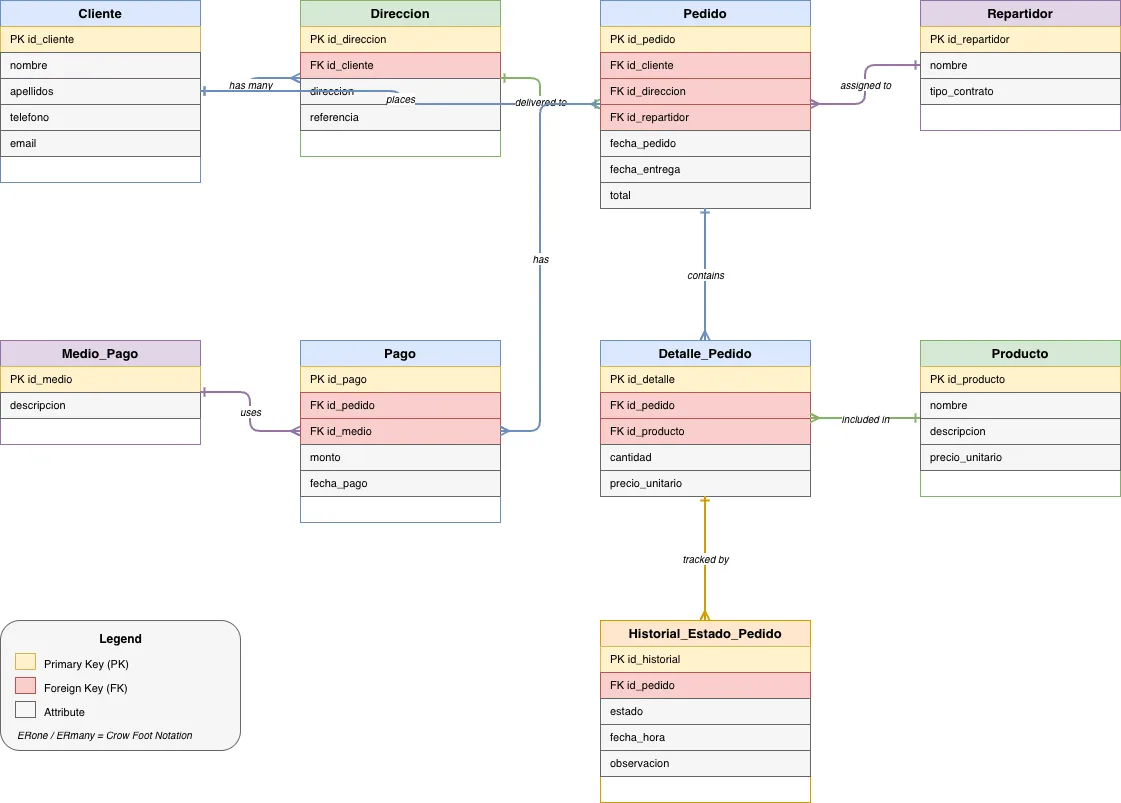
Order Management System ER Diagram
About This Architecture
Order Management System ER diagram models a complete e-commerce fulfillment workflow with Cliente, Pedido, Producto, Repartidor, Pago, and Historial_Estado_Pedido entities connected via foreign keys. Data flows from customer orders through delivery assignments, payment processing, and order status tracking, with Detalle_Pedido bridging products to orders. This normalized schema eliminates redundancy, enforces referential integrity, and supports complex queries across customers, shipments, and payment reconciliation. Fork this diagram on Diagrams.so to customize tables, add indexes, or adapt for your order management platform. The crow's foot notation clearly shows one-to-many relationships critical for scaling multi-vendor or multi-warehouse operations.
People also ask
What does a normalized ER diagram for an order management system look like?
This ER diagram models a complete order management system with Cliente (customer), Pedido (order), Producto (product), Repartidor (delivery driver), Pago (payment), and Historial_Estado_Pedido (order status history) entities. Foreign keys enforce relationships between customers and orders, orders and deliveries, and orders and payments, while Detalle_Pedido acts as a junction table linking product
- Domain:
- Data Engineering
- Audience:
- Database architects and backend engineers designing order management systems
Generated by Diagrams.so — AI architecture diagram generator with native Draw.io output. Fork this diagram, remix it, or download as .drawio, PNG, or SVG.