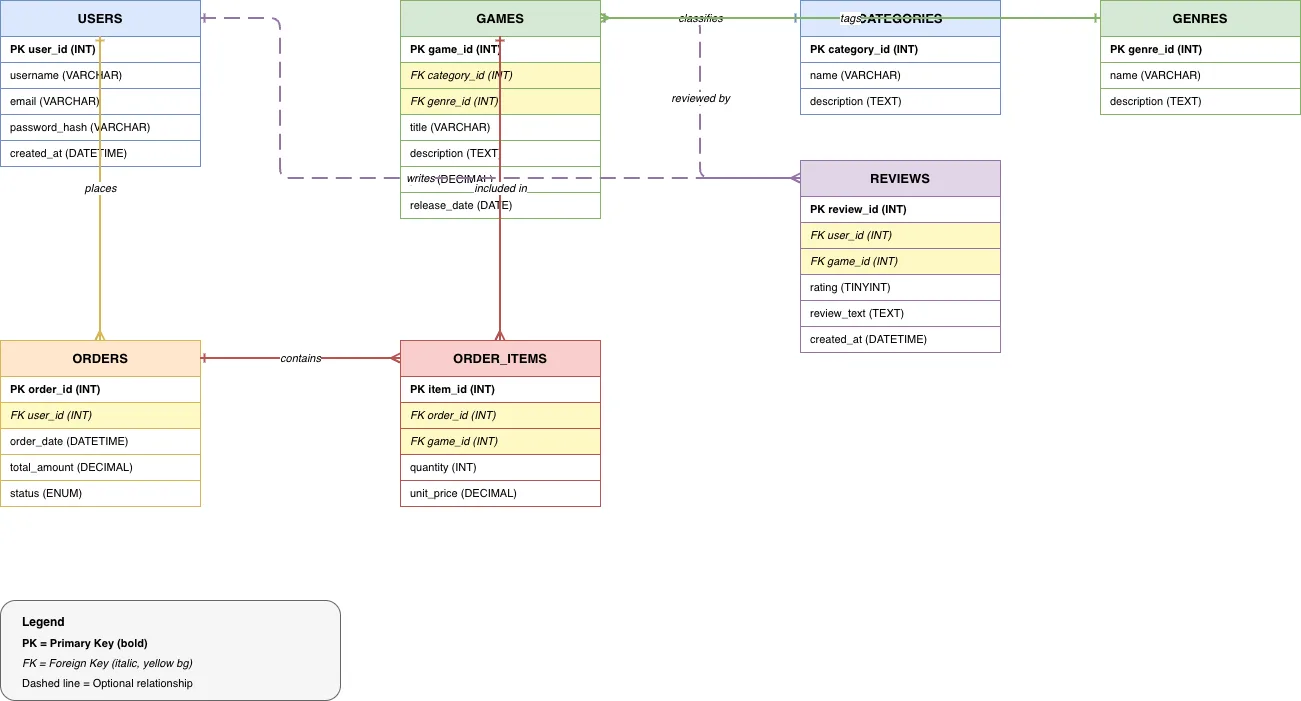
Online Gaming Store ER Diagram

GENERALErintermediate
Online Gaming Store ER Diagram — GENERAL er diagram

About This Architecture

Online gaming store ER diagram models a normalized relational schema with seven core entities: USERS, GAMES, ORDERS, ORDER_ITEMS, REVIEWS, CATEGORIES, and GENRES. Data flows from USERS through ORDERS and ORDER_ITEMS to GAMES, with REVIEWS linking users and games bidirectionally, while CATEGORIES and GENRES classify games via foreign keys. This schema enforces referential integrity and separates concerns—order line items, user reviews, and game metadata—enabling efficient queries for inventory, sales, and user engagement analytics. Fork this diagram on Diagrams.so to customize table structures, add indexes, or adapt it for your gaming platform's specific requirements. Consider adding a WISHLIST entity or payment status tracking if your store requires advanced features.

People also ask

What does a normalized database schema for an online gaming store look like?

This ER diagram shows a seven-entity relational schema where USERS place ORDERS containing ORDER_ITEMS linked to GAMES, while REVIEWS connect users and games. CATEGORIES and GENRES classify games via foreign keys, ensuring data integrity and enabling efficient queries for inventory, sales, and user engagement.

ER diagramdatabase designrelational schemae-commercegaming platformSQL
Domain:
Software Architecture
Audience:
Backend developers and database architects designing e-commerce platforms

Generated by Diagrams.so — AI architecture diagram generator with native Draw.io output. Fork this diagram, remix it, or download as .drawio, PNG, or SVG.

Generate your own er diagram →

About This Architecture

Online gaming store ER diagram models a normalized relational schema with seven core entities: USERS, GAMES, ORDERS, ORDER_ITEMS, REVIEWS, CATEGORIES, and GENRES. Data flows from USERS through ORDERS and ORDER_ITEMS to GAMES, with REVIEWS linking users and games bidirectionally, while CATEGORIES and GENRES classify games via foreign keys. This schema enforces referential integrity and separates concerns—order line items, user reviews, and game metadata—enabling efficient queries for inventory, sales, and user engagement analytics. Fork this diagram on Diagrams.so to customize table structures, add indexes, or adapt it for your gaming platform's specific requirements. Consider adding a WISHLIST entity or payment status tracking if your store requires advanced features.

People also ask

What does a normalized database schema for an online gaming store look like?

This ER diagram shows a seven-entity relational schema where USERS place ORDERS containing ORDER_ITEMS linked to GAMES, while REVIEWS connect users and games. CATEGORIES and GENRES classify games via foreign keys, ensuring data integrity and enabling efficient queries for inventory, sales, and user engagement.

Online Gaming Store ER Diagram

AutointermediateER diagramdatabase designrelational schemae-commercegaming platformSQL
Domain: Software ArchitectureAudience: Backend developers and database architects designing e-commerce platforms
0 views0 favoritesPublic

Created by

May 4, 2026

Updated

May 4, 2026 at 8:10 PM

Type

er

Need a custom architecture diagram?

Describe your architecture in plain English and get a production-ready Draw.io diagram in seconds. Works for AWS, Azure, GCP, Kubernetes, and more.

Generate with AI