Online Gaming App - Chen ERD

GENERALErintermediate
Online Gaming App - Chen ERD — GENERAL er diagram

About This Architecture

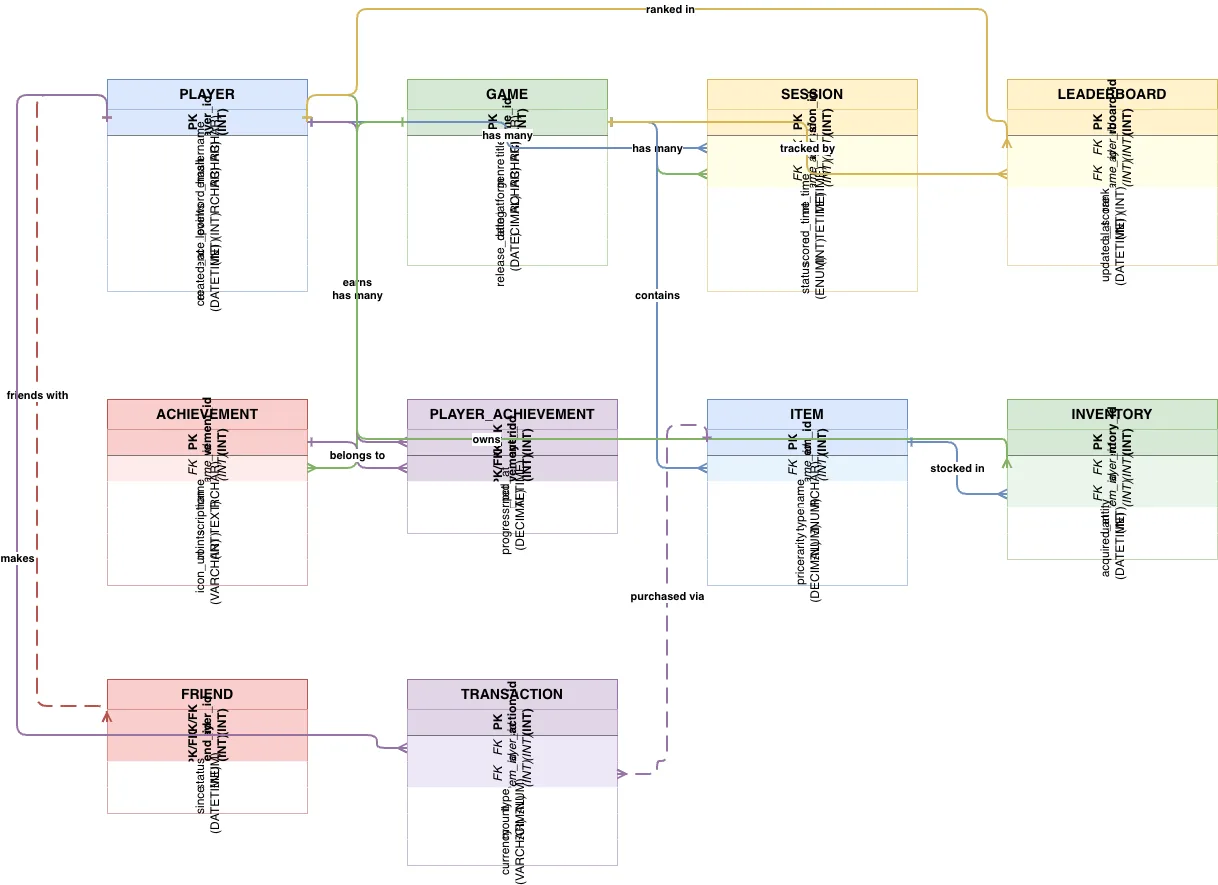
Online gaming platform ERD modeling player profiles, game catalogs, sessions, achievements, and social features through normalized relational schema. The PLAYER table anchors core user data while SESSION, ACHIEVEMENT, and LEADERBOARD tables track gameplay metrics and progression. INVENTORY and TRANSACTION tables manage in-game items and monetization, with FRIEND and PLAYER_ACHIEVEMENT junction tables enabling social connectivity and achievement tracking. This schema demonstrates best practices for gaming backends: foreign key relationships enforce referential integrity, enum fields standardize status and item types, and denormalized rank/score columns optimize leaderboard queries. Fork this diagram to customize for your game's progression system, add payment provider integrations, or extend with clan/guild hierarchies.

People also ask

What does a complete database schema for a multiplayer online gaming platform look like?

This Chen ERD shows a normalized relational design with PLAYER, GAME, SESSION, ACHIEVEMENT, INVENTORY, LEADERBOARD, FRIEND, and TRANSACTION tables. Foreign keys link players to sessions and games, achievements to games, items to inventory, and transactions to players and items, enabling tracking of progression, social features, and monetization.

database-designgaming-architectureERDrelational-schemabackend-engineeringgame-development
Domain:
Software Architecture
Audience:
Backend engineers designing multiplayer gaming databases

Generated by Diagrams.so — AI architecture diagram generator with native Draw.io output. Fork this diagram, remix it, or download as .drawio, PNG, or SVG.

Generate your own er diagram →

About This Architecture

Online gaming platform ERD modeling player profiles, game catalogs, sessions, achievements, and social features through normalized relational schema. The PLAYER table anchors core user data while SESSION, ACHIEVEMENT, and LEADERBOARD tables track gameplay metrics and progression. INVENTORY and TRANSACTION tables manage in-game items and monetization, with FRIEND and PLAYER_ACHIEVEMENT junction tables enabling social connectivity and achievement tracking. This schema demonstrates best practices for gaming backends: foreign key relationships enforce referential integrity, enum fields standardize status and item types, and denormalized rank/score columns optimize leaderboard queries. Fork this diagram to customize for your game's progression system, add payment provider integrations, or extend with clan/guild hierarchies.

People also ask

What does a complete database schema for a multiplayer online gaming platform look like?

This Chen ERD shows a normalized relational design with PLAYER, GAME, SESSION, ACHIEVEMENT, INVENTORY, LEADERBOARD, FRIEND, and TRANSACTION tables. Foreign keys link players to sessions and games, achievements to games, items to inventory, and transactions to players and items, enabling tracking of progression, social features, and monetization.

Online Gaming App - Chen ERD

Autointermediatedatabase-designgaming-architectureERDrelational-schemabackend-engineeringgame-development
Domain: Software ArchitectureAudience: Backend engineers designing multiplayer gaming databases
0 views0 favoritesPublic

Created by

May 6, 2026

Updated

May 6, 2026 at 9:57 AM

Type

er

Need a custom architecture diagram?

Describe your architecture in plain English and get a production-ready Draw.io diagram in seconds. Works for AWS, Azure, GCP, Kubernetes, and more.

Generate with AI