ISP Network Topology - BGP, CGNAT and PPPoE

general · er diagram.

About This Architecture

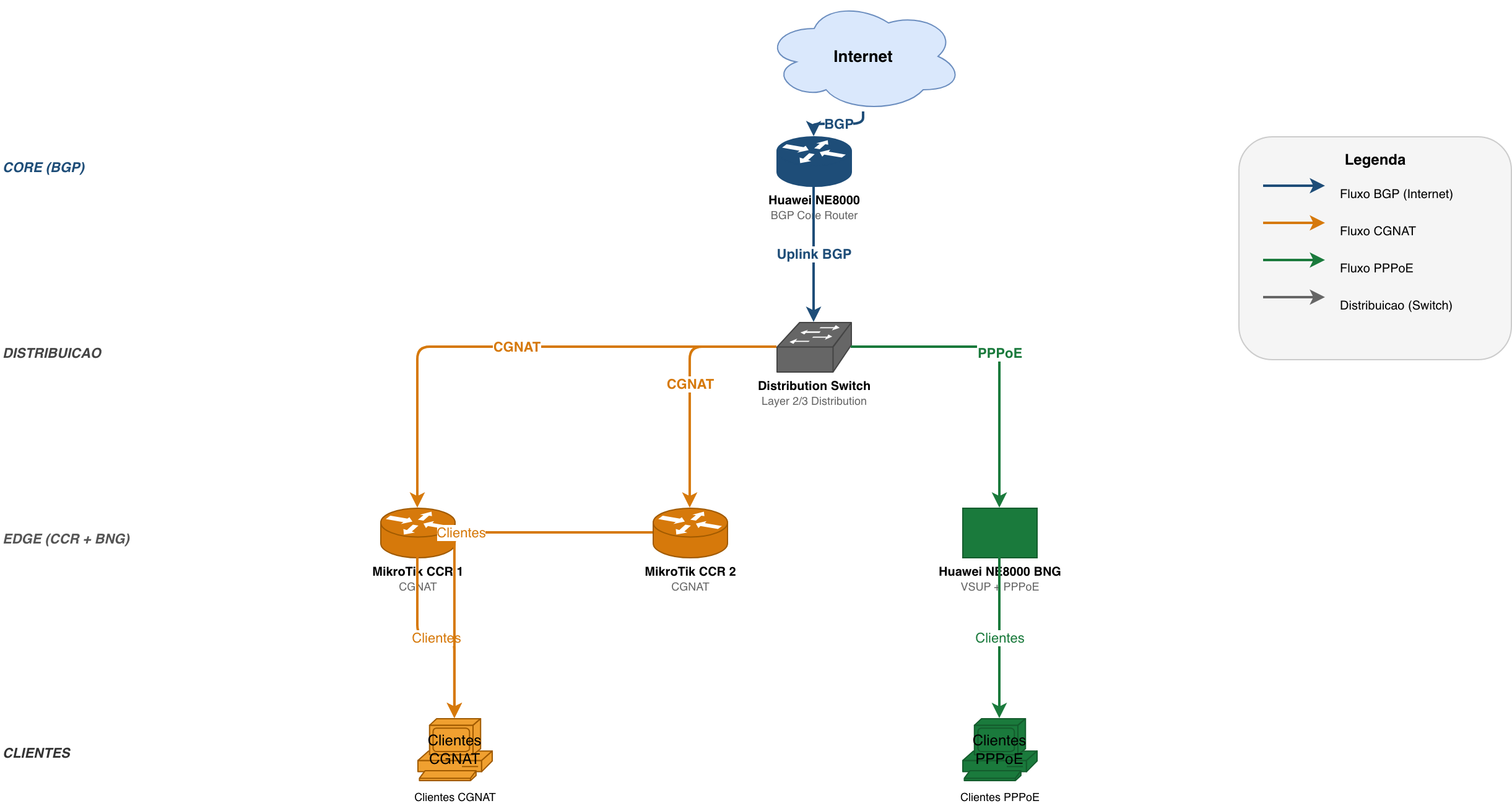
ISP network topology integrating BGP core routing, CGNAT edge processing, and PPPoE subscriber access across Huawei and MikroTik platforms. Internet traffic enters via BGP Core Router, distributes through Layer 2/3 switches to dual MikroTik CCR nodes handling CGNAT translation and a Huawei BNG managing PPPoE sessions. This three-tier architecture separates carrier backbone (BGP), aggregation (distribution switches), and subscriber edge (CGNAT + PPPoE) for scalability and redundancy. Network engineers can fork this diagram to customize for their ISP topology, add failover links, or document VLAN/QoS policies. The design demonstrates industry-standard ISP access patterns supporting both legacy PPPoE and modern CGNAT subscriber models simultaneously.

People also ask

How do ISPs architect networks with BGP core routing, CGNAT edge processing, and PPPoE subscriber access?

This diagram shows a three-tier ISP topology where BGP Core Router handles Internet peering, Distribution Switches aggregate traffic, and edge nodes split into MikroTik CCR (CGNAT) and Huawei BNG (PPPoE) for different subscriber types. This architecture enables ISPs to support legacy PPPoE and modern CGNAT subscribers with carrier-grade redundancy and traffic separation.

ISP Network Topology - BGP, CGNAT and PPPoE

AutoadvancedISPBGPCGNATPPPoEnetworkingHuawei
Domain: NetworkingAudience: ISP network engineers designing carrier-grade access networks
0 views0 favoritesPublic

Created by

April 8, 2026

Updated

April 8, 2026 at 1:41 AM

Type

er

Need a custom architecture diagram?

Describe your architecture in plain English and get a production-ready Draw.io diagram in seconds. Works for AWS, Azure, GCP, Kubernetes, and more.

Generate with AI