Create A Complete Enhanced Entity Relationship

GENERALErintermediate
Create A Complete Enhanced Entity Relationship — GENERAL er diagram

About This Architecture

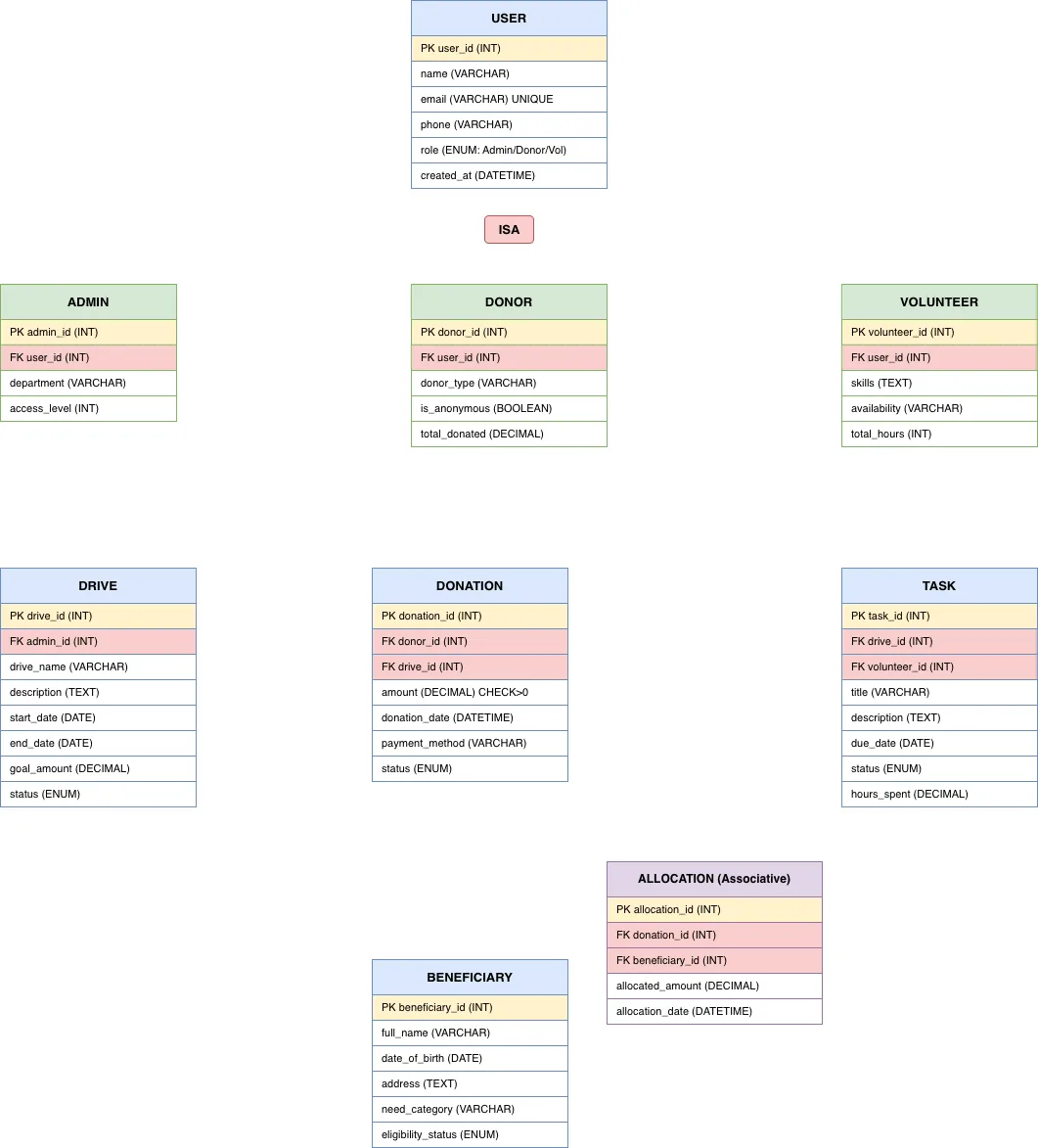
Complete Enhanced Entity-Relationship diagram for a multi-role donation and volunteer management platform with User inheritance (Admin, Donor, Volunteer), Drive coordination, Task allocation, and Beneficiary tracking. The schema enforces referential integrity through foreign keys, role-based access control via ENUM fields, and data validation constraints like CHECK amount>0 on donations. Relationships flow from Users through Drives and Donations to Beneficiaries via an Allocation associative entity, enabling complex queries on donor contributions, volunteer hours, and fund distribution. This normalized design supports real-world nonprofit operations: admins create drives, donors contribute funds, volunteers execute tasks, and allocations ensure transparent beneficiary support. Fork this diagram on Diagrams.so to customize entity attributes, add audit tables, or extend with payment processing and reporting views. The ISA (inheritance) pattern elegantly models role-specific data while maintaining a unified user authentication layer.

People also ask

How do you design a database schema for a nonprofit platform with donors, volunteers, and beneficiaries?

This Enhanced ER diagram shows a normalized schema using User inheritance (Admin, Donor, Volunteer), Drives for fundraising campaigns, Donations linked to Beneficiaries via an Allocation associative entity, and Tasks assigned to volunteers. The design enforces role-based access, donation validation, and transparent fund tracking.

entity-relationship-diagramdatabase-designnonprofit-platformdata-modelingsql-schemainheritance-pattern
Domain:
Data Engineering
Audience:
Database designers and data engineers building donation management systems

Generated by Diagrams.so — AI architecture diagram generator with native Draw.io output. Fork this diagram, remix it, or download as .drawio, PNG, or SVG.

Generate your own er diagram →

About This Architecture

Complete Enhanced Entity-Relationship diagram for a multi-role donation and volunteer management platform with User inheritance (Admin, Donor, Volunteer), Drive coordination, Task allocation, and Beneficiary tracking. The schema enforces referential integrity through foreign keys, role-based access control via ENUM fields, and data validation constraints like CHECK amount>0 on donations. Relationships flow from Users through Drives and Donations to Beneficiaries via an Allocation associative entity, enabling complex queries on donor contributions, volunteer hours, and fund distribution. This normalized design supports real-world nonprofit operations: admins create drives, donors contribute funds, volunteers execute tasks, and allocations ensure transparent beneficiary support. Fork this diagram on Diagrams.so to customize entity attributes, add audit tables, or extend with payment processing and reporting views. The ISA (inheritance) pattern elegantly models role-specific data while maintaining a unified user authentication layer.

People also ask

How do you design a database schema for a nonprofit platform with donors, volunteers, and beneficiaries?

This Enhanced ER diagram shows a normalized schema using User inheritance (Admin, Donor, Volunteer), Drives for fundraising campaigns, Donations linked to Beneficiaries via an Allocation associative entity, and Tasks assigned to volunteers. The design enforces role-based access, donation validation, and transparent fund tracking.

Create A Complete Enhanced Entity Relationship

Autointermediateentity-relationship-diagramdatabase-designnonprofit-platformdata-modelingsql-schemainheritance-pattern
Domain: Data EngineeringAudience: Database designers and data engineers building donation management systems
0 views0 favoritesPublic

Created by

May 10, 2026

Updated

May 10, 2026 at 10:08 AM

Type

er

Need a custom architecture diagram?

Describe your architecture in plain English and get a production-ready Draw.io diagram in seconds. Works for AWS, Azure, GCP, Kubernetes, and more.

Generate with AI