Clasificacion de Suelos Normativa AASHTO
GENERALFlowchartintermediate
Clasificacion de Suelos Normativa AASHTO — GENERAL flowchart diagram

About This Architecture

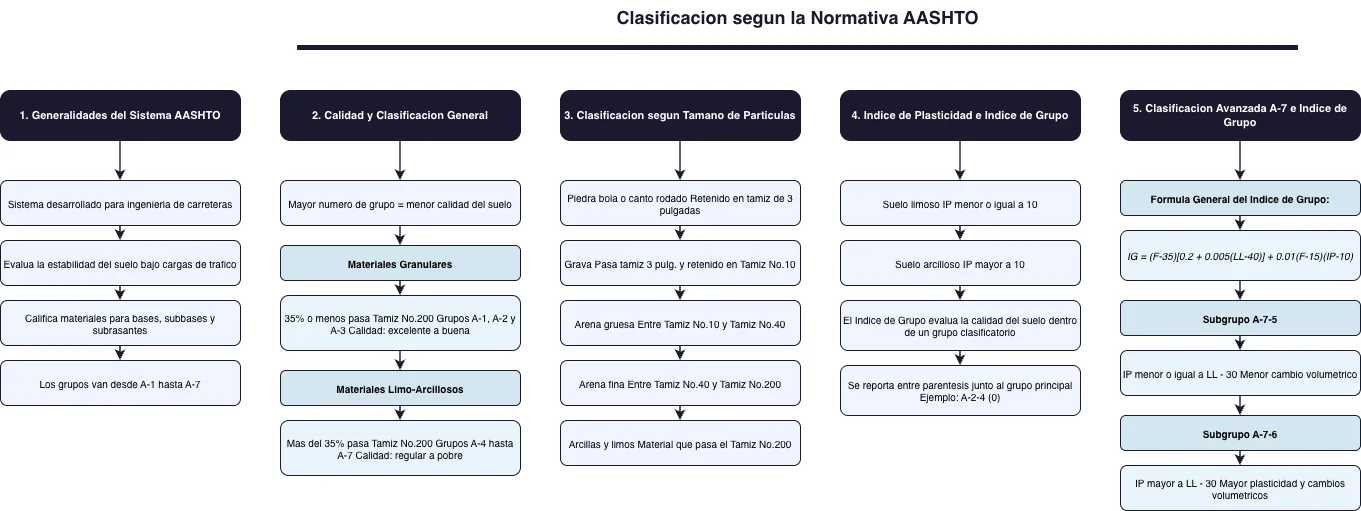
AASHTO soil classification flowchart systematically categorizes soils from A-1 (excellent) to A-7 (poor) based on particle size, plasticity index, and sieve analysis. The diagram evaluates soil stability under traffic loads and determines suitability for road bases, subbases, and subgrades using the No. 200 sieve threshold and plasticity criteria. Engineers use this classification to predict soil behavior, select appropriate materials, and design durable pavement structures that meet highway standards. Fork this diagram to customize soil group criteria, add local specifications, or integrate into geotechnical reports and design documentation. The advanced A-7 subgroup distinction (A-7-5 vs. A-7-6) reflects volumetric change potential critical for long-term pavement performance.

People also ask

How do I classify soil using the AASHTO system for road construction?

The AASHTO classification system categorizes soils A-1 (excellent) through A-7 (poor) using sieve analysis (No. 200 threshold), plasticity index, and liquid limit. Granular materials (≤35% passing No. 200) are groups A-1 to A-3; silt-clay materials (>35% passing) are A-4 to A-7, with A-7 subdivided into A-7-5 and A-7-6 based on volumetric change potential.

AASHTOsoil classificationgeotechnical engineeringpavement designcivil engineeringroad construction
Domain:
Mechanical Engineering
Audience:
Civil engineers and geotechnical professionals classifying soils for road construction and pavement design

Generated by Diagrams.so — AI architecture diagram generator with native Draw.io output. Fork this diagram, remix it, or download as .drawio, PNG, or SVG.

Generate your own flowchartdiagram →

About This Architecture

AASHTO soil classification flowchart systematically categorizes soils from A-1 (excellent) to A-7 (poor) based on particle size, plasticity index, and sieve analysis. The diagram evaluates soil stability under traffic loads and determines suitability for road bases, subbases, and subgrades using the No. 200 sieve threshold and plasticity criteria. Engineers use this classification to predict soil behavior, select appropriate materials, and design durable pavement structures that meet highway standards. Fork this diagram to customize soil group criteria, add local specifications, or integrate into geotechnical reports and design documentation. The advanced A-7 subgroup distinction (A-7-5 vs. A-7-6) reflects volumetric change potential critical for long-term pavement performance.

People also ask

How do I classify soil using the AASHTO system for road construction?

The AASHTO classification system categorizes soils A-1 (excellent) through A-7 (poor) using sieve analysis (No. 200 threshold), plasticity index, and liquid limit. Granular materials (≤35% passing No. 200) are groups A-1 to A-3; silt-clay materials (>35% passing) are A-4 to A-7, with A-7 subdivided into A-7-5 and A-7-6 based on volumetric change potential.

Clasificacion de Suelos Normativa AASHTO

AutointermediateAASHTOsoil classificationgeotechnical engineeringpavement designcivil engineeringroad construction
Domain: Mechanical EngineeringAudience: Civil engineers and geotechnical professionals classifying soils for road construction and pavement design
0 views0 favoritesPublic

Created by

May 24, 2026

Updated

May 24, 2026 at 12:18 AM

Type

flowchart

Need a custom architecture diagram?

Describe your architecture in plain English and get a production-ready Draw.io diagram in seconds. Works for AWS, Azure, GCP, Kubernetes, and more.

Generate with AI