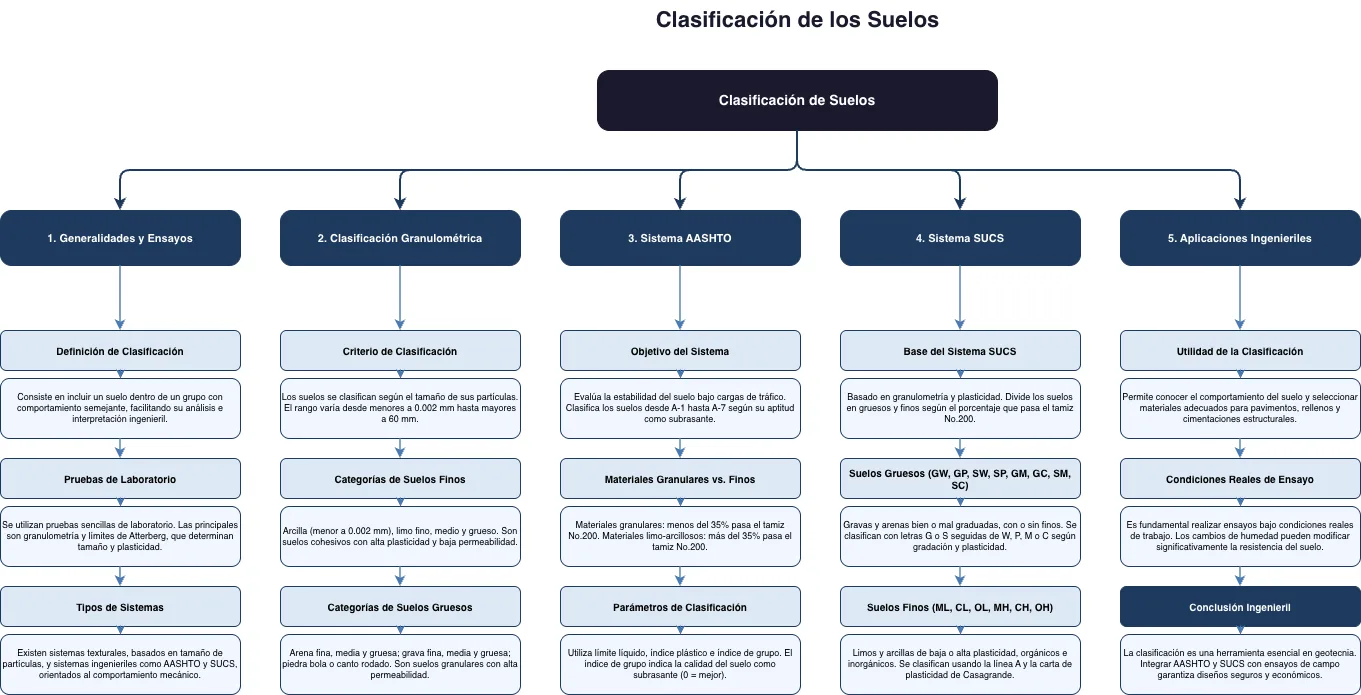
Clasificación de los Suelos - Diagrama de Concepto architecture diagram

About This Architecture

Soil classification framework integrating granulometric analysis, AASHTO and SUCS systems for standardized geotechnical assessment. The diagram flows from foundational concepts through laboratory testing procedures, particle-size criteria, and two major classification methodologies used globally. Engineers use this hierarchical approach to predict soil behavior under traffic loads, select appropriate construction materials, and ensure structural stability. Fork and customize this concept map on Diagrams.so to adapt soil classification workflows for your regional standards or project-specific requirements.

People also ask

What are the main soil classification systems used in geotechnical engineering and how do AASHTO and SUCS differ?

AASHTO classifies soils based on particle size and traffic-load stability, using granular vs. fine-grained criteria and an index of group parameter. SUCS divides soils by granulometry and plasticity into coarse (GW, GP, SW, SP, GM, GC, SM, SC) and fine (ML, CL, OL, MH, CH, OH) categories. Both systems rely on laboratory testing—primarily sieve analysis and Atterberg limits—to predict soil behavior

Clasificación de los Suelos - Diagrama de Concepto

Autointermediategeotechnical engineeringsoil classificationAASHTOSUCScivil engineeringfoundation design
Domain: OtherAudience: civil engineers and geotechnical professionals designing foundations and earthworks
0 views0 favoritesPublic

Created by

May 23, 2026

Updated

June 17, 2026 at 10:46 AM

Type

flowchart

Need a custom architecture diagram?

Describe your architecture in plain English and get a production-ready Draw.io diagram in seconds. Works for AWS, Azure, GCP, Kubernetes, and more.

Generate with AI