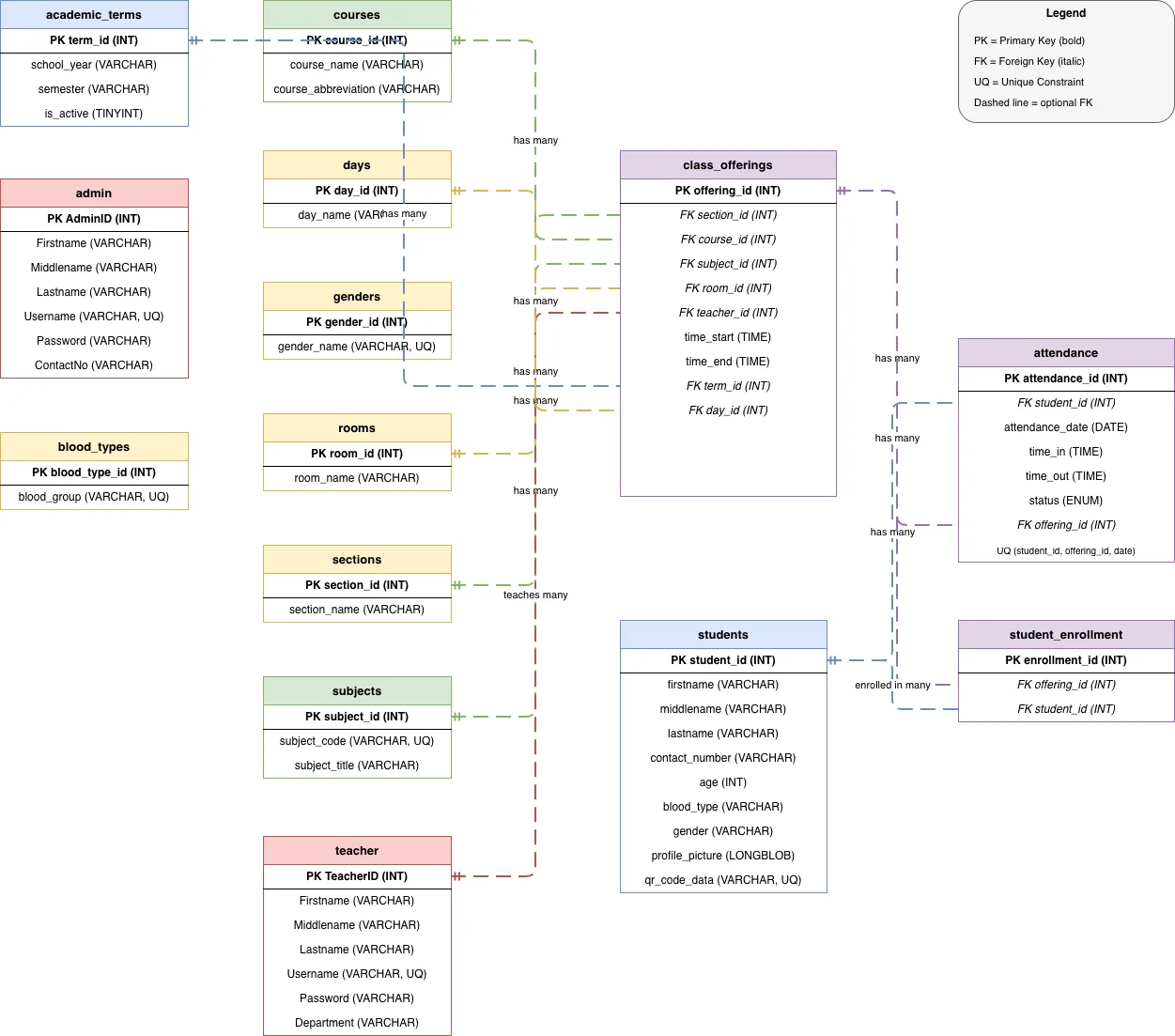
Attendance System ER Diagram

GENERALErintermediate
Attendance System ER Diagram — GENERAL er diagram

About This Architecture

Attendance System ER diagram models a comprehensive student attendance tracking platform with nine core entities: students, teachers, courses, class offerings, and attendance records. Data flows from academic_terms and class_offerings through to attendance logs, capturing student check-ins via time_in/time_out and status enums, with unique constraints on student_id, offering_id, and date to prevent duplicate records. This schema enforces referential integrity across enrollment, class scheduling, and attendance capture—critical for educational institutions managing compliance and student accountability. Fork this diagram on Diagrams.so to customize entity relationships, add audit trails, or extend with grade-linked attendance policies. The design uses optional foreign keys (dashed lines) for flexible scheduling and supports multi-term, multi-section class structures typical of K-12 and higher education systems.

People also ask

How should I design a database schema for a student attendance tracking system?

This ER diagram provides a complete schema with students, teachers, courses, class_offerings, and attendance entities. It uses primary and foreign keys to enforce referential integrity, unique constraints on student_id/offering_id/date to prevent duplicate attendance records, and optional relationships for flexible scheduling across academic terms and sections.

database designER diagramstudent information systemattendance managementrelational schemaeducation technology
Domain:
Software Architecture
Audience:
database architects and backend developers designing student attendance management systems

Generated by Diagrams.so — AI architecture diagram generator with native Draw.io output. Fork this diagram, remix it, or download as .drawio, PNG, or SVG.

Generate your own er diagram →

About This Architecture

Attendance System ER diagram models a comprehensive student attendance tracking platform with nine core entities: students, teachers, courses, class offerings, and attendance records. Data flows from academic_terms and class_offerings through to attendance logs, capturing student check-ins via time_in/time_out and status enums, with unique constraints on student_id, offering_id, and date to prevent duplicate records. This schema enforces referential integrity across enrollment, class scheduling, and attendance capture—critical for educational institutions managing compliance and student accountability. Fork this diagram on Diagrams.so to customize entity relationships, add audit trails, or extend with grade-linked attendance policies. The design uses optional foreign keys (dashed lines) for flexible scheduling and supports multi-term, multi-section class structures typical of K-12 and higher education systems.

People also ask

How should I design a database schema for a student attendance tracking system?

This ER diagram provides a complete schema with students, teachers, courses, class_offerings, and attendance entities. It uses primary and foreign keys to enforce referential integrity, unique constraints on student_id/offering_id/date to prevent duplicate attendance records, and optional relationships for flexible scheduling across academic terms and sections.

Attendance System ER Diagram

Autointermediatedatabase designER diagramstudent information systemattendance managementrelational schemaeducation technology
Domain: Software ArchitectureAudience: database architects and backend developers designing student attendance management systems
0 views0 favoritesPublic

Created by

May 12, 2026

Updated

May 12, 2026 at 12:55 PM

Type

er

Need a custom architecture diagram?

Describe your architecture in plain English and get a production-ready Draw.io diagram in seconds. Works for AWS, Azure, GCP, Kubernetes, and more.

Generate with AI