
About This Architecture
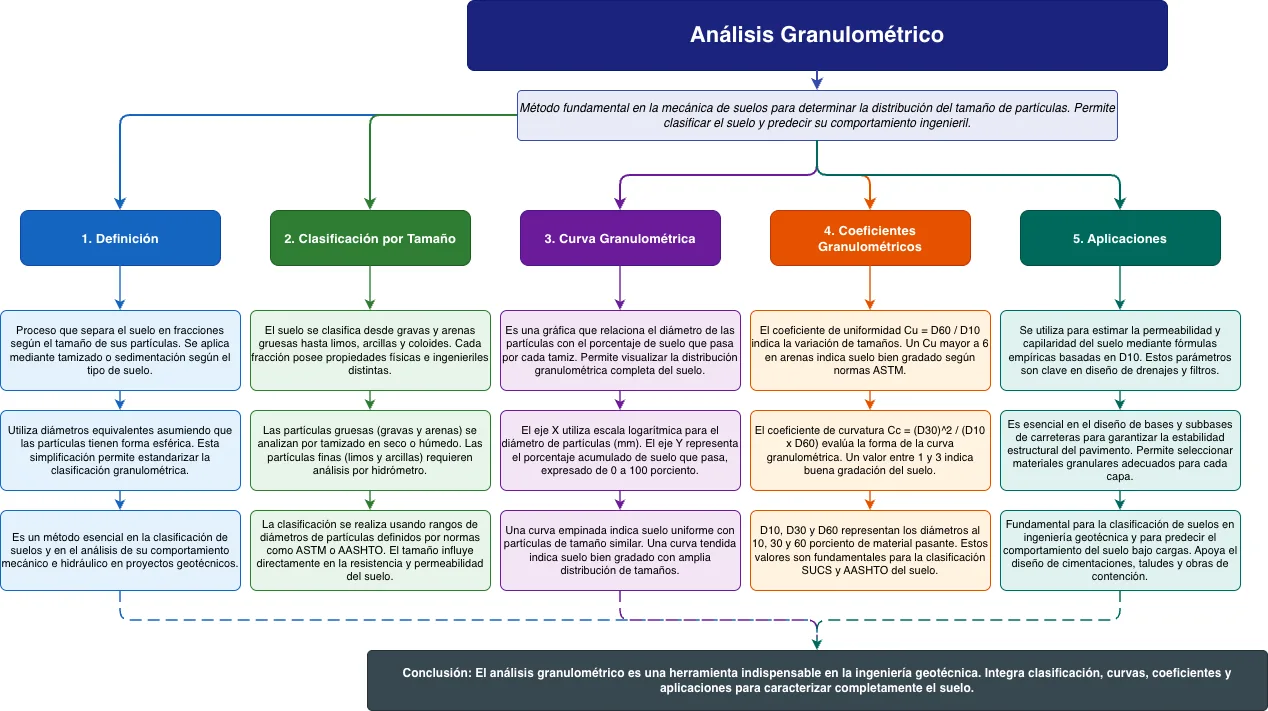
Granulometric analysis is a fundamental soil mechanics method that separates soil into particle-size fractions to determine distribution and engineering properties. The process uses sieving and equivalent diameter assumptions to classify particles from gravels and coarse sands through silts, clays, and colloids, with results plotted on a granulometric curve using logarithmic particle-diameter scales. Engineers apply granulometric coefficients—uniformity (Cu) and curvature (Cc)—derived from D10, D30, and D60 percentile diameters to predict soil permeability, design road bases, and classify geotechnical behavior. Fork this diagram to customize soil classification ranges, add site-specific particle distributions, or embed granulometric curve templates in geotechnical reports. The steep or gentle curve slope reveals soil uniformity and gradation, critical inputs for foundation design and earthwork specifications.