Amazon E-Commerce ER Diagram

GENERALErintermediate
Amazon E-Commerce ER Diagram — GENERAL er diagram

About This Architecture

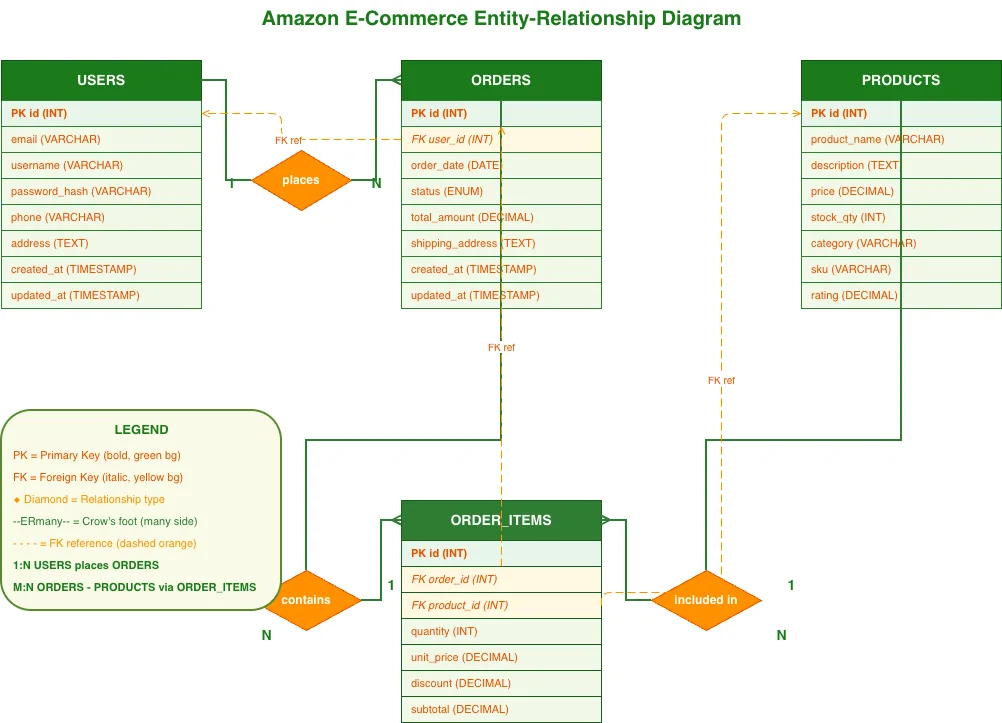
Amazon-style e-commerce ER diagram modeling a complete order-to-product data schema with USERS, ORDERS, PRODUCTS, and ORDER_ITEMS entities. The design captures one-to-many relationships between users and orders, and many-to-many relationships between orders and products through a junction table. Primary and foreign keys enforce referential integrity across customer accounts, order history, inventory tracking, and line-item details including quantity, pricing, and discounts. Fork this diagram to customize schemas for your own marketplace, add payment or review entities, or export as SQL DDL for immediate database implementation. The ORDER_ITEMS bridge table elegantly resolves the many-to-many relationship while preserving historical unit prices and discounts per transaction.

People also ask

What does a typical e-commerce database schema look like with users, orders, and products?

This ER diagram shows a standard e-commerce schema with USERS placing ORDERS (1:N), PRODUCTS linked to ORDERS via ORDER_ITEMS (M:N), and all entities connected through primary and foreign keys. It captures customer accounts, order history, inventory, and line-item pricing including discounts.

ER diagramdatabase designe-commerceSQL schemadata modelingmarketplace
Domain:
Data Engineering
Audience:
Backend developers and database architects designing e-commerce platforms

Generated by Diagrams.so — AI architecture diagram generator with native Draw.io output. Fork this diagram, remix it, or download as .drawio, PNG, or SVG.

Generate your own er diagram →

About This Architecture

Amazon-style e-commerce ER diagram modeling a complete order-to-product data schema with USERS, ORDERS, PRODUCTS, and ORDER_ITEMS entities. The design captures one-to-many relationships between users and orders, and many-to-many relationships between orders and products through a junction table. Primary and foreign keys enforce referential integrity across customer accounts, order history, inventory tracking, and line-item details including quantity, pricing, and discounts. Fork this diagram to customize schemas for your own marketplace, add payment or review entities, or export as SQL DDL for immediate database implementation. The ORDER_ITEMS bridge table elegantly resolves the many-to-many relationship while preserving historical unit prices and discounts per transaction.

People also ask

What does a typical e-commerce database schema look like with users, orders, and products?

This ER diagram shows a standard e-commerce schema with USERS placing ORDERS (1:N), PRODUCTS linked to ORDERS via ORDER_ITEMS (M:N), and all entities connected through primary and foreign keys. It captures customer accounts, order history, inventory, and line-item pricing including discounts.

Amazon E-Commerce ER Diagram

AutointermediateER diagramdatabase designe-commerceSQL schemadata modelingmarketplace
Domain: Data EngineeringAudience: Backend developers and database architects designing e-commerce platforms
0 views0 favoritesPublic

Created by

May 17, 2026

Updated

May 17, 2026 at 2:26 PM

Type

er

Need a custom architecture diagram?

Describe your architecture in plain English and get a production-ready Draw.io diagram in seconds. Works for AWS, Azure, GCP, Kubernetes, and more.

Generate with AI