Transport Ticketing System - Multi-AZ AWS

GENERALArchitectureadvanced
Transport Ticketing System - Multi-AZ AWS — GENERAL architecture diagram

About This Architecture

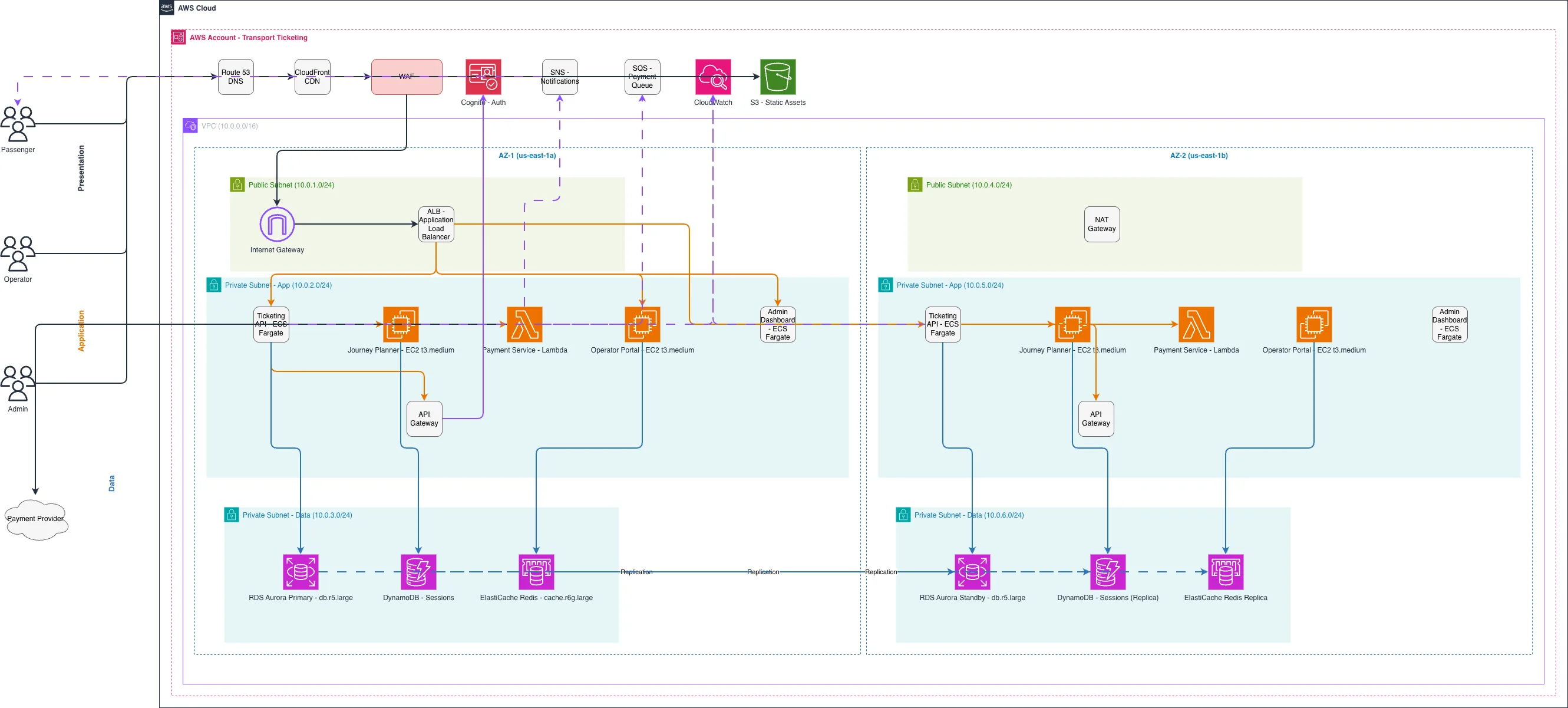
Multi-AZ transport ticketing system leveraging Route 53, CloudFront, WAF, and Cognito for global access and security across two AWS availability zones. Traffic flows through ALB to containerized Ticketing API and Journey Planner services, with Lambda handling payments via SQS, while RDS Aurora and DynamoDB provide resilient data persistence. This architecture demonstrates high-availability best practices: redundant compute across AZ-1 and AZ-2, read replicas for databases, and SNS for asynchronous notifications to passengers and operators. Fork this diagram to customize subnets, instance types, or add additional regions for your transport network. The design isolates public, application, and data tiers within VPCs, enforcing least-privilege access and enabling independent scaling of API, portal, and admin dashboard workloads.

People also ask

How do I design a highly available transport ticketing system on AWS across multiple availability zones?

This diagram shows a production-grade multi-AZ ticketing architecture spanning us-east-1a and us-east-1b with redundant ECS Fargate APIs, EC2 Journey Planners, Lambda payment services, and RDS Aurora primary-standby databases. Route 53 DNS, CloudFront CDN, and WAF provide global access and DDoS protection, while SQS decouples payment processing and SNS delivers notifications to passengers and oper

AWSmulti-AZECS FargateRDS AuroraDynamoDBticketing
Domain:
Cloud Aws
Audience:
AWS solutions architects designing multi-AZ ticketing platforms

Generated by Diagrams.so — AI architecture diagram generator with native Draw.io output. Fork this diagram, remix it, or download as .drawio, PNG, or SVG.

Generate your own architecture diagram →

About This Architecture

Multi-AZ transport ticketing system leveraging Route 53, CloudFront, WAF, and Cognito for global access and security across two AWS availability zones. Traffic flows through ALB to containerized Ticketing API and Journey Planner services, with Lambda handling payments via SQS, while RDS Aurora and DynamoDB provide resilient data persistence. This architecture demonstrates high-availability best practices: redundant compute across AZ-1 and AZ-2, read replicas for databases, and SNS for asynchronous notifications to passengers and operators. Fork this diagram to customize subnets, instance types, or add additional regions for your transport network. The design isolates public, application, and data tiers within VPCs, enforcing least-privilege access and enabling independent scaling of API, portal, and admin dashboard workloads.

People also ask

How do I design a highly available transport ticketing system on AWS across multiple availability zones?

This diagram shows a production-grade multi-AZ ticketing architecture spanning us-east-1a and us-east-1b with redundant ECS Fargate APIs, EC2 Journey Planners, Lambda payment services, and RDS Aurora primary-standby databases. Route 53 DNS, CloudFront CDN, and WAF provide global access and DDoS protection, while SQS decouples payment processing and SNS delivers notifications to passengers and oper

Transport Ticketing System - Multi-AZ AWS

AutoadvancedAWSmulti-AZECS FargateRDS AuroraDynamoDBticketing
Domain: Cloud AwsAudience: AWS solutions architects designing multi-AZ ticketing platforms
0 views0 favoritesPublic

Created by

May 4, 2026

Updated

May 4, 2026 at 9:17 AM

Type

architecture

Need a custom architecture diagram?

Describe your architecture in plain English and get a production-ready Draw.io diagram in seconds. Works for AWS, Azure, GCP, Kubernetes, and more.

Generate with AI