
About This Architecture
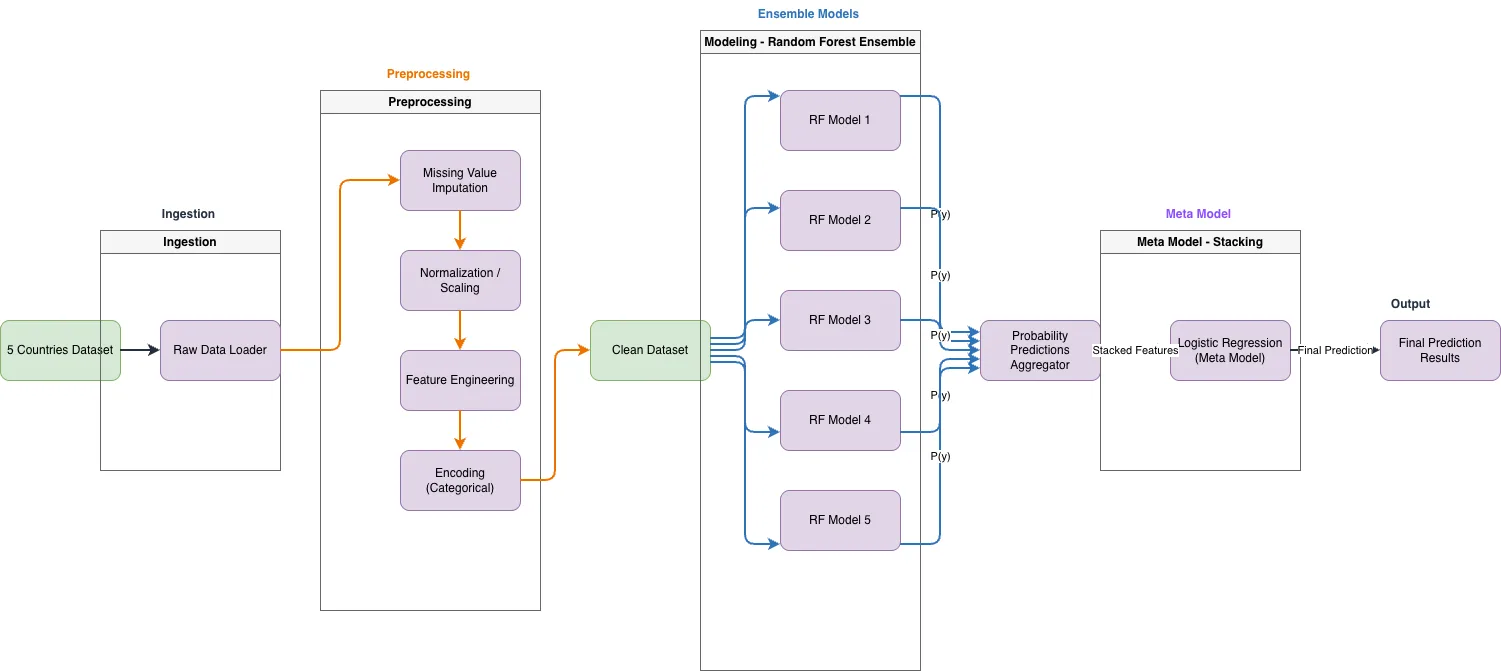
Stacking ensemble pipeline combining five Random Forest base models with Logistic Regression as a meta-learner for improved classification accuracy. Raw data from the 5 Countries Dataset flows through ingestion, missing value imputation, normalization, feature engineering, and categorical encoding to produce a clean dataset. Each of the five Random Forest models generates probability predictions that feed into an aggregator, which passes meta-features to the Logistic Regression meta-model for final predictions. This two-level stacking approach reduces overfitting and leverages the strengths of both tree-based and linear classifiers. Fork and customize this diagram on Diagrams.so to adapt ensemble architectures for your datasets and model combinations.