SOC Analyst Operational Cycle — SketchChain

GENERALNetworkadvanced
SOC Analyst Operational Cycle — SketchChain — GENERAL network diagram

About This Architecture

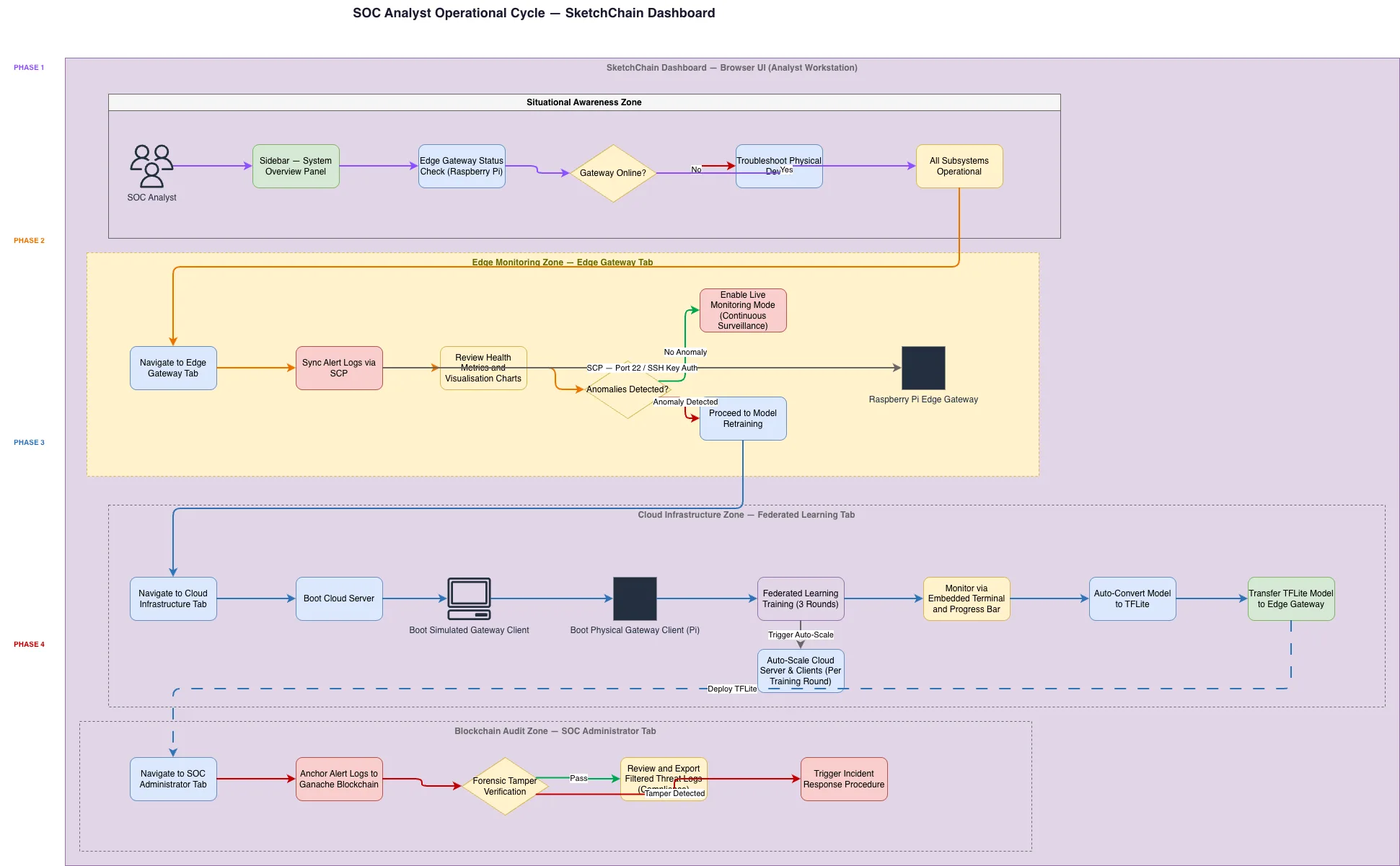
SOC Analyst Operational Cycle on SketchChain integrates situational awareness, edge gateway monitoring, federated learning model training, and blockchain-anchored audit logs into a unified dashboard workflow. The four-phase cycle guides analysts from initial system health checks through anomaly detection, continuous model retraining on edge devices, and immutable forensic logging via Ganache blockchain. This architecture demonstrates how distributed machine learning and tamper-proof audit trails strengthen incident response without centralizing sensitive data. Fork and customize this diagram to map your own SOC processes, integrate your edge gateways, or adapt the federated learning pipeline to your threat model. The design balances real-time monitoring responsiveness with compliance-grade forensic integrity across hybrid infrastructure.

People also ask

How can SOC analysts monitor edge gateways, retrain ML models, and maintain tamper-proof audit logs in a unified workflow?

The SketchChain SOC Analyst Operational Cycle diagram shows a four-phase workflow: Phase 1 checks edge gateway health via Raspberry Pi; Phase 2 monitors anomalies and enables live surveillance; Phase 3 retrains federated learning models and deploys TFLite to edge; Phase 4 anchors alert logs to Ganache blockchain for forensic verification. This hybrid approach keeps sensitive data distributed while

SOC operationsedge computingfederated learningblockchain auditthreat detectionsecurity architecture
Domain:
Security
Audience:
SOC analysts and security operations center managers overseeing edge-cloud hybrid threat detection and response

Generated by Diagrams.so — AI architecture diagram generator with native Draw.io output. Fork this diagram, remix it, or download as .drawio, PNG, or SVG.

Generate your own network diagram →

About This Architecture

SOC Analyst Operational Cycle on SketchChain integrates situational awareness, edge gateway monitoring, federated learning model training, and blockchain-anchored audit logs into a unified dashboard workflow. The four-phase cycle guides analysts from initial system health checks through anomaly detection, continuous model retraining on edge devices, and immutable forensic logging via Ganache blockchain. This architecture demonstrates how distributed machine learning and tamper-proof audit trails strengthen incident response without centralizing sensitive data. Fork and customize this diagram to map your own SOC processes, integrate your edge gateways, or adapt the federated learning pipeline to your threat model. The design balances real-time monitoring responsiveness with compliance-grade forensic integrity across hybrid infrastructure.

People also ask

How can SOC analysts monitor edge gateways, retrain ML models, and maintain tamper-proof audit logs in a unified workflow?

The SketchChain SOC Analyst Operational Cycle diagram shows a four-phase workflow: Phase 1 checks edge gateway health via Raspberry Pi; Phase 2 monitors anomalies and enables live surveillance; Phase 3 retrains federated learning models and deploys TFLite to edge; Phase 4 anchors alert logs to Ganache blockchain for forensic verification. This hybrid approach keeps sensitive data distributed while

SOC Analyst Operational Cycle — SketchChain

AutoadvancedSOC operationsedge computingfederated learningblockchain auditthreat detectionsecurity architecture
Domain: SecurityAudience: SOC analysts and security operations center managers overseeing edge-cloud hybrid threat detection and response
0 views0 favoritesPublic

Created by

May 18, 2026

Updated

May 18, 2026 at 1:03 AM

Type

network

Need a custom architecture diagram?

Describe your architecture in plain English and get a production-ready Draw.io diagram in seconds. Works for AWS, Azure, GCP, Kubernetes, and more.

Generate with AI