Sinhala Sign Language Recognition AI Pipeline

general · architecture diagram.

About This Architecture

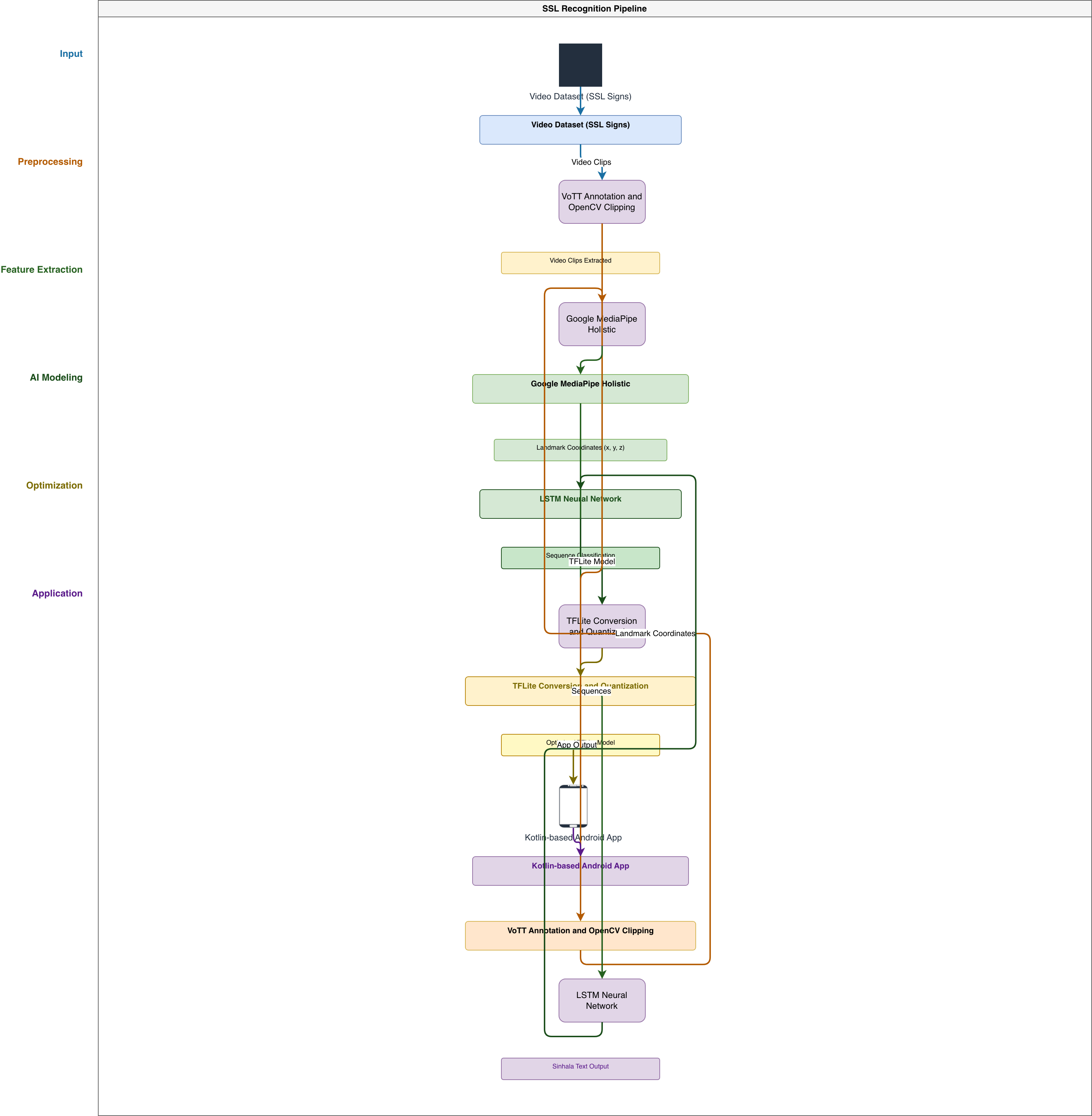
End-to-end Sinhala Sign Language recognition pipeline combining video annotation, pose estimation, and mobile deployment. Raw SSL video datasets flow through VoTT annotation and OpenCV clipping, then Google MediaPipe Holistic extracts landmark coordinates for sequence modeling. An LSTM neural network classifies sign sequences, which are optimized via TFLite conversion and quantization for deployment on a Kotlin-based Android app that outputs recognized Sinhala text. This architecture demonstrates best practices for real-time gesture recognition on mobile devices with minimal latency and resource constraints. Fork and customize this diagram to adapt the pipeline for other sign languages or gesture recognition tasks on Diagrams.so.

People also ask

How do you build an end-to-end Sinhala Sign Language recognition system for mobile deployment?

This diagram shows a complete SSL recognition pipeline: annotate video datasets with VoTT and OpenCV, extract pose landmarks using Google MediaPipe Holistic, train an LSTM neural network for sequence classification, optimize the model with TFLite conversion and quantization, and deploy to a Kotlin-based Android app. This approach balances accuracy with mobile performance constraints.

Sinhala Sign Language Recognition AI Pipeline

Autoadvancedmachine-learningsign-language-recognitionMediaPipeLSTMmobile-deploymentTFLite
Domain: Ml PipelineAudience: Machine learning engineers building sign language recognition systems
0 views0 favoritesPublic

Created by

March 9, 2026

Updated

March 9, 2026 at 7:38 AM

Type

architecture

Need a custom architecture diagram?

Describe your architecture in plain English and get a production-ready Draw.io diagram in seconds. Works for AWS, Azure, GCP, Kubernetes, and more.

Generate with AI