Security Scanning System Architecture
About This Architecture
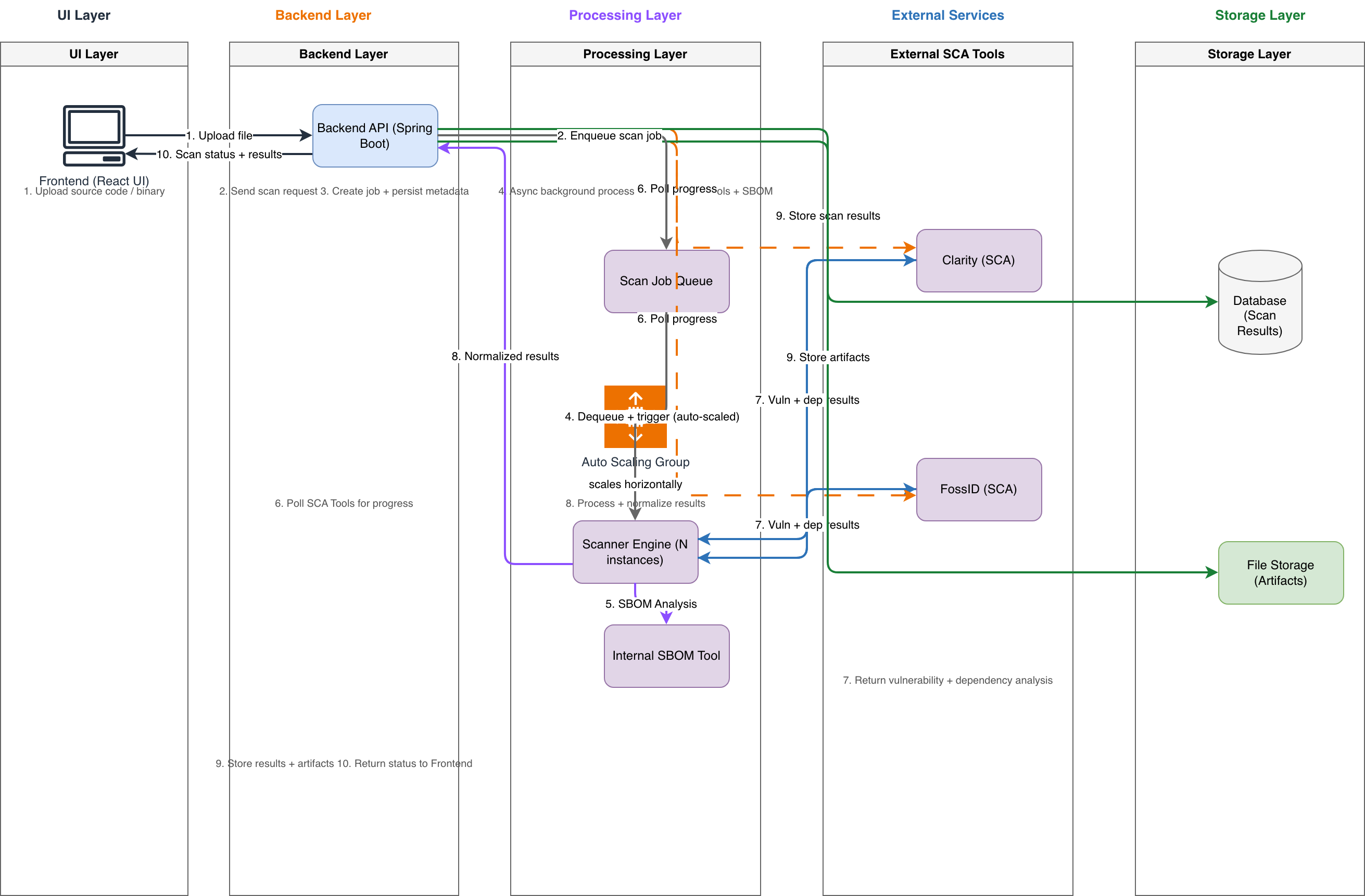
Security scanning system with React frontend, Spring Boot backend, and async processing engine orchestrating multiple SCA tools. Frontend uploads source code or binaries to the backend API, which creates scan jobs and persists metadata while delegating analysis to the Scanner Engine. The Scanner Engine invokes Clarity and FossID for vulnerability detection and SBOM generation, normalizes results, and stores findings in a database with artifact storage. This architecture decouples UI responsiveness from long-running security scans, enabling parallel tool execution and scalable vulnerability management. Fork this diagram on Diagrams.so to customize tool integrations, add policy enforcement layers, or adapt for your CI/CD pipeline.
People also ask
How do I design a security scanning system that orchestrates multiple SCA tools without blocking the UI?
This diagram shows a three-layer architecture where the React frontend submits code to a Spring Boot backend API, which asynchronously delegates scanning to a Scanner Engine. The engine invokes Clarity and FossID in parallel, normalizes results, and stores findings in a database while returning status to the frontend, ensuring responsive user experience during long-running security analysis.
- Domain:
- Devops Cicd
- Audience:
- DevOps engineers and security architects implementing automated vulnerability scanning and software composition analysis
Generated by Diagrams.so — AI architecture diagram generator with native Draw.io output. Fork this diagram, remix it, or download as .drawio, PNG, or SVG.