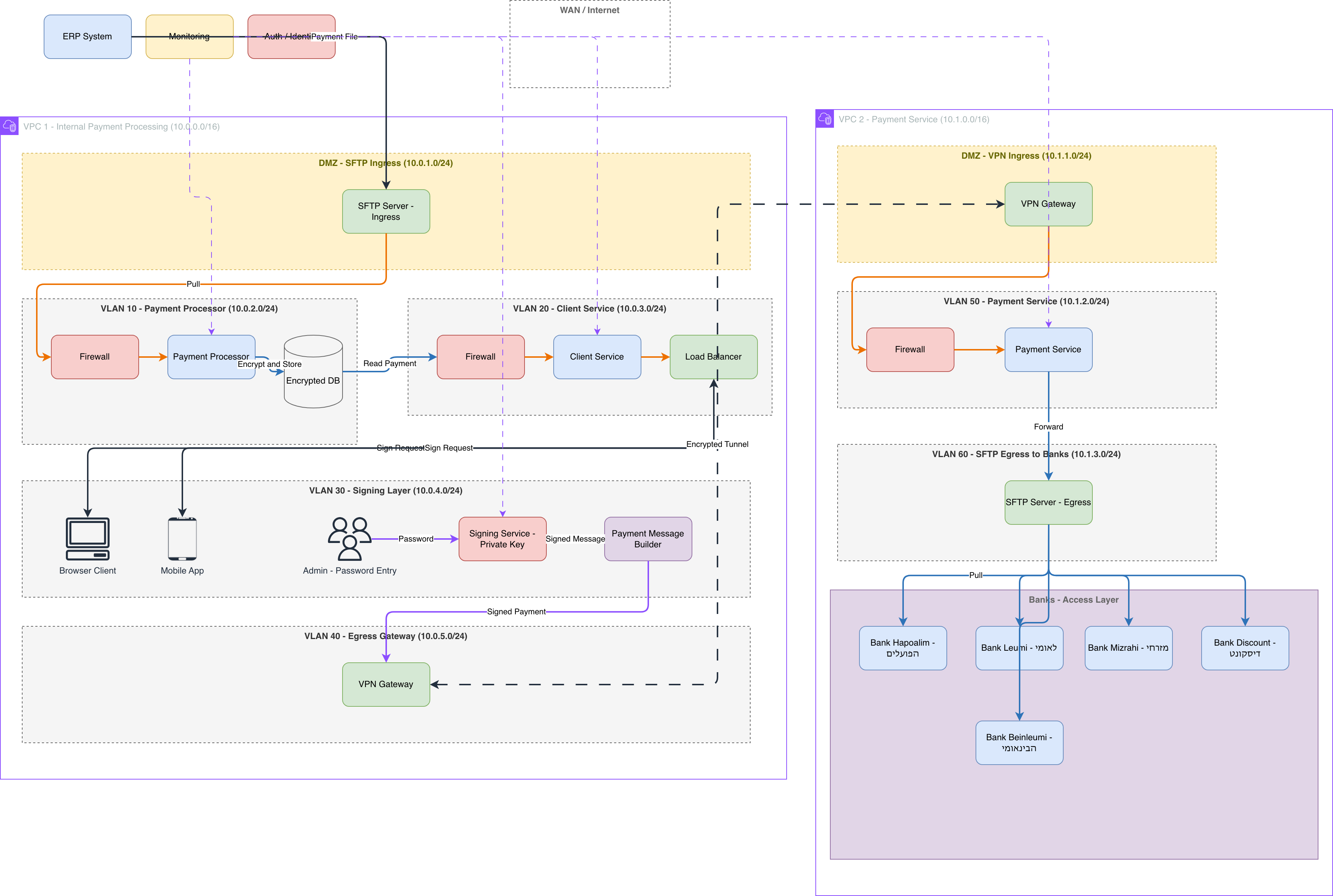
Secure Payment Processing - Dual VPC Architecture
About This Architecture
Dual-VPC payment processing architecture separating internal payment logic from external bank integration using isolated network segments and encrypted channels. VPC 1 handles inbound SFTP ingestion, payment processing, and client-facing services across four firewalled VLANs, while VPC 2 manages outbound payment delivery to five Israeli banks via dedicated SFTP egress. Private key signing layer enforces cryptographic controls for payment authorization, with VPN gateway bridging VPCs and monitoring spanning both domains. This zero-trust network design minimizes blast radius, enforces least-privilege access, and meets financial regulatory requirements for payment system isolation and auditability.
People also ask
How should I architect a secure payment processing system that separates internal payment logic from bank integration while enforcing encryption and compliance?
This dual-VPC architecture isolates payment processing (VPC 1) from bank delivery (VPC 2) using firewalled VLANs, encrypted databases, and private key signing layers. SFTP servers handle inbound ERP data and outbound bank transfers, while VPN gateways and monitoring provide secure inter-VPC communication and auditability across all payment flows.
- Domain:
- Networking
- Audience:
- Security architects designing multi-VPC payment processing networks with strict compliance requirements
Generated by Diagrams.so — AI architecture diagram generator with native Draw.io output. Fork this diagram, remix it, or download as .drawio, PNG, or SVG.