Pakistan Oil Import Bill Economic Impact

GENERALOthersintermediate
Pakistan Oil Import Bill Economic Impact — GENERAL others diagram

About This Architecture

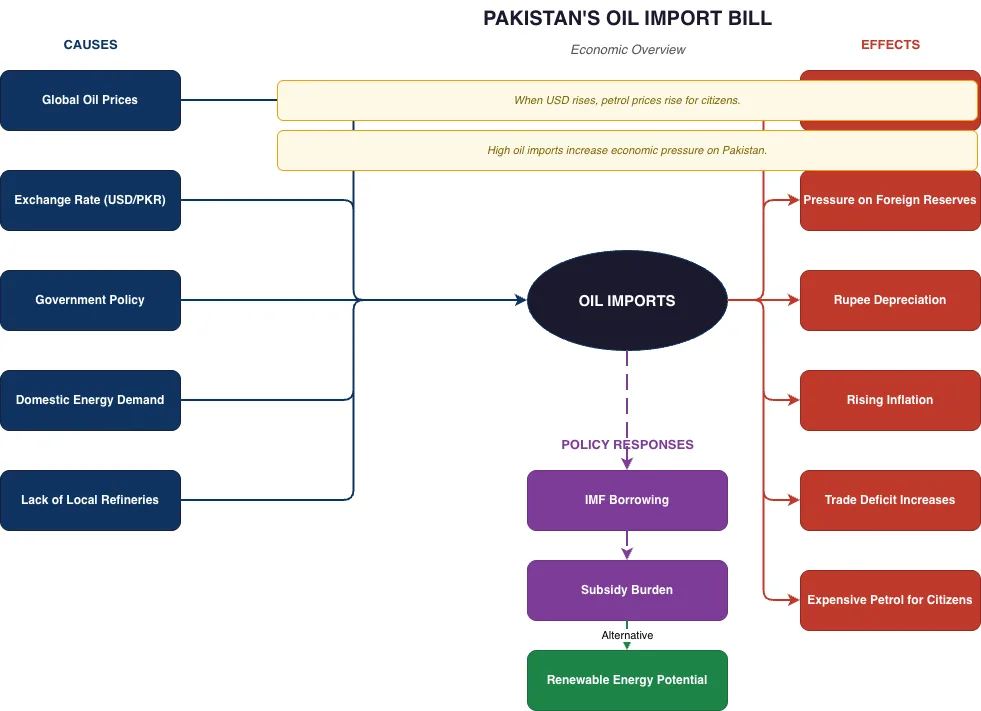
Pakistan's oil import bill creates a cascading economic crisis driven by global oil prices, USD/PKR exchange rates, and domestic energy demand exceeding local refinery capacity. High oil imports directly weaken the economy, deplete foreign reserves, trigger rupee depreciation, and fuel inflation, ultimately raising petrol costs for citizens and forcing IMF borrowing. This diagram maps the causal chain from import drivers through macroeconomic effects to policy responses, illustrating how external commodity shocks amplify structural vulnerabilities in import-dependent economies. Use this diagram to brief stakeholders, teach economic systems thinking, or customize it for comparative analysis across oil-importing nations. The model highlights why renewable energy investment becomes critical when subsidy burdens constrain fiscal space.

People also ask

What are the causes and economic effects of Pakistan's high oil import bill?

Pakistan's oil import bill is driven by global oil prices, unfavorable USD/PKR exchange rates, high domestic energy demand, and lack of local refinery capacity. These imports weaken the economy, deplete foreign reserves, trigger rupee depreciation and inflation, increase the trade deficit, raise petrol prices for citizens, and force IMF borrowing—creating a subsidy burden that diverts resources fr

economic-policyemerging-marketscommodity-shockpakistan-economytrade-deficitrenewable-energy
Domain:
Other
Audience:
economic policy analysts and development economists studying emerging market vulnerabilities

Generated by Diagrams.so — AI architecture diagram generator with native Draw.io output. Fork this diagram, remix it, or download as .drawio, PNG, or SVG.

Generate your own others diagram →

About This Architecture

Pakistan's oil import bill creates a cascading economic crisis driven by global oil prices, USD/PKR exchange rates, and domestic energy demand exceeding local refinery capacity. High oil imports directly weaken the economy, deplete foreign reserves, trigger rupee depreciation, and fuel inflation, ultimately raising petrol costs for citizens and forcing IMF borrowing. This diagram maps the causal chain from import drivers through macroeconomic effects to policy responses, illustrating how external commodity shocks amplify structural vulnerabilities in import-dependent economies. Use this diagram to brief stakeholders, teach economic systems thinking, or customize it for comparative analysis across oil-importing nations. The model highlights why renewable energy investment becomes critical when subsidy burdens constrain fiscal space.

People also ask

What are the causes and economic effects of Pakistan's high oil import bill?

Pakistan's oil import bill is driven by global oil prices, unfavorable USD/PKR exchange rates, high domestic energy demand, and lack of local refinery capacity. These imports weaken the economy, deplete foreign reserves, trigger rupee depreciation and inflation, increase the trade deficit, raise petrol prices for citizens, and force IMF borrowing—creating a subsidy burden that diverts resources fr

Pakistan Oil Import Bill Economic Impact

Autointermediateeconomic-policyemerging-marketscommodity-shockpakistan-economytrade-deficitrenewable-energy
Domain: OtherAudience: economic policy analysts and development economists studying emerging market vulnerabilities
0 views0 favoritesPublic

Created by

May 16, 2026

Updated

May 16, 2026 at 9:24 AM

Type

others

Need a custom architecture diagram?

Describe your architecture in plain English and get a production-ready Draw.io diagram in seconds. Works for AWS, Azure, GCP, Kubernetes, and more.

Generate with AI