Oculomotor Apparatus - Muscles, Nerves, and Nuclei

GENERALOthersadvanced
Oculomotor Apparatus - Muscles, Nerves, and Nuclei — GENERAL others diagram

About This Architecture

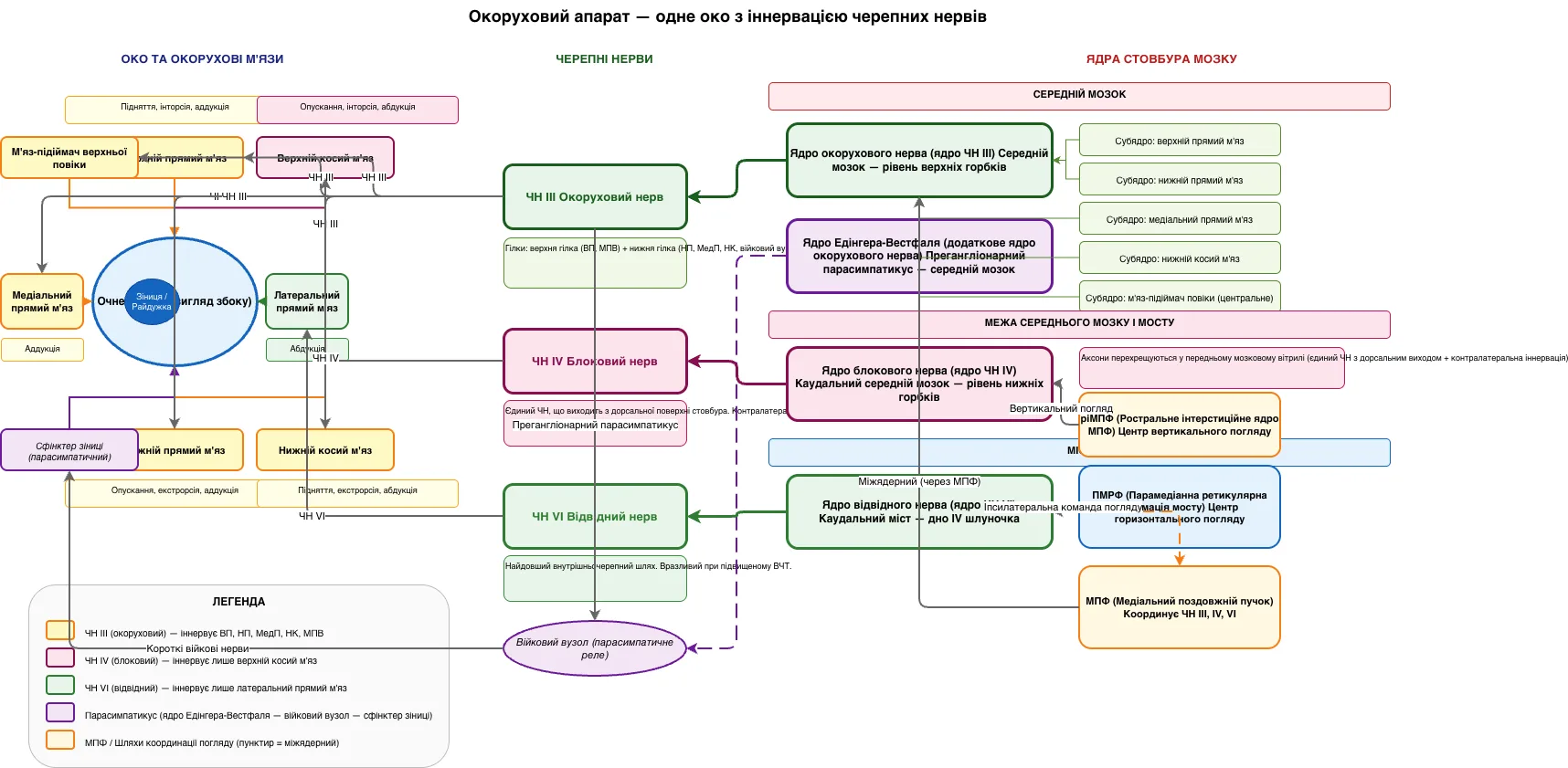
The oculomotor apparatus integrates three cranial nerves—CN III, CN IV, and CN VI—with six extraocular muscles and brainstem nuclei to coordinate eye movement and pupil function. CN III (oculomotor) innervates the superior rectus, inferior rectus, medial rectus, inferior oblique, and levator palpebrae; CN IV (trochlear) controls the superior oblique via unique dorsal brainstem exit and contralateral decussation; CN VI (abducens) drives the lateral rectus and has the longest intracranial course, making it vulnerable to raised intracranial pressure. The oculomotor nucleus resides at the midbrain level of the superior colliculus with sub-nuclei for each muscle, while the Edinger-Westphal nucleus provides parasympathetic preganglionic fibers to the ciliary ganglion for pupil and accommodation control. Horizontal gaze is coordinated by the paramedian pontine reticular formation (PPRF) in the pons, and vertical gaze by the rostral interstitial nucleus of the MLF (riMLF) in the midbrain, with the medial longitudinal fasciculus (MLF) synchronizing all three cranial nerves. This diagram is essential for understanding oculomotor palsies, internuclear ophthalmoplegia, and brainstem lesion localization in clinical neurology. Fork and customize this anatomy reference on Diagrams.so to create study guides, teaching slides, or clinical case presentations.

People also ask

What are the anatomical relationships between the oculomotor, trochlear, and abducens nerves and their brainstem nuclei?

The oculomotor nucleus (CN III) at the midbrain superior colliculus level innervates five extraocular muscles and the levator palpebrae via superior and inferior divisions. The trochlear nucleus (CN IV) at the caudal midbrain uniquely exits dorsally with contralateral decussation to innervate only the superior oblique. The abducens nucleus (CN VI) in the caudal pons innervates the lateral rectus a

neuroanatomycranial-nervesbrainstemoculomotormedical-educationclinical-neurology
Domain:
Other
Audience:
Medical students and neurology residents studying cranial nerve anatomy and oculomotor control

Generated by Diagrams.so — AI architecture diagram generator with native Draw.io output. Fork this diagram, remix it, or download as .drawio, PNG, or SVG.

Generate your own others diagram →

About This Architecture

The oculomotor apparatus integrates three cranial nerves—CN III, CN IV, and CN VI—with six extraocular muscles and brainstem nuclei to coordinate eye movement and pupil function. CN III (oculomotor) innervates the superior rectus, inferior rectus, medial rectus, inferior oblique, and levator palpebrae; CN IV (trochlear) controls the superior oblique via unique dorsal brainstem exit and contralateral decussation; CN VI (abducens) drives the lateral rectus and has the longest intracranial course, making it vulnerable to raised intracranial pressure. The oculomotor nucleus resides at the midbrain level of the superior colliculus with sub-nuclei for each muscle, while the Edinger-Westphal nucleus provides parasympathetic preganglionic fibers to the ciliary ganglion for pupil and accommodation control. Horizontal gaze is coordinated by the paramedian pontine reticular formation (PPRF) in the pons, and vertical gaze by the rostral interstitial nucleus of the MLF (riMLF) in the midbrain, with the medial longitudinal fasciculus (MLF) synchronizing all three cranial nerves. This diagram is essential for understanding oculomotor palsies, internuclear ophthalmoplegia, and brainstem lesion localization in clinical neurology. Fork and customize this anatomy reference on Diagrams.so to create study guides, teaching slides, or clinical case presentations.

People also ask

What are the anatomical relationships between the oculomotor, trochlear, and abducens nerves and their brainstem nuclei?

The oculomotor nucleus (CN III) at the midbrain superior colliculus level innervates five extraocular muscles and the levator palpebrae via superior and inferior divisions. The trochlear nucleus (CN IV) at the caudal midbrain uniquely exits dorsally with contralateral decussation to innervate only the superior oblique. The abducens nucleus (CN VI) in the caudal pons innervates the lateral rectus a

Oculomotor Apparatus - Muscles, Nerves, and Nuclei

Autoadvancedneuroanatomycranial-nervesbrainstemoculomotormedical-educationclinical-neurology
Domain: OtherAudience: Medical students and neurology residents studying cranial nerve anatomy and oculomotor control
0 views0 favoritesPublic

Created by

May 3, 2026

Updated

May 3, 2026 at 11:59 AM

Type

others

Need a custom architecture diagram?

Describe your architecture in plain English and get a production-ready Draw.io diagram in seconds. Works for AWS, Azure, GCP, Kubernetes, and more.

Generate with AI