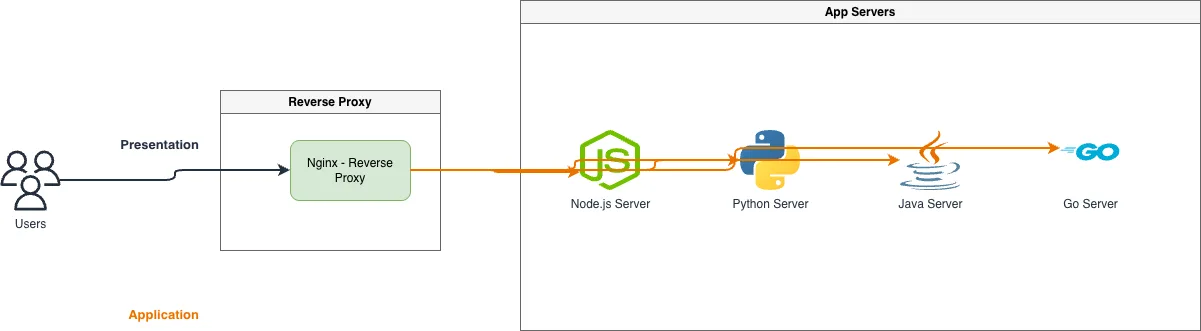
Nginx Reverse Proxy - Multi-Language App Servers
About This Architecture
Nginx reverse proxy distributes incoming user traffic across heterogeneous application servers running Node.js, Python, Java, and Go simultaneously. The reverse proxy layer handles request routing, load balancing, and protocol translation, decoupling clients from backend language choices. This polyglot architecture enables teams to use the best language for each service while maintaining a unified entry point and simplified client communication. Fork this diagram on Diagrams.so to customize server counts, add health checks, or integrate SSL/TLS termination. Consider adding a load balancing algorithm specification and backend pool health monitoring for production deployments.
People also ask
How do you route traffic from a single entry point to application servers built in different programming languages?
Use Nginx as a reverse proxy to accept all incoming requests and distribute them across backend servers running Node.js, Python, Java, Go, or any other language. Nginx handles load balancing, connection pooling, and protocol translation, allowing teams to deploy polyglot microservices behind a unified gateway without modifying client code.
- Domain:
- Software Architecture
- Audience:
- Backend engineers and DevOps professionals designing polyglot application architectures
Generated by Diagrams.so — AI architecture diagram generator with native Draw.io output. Fork this diagram, remix it, or download as .drawio, PNG, or SVG.