
About This Architecture
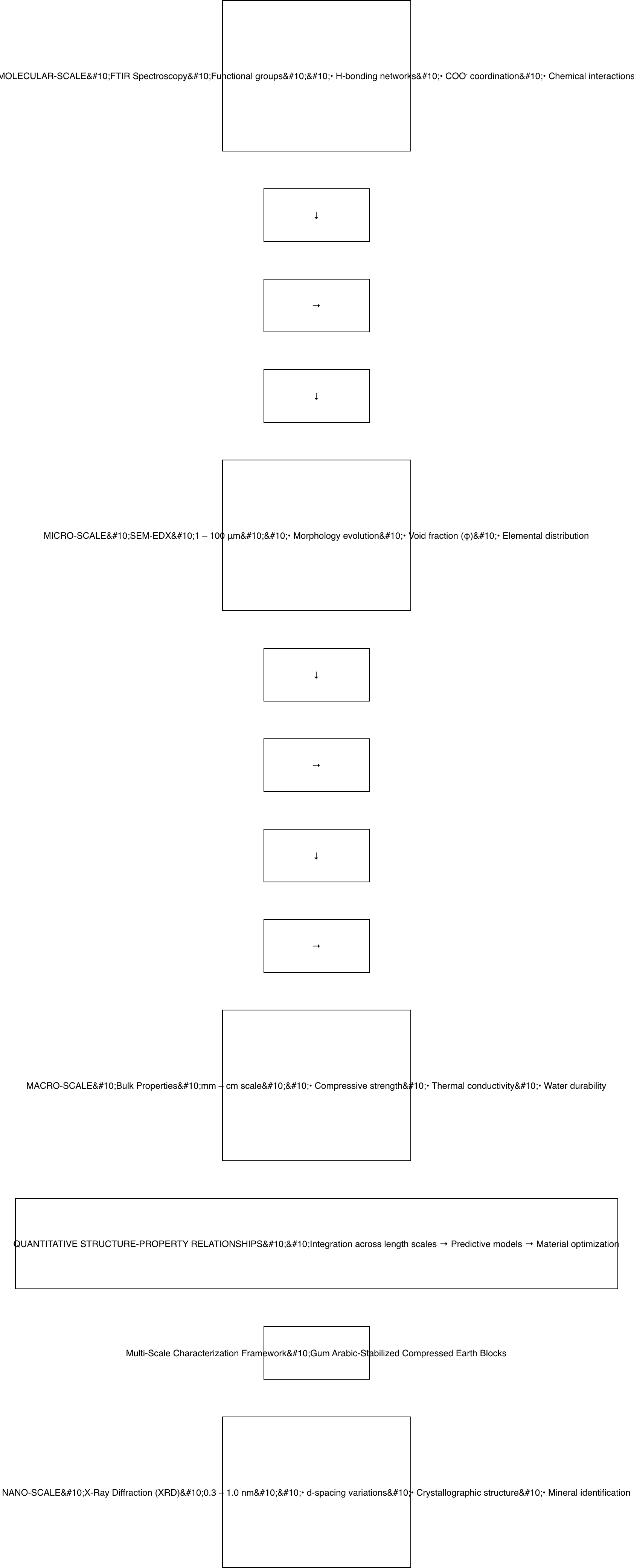
Multi-scale characterization framework systematically investigates gum arabic-stabilized compressed earth blocks across four length scales. Experimental design controls biopolymer concentration and processing parameters, feeding nanometric crystallographic analysis, molecular chemical bonding studies, microscopic morphological examination, and macroscopic mechanical-thermal testing. Structure-property relationships emerge from integrating crystallographic data, chemical bonding data, morphological data, mechanical properties, and thermal properties to explain microstructural evolution, interfacial phenomena, and bulk material properties. This framework enables materials scientists to optimize bio-stabilized earth construction by linking molecular interactions to macroscopic performance. Fork this diagram on Diagrams.so to adapt the characterization workflow for other biopolymer-earth composite systems or export as .drawio for research documentation.