Modular Protocol Stack Architecture
About This Architecture
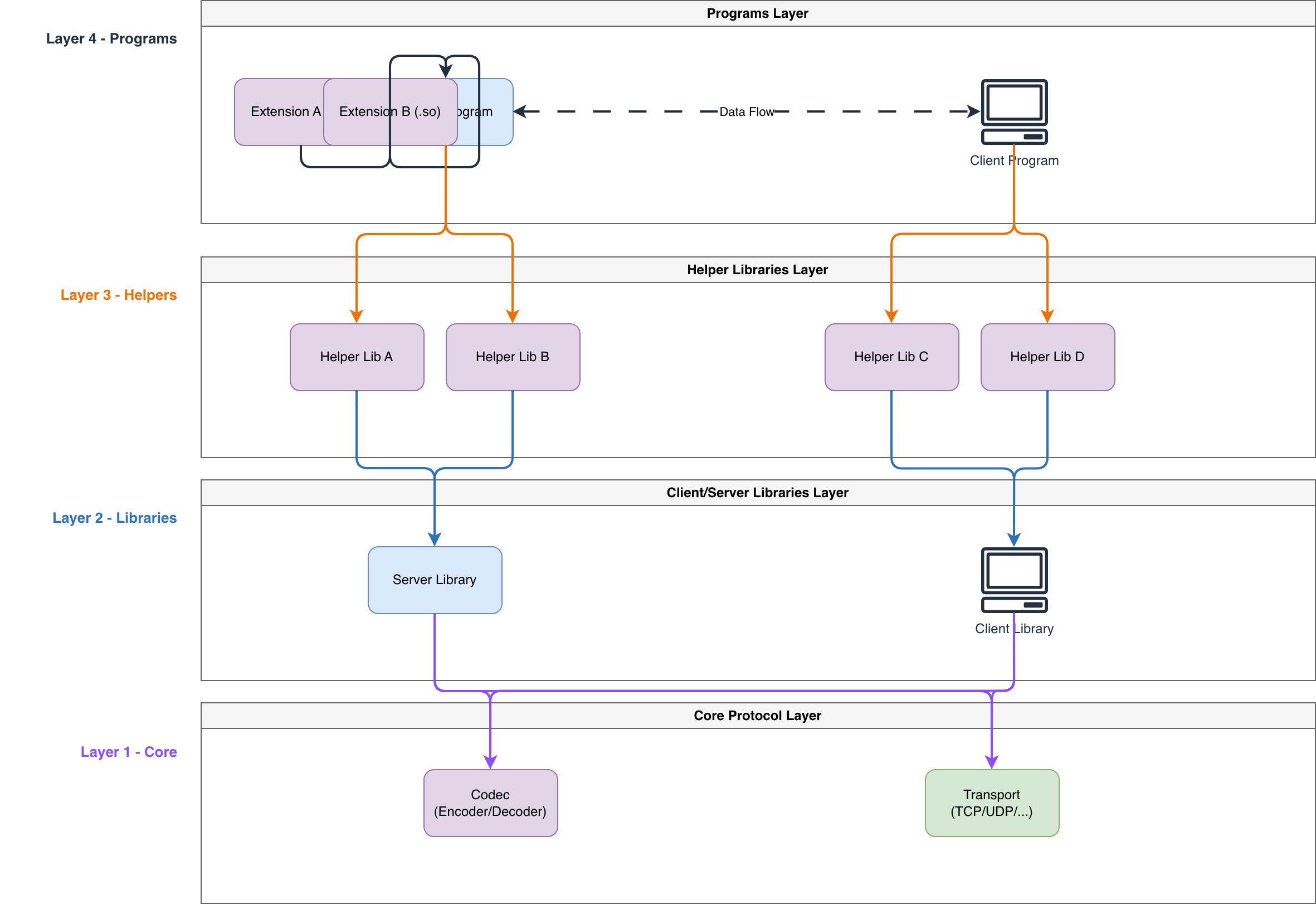
Modular protocol stack architecture organizes communication layers into four tiers: Core Protocol (codec and transport), Client/Server Libraries, Helper Libraries, and Programs with loadable extensions. Data flows upward from TCP/UDP transport through encoder/decoder components to reusable helper libraries that support both server and client programs. This layered design enables teams to build extensible, maintainable protocol implementations where extensions (.so modules) can be loaded into the server without recompiling core logic. Fork this diagram on Diagrams.so to customize helper libraries, add new transport protocols, or document your own modular stack architecture.
People also ask
How should I structure a modular protocol stack with extensible programs and reusable libraries?
This diagram shows a four-layer architecture: Core Protocol (codec and transport), Client/Server Libraries (abstraction), Helper Libraries (shared utilities), and Programs (server/client with loadable extensions). Each layer depends on lower layers, enabling code reuse and extension without modifying core components.
- Domain:
- Software Architecture
- Audience:
- Software architects designing modular protocol stacks and extensible client-server systems
Generated by Diagrams.so — AI architecture diagram generator with native Draw.io output. Fork this diagram, remix it, or download as .drawio, PNG, or SVG.