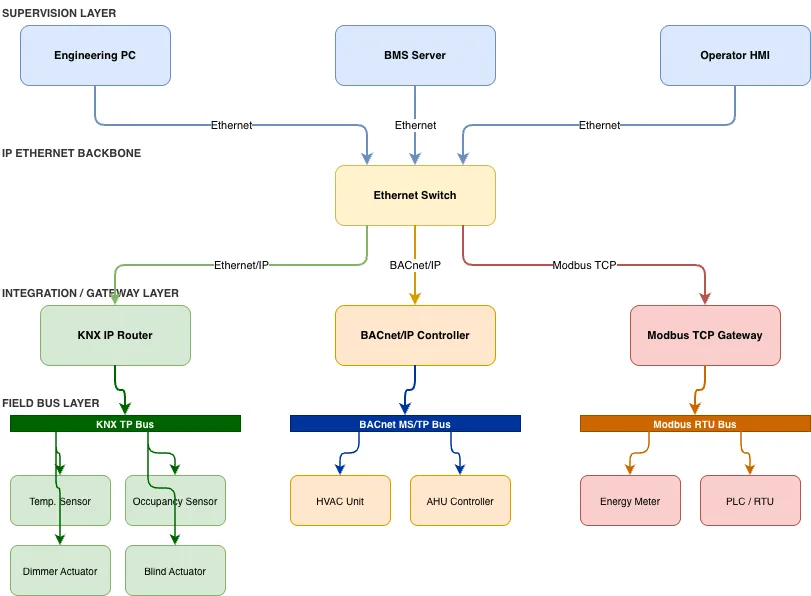
KNX BMS Control System Architecture

GENERALOthersadvanced
KNX BMS Control System Architecture — GENERAL others diagram

About This Architecture

Multi-protocol building management system integrating KNX, BACnet, and Modbus devices through a centralized IP Ethernet backbone and gateway layer. The supervision layer—comprising Engineering PC, BMS Server, and Operator HMI—communicates via Ethernet Switch to protocol-specific gateways (KNX IP Router, BACnet/IP Controller, Modbus TCP Gateway) that bridge to field buses. Each field bus layer manages sensors, actuators, and controllers: KNX TP Bus handles lighting and occupancy control, BACnet MS/TP Bus manages HVAC and AHU systems, and Modbus RTU Bus monitors energy meters and RTU devices. This architecture enables interoperability across legacy and modern building systems while maintaining protocol-native performance at the device level. Fork and customize this diagram on Diagrams.so to design your own multi-vendor BMS topology, then export as .drawio, SVG, or PNG for documentation and stakeholder review.

People also ask

How do you integrate KNX, BACnet, and Modbus devices in a single building management system?

Use a centralized IP Ethernet backbone with protocol-specific gateways: KNX IP Router bridges KNX TP Bus devices (sensors, actuators), BACnet/IP Controller manages BACnet MS/TP HVAC systems, and Modbus TCP Gateway connects Modbus RTU energy meters and PLCs. A supervision layer (BMS Server, Operator HMI, Engineering PC) communicates via Ethernet Switch to all gateways, enabling unified monitoring a

building-automationKNXBACnetModbusgateway-architectureHVAC-control
Domain:
Building Automation
Audience:
Building automation engineers designing multi-protocol BMS systems

Generated by Diagrams.so — AI architecture diagram generator with native Draw.io output. Fork this diagram, remix it, or download as .drawio, PNG, or SVG.

Generate your own others diagram →

About This Architecture

Multi-protocol building management system integrating KNX, BACnet, and Modbus devices through a centralized IP Ethernet backbone and gateway layer. The supervision layer—comprising Engineering PC, BMS Server, and Operator HMI—communicates via Ethernet Switch to protocol-specific gateways (KNX IP Router, BACnet/IP Controller, Modbus TCP Gateway) that bridge to field buses. Each field bus layer manages sensors, actuators, and controllers: KNX TP Bus handles lighting and occupancy control, BACnet MS/TP Bus manages HVAC and AHU systems, and Modbus RTU Bus monitors energy meters and RTU devices. This architecture enables interoperability across legacy and modern building systems while maintaining protocol-native performance at the device level. Fork and customize this diagram on Diagrams.so to design your own multi-vendor BMS topology, then export as .drawio, SVG, or PNG for documentation and stakeholder review.

People also ask

How do you integrate KNX, BACnet, and Modbus devices in a single building management system?

Use a centralized IP Ethernet backbone with protocol-specific gateways: KNX IP Router bridges KNX TP Bus devices (sensors, actuators), BACnet/IP Controller manages BACnet MS/TP HVAC systems, and Modbus TCP Gateway connects Modbus RTU energy meters and PLCs. A supervision layer (BMS Server, Operator HMI, Engineering PC) communicates via Ethernet Switch to all gateways, enabling unified monitoring a

KNX BMS Control System Architecture

Autoadvancedbuilding-automationKNXBACnetModbusgateway-architectureHVAC-control
Domain: Building AutomationAudience: Building automation engineers designing multi-protocol BMS systems
0 views0 favoritesPublic

Created by

May 5, 2026

Updated

May 5, 2026 at 2:08 PM

Type

others

Need a custom architecture diagram?

Describe your architecture in plain English and get a production-ready Draw.io diagram in seconds. Works for AWS, Azure, GCP, Kubernetes, and more.

Generate with AI